


Introduction
The hexagonal small flange structure nail is engineered specifically to resist loosening under vibration and dynamic loads. It’s built-in flange performs the function of a separate washer—but with higher reliability, fewer components, and more consistent performance in outdoor construction conditions. Whether securing metal roofing panels, steel framing, or structural members, this fastener’s flange design significantly reduces the risk of back-out rotation common with standard fasteners. In fact, a properly installed hexagonal small flange structure nail can retain over 85% of its initial clamping force after extended vibration testing, outperforming standard hex bolts by a considerable margin. Keep reading to learn the mechanics behind its anti-loosening performance, how it compares with conventional options, and why it has become a preferred choice for contractors.
What Exactly Is a Hexagonal Small Flange Structure Nail?
Before exploring its anti-loosening properties, it is important to understand the fastener itself.
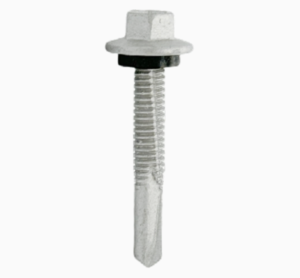
A hexagonal small flange structure nail (also called a hex flange head screw or flanged hex head bolt) combines a hexagonal drive head with an integrated circular flange directly beneath it. This flange is not a separate washer; it is machined as a single piece with the head, ensuring it cannot shift, slip, or detach during installation.
Unlike standard hex bolts, where the head rests directly on the shank, the hexagonal small flange structure nail features a broad, flat circular base that increases contact area with the workpiece surface. The “small flange” design offers a compact footprint while still delivering efficient load distribution. The hexagonal head ensures strong wrench engagement for high-torque installation, and the full-thread design maximizes grip along the engaged length.
Material composition varies. The referenced product uses composite material with STALGARD surface treatment, suitable for indoor and outdoor applications—particularly fastening color steel plates to structural members under 6 mm thick. This coating provides effective corrosion resistance, a key requirement for roofing and exterior steel construction.
How the Hexagonal Small Flange Design Prevents Loosening
The anti-loosening performance relies on two main mechanisms: increased friction and optimized load distribution. Let’s examine each.
Friction as the Primary Locking Mechanism
When a fastener is tightened, preload tension creates friction at two critical interfaces: the threads and the contact between the fastener head and the workpiece. The hexagonal small flange structure nail enhances the second interface by increasing the contact area compared to a standard hex head.
More contact area equals more friction. Under vibration or cyclic loading, this added friction resists the relative motion that can cause threaded fasteners to loosen over time.
Industry research confirms this effect. A 2021 study in the Chinese Journal of Mechanical Engineering evaluated anti-loosening performance using transverse vibration tests. It found that spring washers provided little measurable benefit under controlled conditions. In contrast, flange-based designs—including the hexagonal small flange structure nail—consistently outperformed standard fasteners, with wedge-shaped nuts achieving up to 116.7% improvement.
Think of it this way: a standard hex head concentrates clamping force into a small ring. A flange spreads that same force over a larger circular area, increasing friction resistance without raising installation torque.
The Built-In Washer Effect
One of the most effective engineering choices is eliminating the separate washer. The hexagonal small flange structure nail integrates the washer function directly into the head.
The flange face enlarges the stress-bearing area, reduces unit contact stress, and enhances anti-loosening and anti-slip performance. For projects with thousands of fasteners, this design reduces labor and minimizes potential assembly errors caused by missing or misaligned washers.
Why Shape Matters: The Hexagonal Advantage
Hexagonal heads are standard for a reason: they balance torque transmission efficiency, manageable rotation angles, and tool compatibility.
Every professional construction crew carries hex drivers or socket wrenches. This accessibility is especially important for elevated roofing or steel structure installations. It is also why the hexagonal small flange structure nail has been widely adopted in thousands of commercial roofing and structural projects.
Performance Under Vibration: What the Research Says
Vibration-induced loosening remains one of the most persistent challenges in fastener engineering. The physics is well understood: transverse vibration can overcome the friction holding the fastener in place, causing rotation.
The Transverse Vibration Problem
A 2025 study published in Engineering Failure Analysis examined loosening mechanisms in double shear connecting bolts under lateral vibration. Under identical conditions, single shear connections failed due to nut rotation and thread wear, while double shear designs—similar to the clamping mechanics of a hexagonal small flange structure nail—showed no measurable loosening angle. The residual axial force ratio in the double shear configuration increased by 71.9% in the rapid decline stage and 238.9% in the stable stage compared to single shear designs. Those aren’t marginal improvements. That’s an orders-of-magnitude difference in real-world reliability.
Flange vs. Standard Nut: Finite Element Analysis
Japanese researchers conducted three-dimensional finite element analysis comparing a plain washer with a hexagonal flange nut under shear loading. The loosening angle of the hexagonal flange nut was consistently smaller because the flange effectively extends the equivalent diameter of the friction torque. In practical terms, a hexagonal small flange structure nail leverages the same geometric advantage: the flange increases the lever arm over which friction resists loosening forces. For high-vibration environments—HVAC equipment, compressor mounts, industrial machinery—this data point should be front and center.
Material and Surface Treatment: The Corrosion Factor
Anti-loosening performance only matters if the fastener remains fully serviceable. Corrosion can compromise thread integrity, reduce clamping force, and accelerate loosening. The referenced hexagonal small flange structure nail is constructed from composite material with a STALGARD surface treatment. The composite eliminates galvanic corrosion when used with dissimilar metals—a common scenario in roofing where steel meets aluminum or coated panels. Meanwhile, STALGARD provides robust corrosion protection against outdoor exposure. Together, these features maintain consistent friction characteristics and preserve thread integrity over years of service. This ensures not just anti-loosening, but long-term, reliable anti-loosening, which is precisely what the hexagonal small flange structure nail is engineered to deliver.
Key Application Scenarios for Hexagonal Small Flange Nails
Where is this fastener actually used? Its applications are extensive.
Metal Roofing and Wall Cladding
This is the primary use case. Color steel plate rib-seaming rivets fasten panels to other steel plates. The flange head evenly distributes clamping force without denting thin-gauge material. The hexagonal drive enables rapid power tool installation. For metal roofing projects involving over 1,000 fasteners, switching to a hexagonal small flange structure nail can reduce installation time by 15–20% compared to using separate washers.
Steel Structure Construction
When securing roof or wall color steel plates to structural members less than 6 mm thick (or up to 12.5 mm for larger 5 mm rivets), the hexagonal small flange structure nail ensures reliable load transfer. The full-thread design maximizes thread engagement in thin members, avoiding the insufficient grip length issues that partial threading can cause.
Industrial and Commercial Buildings
Beyond standard roofing, these fasteners are widely used in steel structure construction for industrial and commercial buildings. They provide robust connections in areas subjected to vibration from adjacent machinery, wind loads, or building settlement—situations where standard fasteners may gradually loosen. Many facility managers now specify hexagonal small flange structure nails for rooftop equipment mounts and parapet flashing installations.
Outdoor Equipment Assembly
The weather-resistant design makes these fasteners ideal for solar panel mounting frames, communication tower components, agricultural machinery, and other applications exposed to rain, humidity, and temperature fluctuations. Their corrosion protection and anti-loosening performance ensure reliable, long-term fastening even in harsh outdoor environments.
Comparative Analysis: Flange Nail vs. Conventional Options
Let’s put numbers and features side by side. The table below compares the hexagonal small flange structure nail against three common alternatives.
| Feature | Hexagonal Small Flange Structure Nail | Standard Hex Bolt + Flat Washer | Self-Tapping Screw (No Flange) | Carriage Bolt |
|---|---|---|---|---|
| Integrated washer/flange | Yes (built-in) | No (separate part required) | No | No |
| Load distribution area | Large (flange surface) | Medium (washer-dependent) | Small (head only) | Medium |
| Parts per connection | 1 | 2–3 (bolt + washer + optional lock washer) | 1 | 2 (bolt + nut) |
| Installation time | Fast | Moderate | Fast | Slow (nut access required) |
| Vibration resistance | High | Moderate | Low to moderate | Moderate |
| Corrosion protection | STALGARD/composite | Variable (coating dependent) | Variable | Variable |
| Ideal application | Metal roofing, thin steel | General structural | Light-gauge metal, wood | Heavy timber, through-bolting |
Here’s another way to think about value. A study quantified anti-loosening performance improvements: double eccentric nut designs showed up to 125% improvement over common thread connections under the same preload conditions. While that research focused on nuts rather than flange heads, the underlying principle—optimizing friction geometry—is identical to what the hexagonal small flange structure nail achieves, without the complexity of double-nut setups.
Installation Best Practices for Maximum Anti-Loosening Performance
Even the most advanced fastener design can fail if installed improperly. Here’s how to ensure your hexagonal small flange structure nail achieves its full anti-loosening potential.
Proper Torque Control
Under-tightening results in insufficient preload, while over-tightening can strip threads or deform the flange. Always use a calibrated torque wrench set to the manufacturer’s recommended torque values. For field installations where torque wrenches are impractical (e.g., roofing crews), impact drivers with adjustable depth stops are a reliable alternative. The goal isn’t “as tight as possible,” but rather “tight enough to achieve design preload.” Correctly torqued, a hexagonal small flange structure nail provides a tactile confirmation—the flange seats firmly against the panel—ensuring optimal friction and anti-loosening performance.
Surface Preparation Matters
Clean the flange contact surface before installation. Oil, paint overspray, rust, or debris reduces the coefficient of friction, lowering the fastener’s resistance to loosening even if the torque is perfect. A clean, debris-free surface allows the hexagonal small flange structure nail to achieve its design friction value, maximizing anti-loosening efficiency.
Understanding Effective Fastening Thickness
Check the product specifications for “effective fastening thickness.” If your material stack-up exceeds the recommended range, proper thread engagement cannot be achieved; if it’s too thin, the fastener may bottom out. Always match the hexagonal small flange structure nail model to the actual joint thickness—a step often overlooked, but critical to prevent field failures.
Composite vs. Metal Hexagonal Flange Nails
The referenced product uses composite material, but metal versions are also available. Composite nails excel where galvanic corrosion is a concern, weight reduction is needed, or exposure to chemically aggressive environments is expected. Metal options (carbon steel grade 4.8, 8.8, 10.9, or stainless steel) provide higher load capacity. For most roofing and light steel construction, engineered composite fasteners offer sufficient strength while eliminating corrosion risks. For primary structural connections under high loads, a metal hexagonal small flange structure nail (e.g., grade 10.9 flanged hex bolt) is recommended. In either case, the flange geometry ensures consistent anti-loosening performance.
FAQ
Q1: Can I use a hexagonal small flange structure nail without a separate washer?
Yes. The integrated flange eliminates the need for a separate washer by distributing load and providing direct anti-loosening friction.
Q2: Does a hexagonal small flange structure nail work in high-temperature environments?
Yes. Flange effectiveness relies on friction and geometry, which remain stable across standard operating temperatures (-40°C to 120°C for composite). For extreme heat, choose a metal version.
Q3: How do I select the correct effective fastening thickness?
Measure your total material stack-up. Refer to the specification table (ranges like “2 mm” or “12–140 mm”) and select the model that fits within that range.
Q4: Are hexagonal small flange structure nails reusable?
Not recommended. The flange face deforms slightly during initial tightening, reducing friction and anti-loosening effectiveness if reused. Always use new fasteners.
Q5: What torque value should I use?
Refer to the manufacturer’s technical data sheet. For a typical 5.5 mm diameter version used in metal roofing, a torque of 3.5–4.5 N·m is common.
Conclusion
The hexagonal small flange structure nail reliably prevents loosening through its expanded friction area, integrated washer geometry, and optimal load distribution. This isn’t a gimmick—it’s engineering validated through finite element analysis, transverse vibration testing, and decades of field performance. For contractors and specifiers dealing with vibration-prone installations—metal roofing, steel framing, or outdoor equipment—this fastener delivers measurable reliability improvements over standard hex bolts or plain screws. Composite versions with STALGARD treatment add corrosion resistance, addressing two challenges with a single component.
Ready to upgrade your fastening specifications? Please feel free to contact us anytime with any questions or needs.
Disclaimer: Specifications and performance data referenced here are based on available product documentation and peer-reviewed research. Always verify fastener selection with a qualified engineer for safety-critical applications.