
Streszczenie
Specifying the wrong fastener in a structural assembly can trigger accelerated corrosion, joint failure, and costly remediation. The Hex Flange Bimetallic Structural Screw addresses a specific engineering challenge: delivering high clamping force and corrosion resistance simultaneously, without the cost penalty of an all-stainless assembly.
This article provides procurement engineers and specification writers with a structured decision framework. It covers the material science behind bimetallic construction, the mechanical and dimensional parameters that define structural classification, environment-to-grade mapping, substrate compatibility rules, and the supplier qualification criteria that separate compliant product from commodity hardware. Whether you are designing solar mounting arrays, curtain wall systems, or modular steel buildings, the five-factor checklist developed here—environment, substrate, mechanical grade, coating, and supplier compliance—will reduce specification risk and support defensible procurement decisions.
1. Understanding the Bimetallic Structural Screw
1.1 What Makes It “Bimetallic”
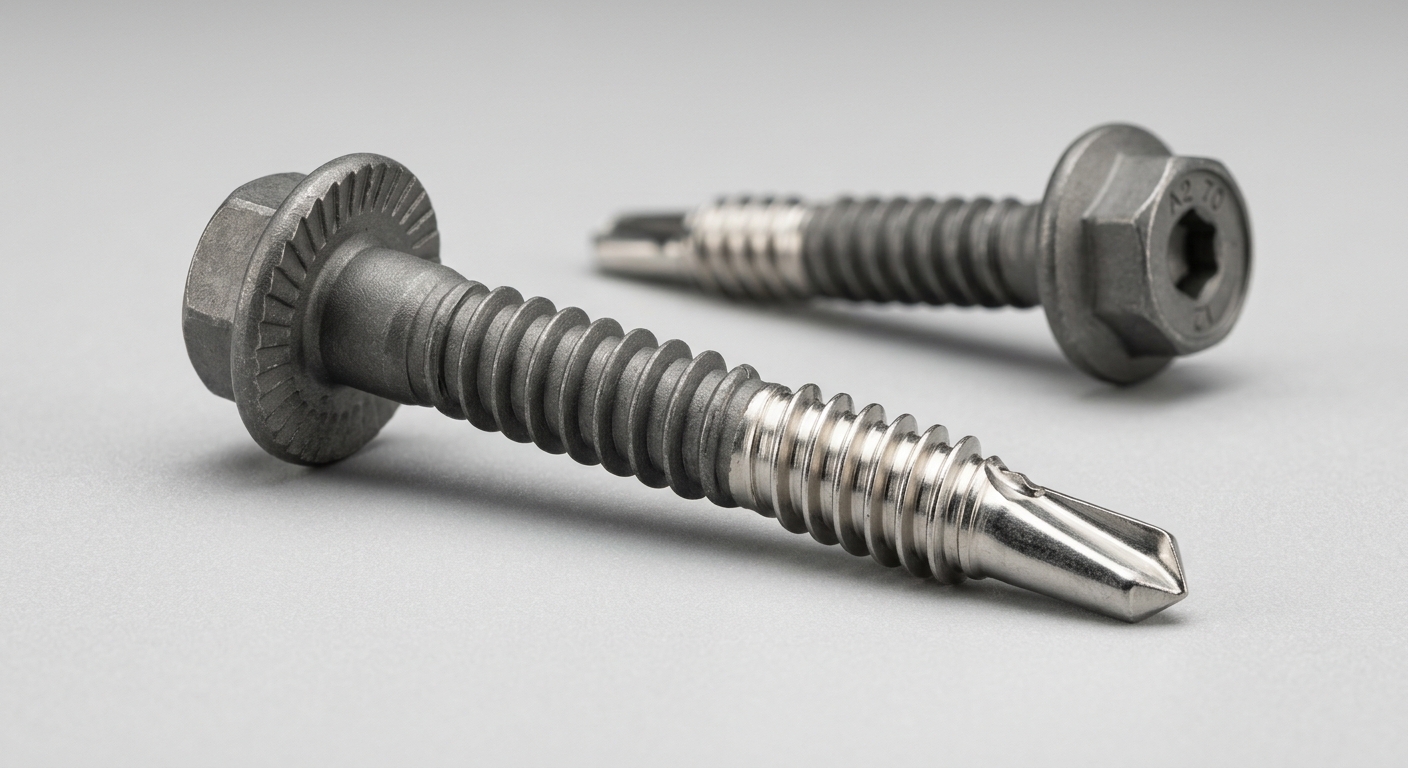
A bimetallic structural screw combines two distinct metallic materials within a single fastener body, most commonly a hardened carbon steel shank bonded or friction-welded to a stainless steel tip and thread section. The carbon steel core delivers the tensile strength and torsional rigidity required for structural load-bearing—typically achieving Class 8.8 or higher equivalent performance—while the stainless steel drilling tip and exposed thread zone provide the corrosion resistance that carbon steel alone cannot sustain in outdoor or chemically aggressive environments.
The galvanic isolation logic is critical. When a fastener penetrates dissimilar substrates (e.g., aluminum cladding over a galvanized steel purlin), the fastener itself becomes part of the galvanic cell. By presenting a stainless steel surface at the thread-substrate interface—where moisture and oxygen concentration are highest—the bimetallic design dramatically reduces anodic dissolution compared to a fully carbon steel fastener. The carbon steel shank, encapsulated within the assembly and often coated, is shielded from the primary electrochemical exposure zone.
This construction is not a compromise. It is an engineered solution that outperforms single-material alternatives across the cost-performance curve in moderate-to-severe corrosion categories.
1.2 Role of the Hex Flange Drive Geometry
The hex flange head geometry contributes meaningfully beyond aesthetics. The integrated flange—a wide, flat bearing washer formed as one piece with the hex head—distributes clamp load over a significantly larger surface area than a standard hex head or pan head fastener. This reduces substrate crushing stress, which is particularly important when fastening into thin-gauge steel, aluminum composite panels, or fiber cement cladding.
From an installation standpoint, the hex flange eliminates the need for a separate sealing washer in many applications, reducing component count and assembly time. Drive engagement via a standard hex socket or impact driver is positive and slip-resistant. In high-volume installations such as solar racking or metal roofing, the reduction in installation steps per fastener translates to measurable labor savings at scale. The flange also provides a visible torque indicator—experienced installers can confirm proper seating without torque measurement tools in non-critical applications.
2. Key Specification Parameters
2.1 Mechanical & Dimensional Standards
Structural classification requires fasteners to meet defined tensile, proof load, and shear strength thresholds. For bimetallic screws used in steel framing, the relevant benchmarks include:
- Tensile strength: Minimum 800 MPa (Class 8.8 equivalent) for the shank section
- Thread form: Coarse thread (UNC or metric coarse) for steel-to-steel; fine thread for thin-gauge or pre-tapped applications
- Flange diameter ratio: Typically 1.5–1.8× the nominal shank diameter to achieve adequate bearing surface
- Applicable standards: AS 3566 (Class 3/4 corrosion resistance for Australian markets), ISO 15480 (hex flange drilling screws), ASTM F1941 (electrodeposited coatings), and EN 14566 for European structural applications
Dimensional tolerances on thread pitch, point geometry, and flange runout directly affect installation performance and pull-out strength. Specify tolerances explicitly in procurement documents rather than relying on manufacturer defaults.
2.2 Material & Coating Grades by Environment
Material pairing and coating selection must be matched to the corrosion category of the installation environment. The following matrix provides a specification-ready reference:
| Environment Category | Recommended Bimetal Pairing | Typ powłoki | Salt Spray Rating (min.) | Applicable Standard | Typical Use Case |
|---|---|---|---|---|---|
| Mild (inland, sheltered) | 304 SS tip / C1022 carbon shank | Geomet 500 or zinc-flake | 500 hrs | AS 3566 Class 3 | Interior steel framing, HVAC ducts |
| Moderate (suburban, light industrial) | 304 SS tip / C1022 carbon shank | Hot-dip zinc + sealant | 1,000 hrs | AS 3566 Class 3 | Solar ground mounts, modular buildings |
| Severe (industrial, high humidity) | 316 SS tip / alloy steel shank | Geomet 321 + topcoat | 1,500 hrs | AS 3566 Class 4 | Coastal infrastructure, chemical plants |
| Coastal / Marine-adjacent | 316 SS tip / alloy steel shank | Duplex coating (zinc + polymer) | 2,000+ hrs | ISO 9227 / ASTM B117 | Waterfront cladding, offshore structures |
Geomet (zinc-aluminum flake) coatings are preferred over standard electroplating where hydrogen embrittlement risk is a concern in high-strength fasteners.
3. Application Scenarios & Substrate Compatibility
3.1 Structural Substrates: Steel, Aluminum & Dissimilar Metal Joints
Substrate compatibility governs both mechanical performance and long-term corrosion behavior. Key rules for specifying hex flange bimetallic screws across common structural substrates:
Steel-to-steel: The most straightforward application. Ensure the carbon steel shank hardness exceeds the substrate hardness to enable self-drilling without pre-drilling for gauges up to 12 mm combined thickness. Beyond this, pilot holes are required to prevent tip breakage.
Aluminum-to-steel: The highest galvanic risk pairing. The stainless steel tip of the bimetallic screw is electrochemically compatible with aluminum (small potential difference), while the galvanized steel substrate is protected by its zinc layer. Specify 316 SS tip material and verify that the coating on the shank extends to the thread runout zone.
Dissimilar metal joints (general): Apply the galvanic series rule—the fastener material should be cathodic relative to or equal to the more noble substrate material. Bimetallic screws with 316 SS thread zones satisfy this criterion across most structural metal pairings.
Minimum substrate thickness for self-drilling engagement: 0.75 mm for point Type 3; 1.5 mm for point Type 5. Exceeding the rated combined thickness without pre-drilling is the most common cause of tip failure in the field.
3.2 Industry-Specific Use Cases
Solar mounting structures: Aluminum rail-to-galvanized steel purlin connections demand high corrosion resistance and rapid installation. The hex flange geometry supports single-side installation with impact drivers, critical where access is restricted.
Curtain wall and cladding systems: Thin aluminum composite panels require the load-spreading flange to prevent pull-through. Coastal projects demand Class 4 / 316 SS specification.
Modular steel buildings: High fastener volumes make installation efficiency a primary driver. Bimetallic screws reduce the bill of materials by eliminating separate washers and sealants.
HVAC frameworks: Indoor industrial environments with condensation or chemical exposure benefit from the corrosion resistance of the stainless tip without the cost of all-stainless fasteners throughout.
4. Supplier Qualification & Procurement Checklist
4.1 Compliance Documentation & Testing Requirements
A technically sound specification is only as strong as the supplier’s ability to demonstrate conformance. Require the following documentation as standard:
- Mill certificates: Material composition for both the stainless tip and carbon steel shank, with heat/lot number traceability
- Third-party salt-spray test reports: Conducted per ISO 9227 or ASTM B117; reports must reference the specific product lot, not a generic product family
- Mechanical test certificates: Tensile, proof load, and torsional strength per applicable standard, with actual values (not just pass/fail)
- RoHS/REACH compliance declaration: Required for EU market access and increasingly demanded in global supply chains
- Dimensional inspection reports: Thread pitch, flange diameter, and point geometry per drawing tolerances
Reject suppliers who cannot provide lot-traceable documentation. Generic catalog claims of “meets AS 3566 Class 4” without supporting test data are insufficient for structural specification.
4.2 Total Cost of Ownership Considerations
Unit price comparison is a poor proxy for procurement value in structural fasteners. Evaluate total cost of ownership across these dimensions:
- Installation labor: Hex flange bimetallic screws with integrated washers eliminate one component and one installation step. At 5,000+ fasteners per project, this compounds significantly.
- Rework and warranty exposure: A fastener failure in a structural connection generates remediation costs that dwarf the original fastener cost differential. Specify to the correct corrosion class from the outset.
- MOQ and lead time: Standard bimetallic structural screws in common sizes (M5–M10, lengths 25–100 mm) should be available ex-stock from qualified distributors. Custom lengths or coatings typically carry 4–8 week lead times; factor this into project scheduling.
- Warranty clauses: Require suppliers to warrant conformance to specified standards for a minimum of 12 months from delivery, with defined remedies for non-conforming product.
FAQ
Q1: Can a Hex Flange Bimetallic Structural Screw fasten aluminum cladding directly to a galvanized steel frame without additional isolation?
Yes, with correct material selection. Specify a 316 SS tip bimetallic screw with a fully coated shank (Geomet or hot-dip zinc to the thread runout). The stainless steel at the thread-substrate interface is galvanically compatible with aluminum. Additional EPDM or neoprene isolation tape at the panel-to-frame interface is recommended in severe or coastal environments as a secondary measure, but the fastener itself does not require a separate isolation sleeve.
Q2: What salt-spray test hours should I require as a minimum for coastal or marine-adjacent installations?
Specify a minimum of 2,000 hours per ISO 9227 with no red rust on the stainless tip section and no more than 5% white corrosion product on coated shank surfaces. This aligns with AS 3566 Class 4 and is achievable with 316 SS tip + duplex coating construction. Request test reports referencing the actual lot, not a product family.
Q3: How do I verify that a supplier’s bimetallic screw meets structural rather than light-duty classification?
Request mechanical test certificates showing tensile strength ≥ 800 MPa and torsional strength meeting the applicable standard (e.g., AS 3566, ISO 15480). Confirm the test specimens are from the supplied lot. Structural classification also requires defined pull-out and pull-over values tested in the specified substrate gauge—ask for application-specific test data if the project involves non-standard substrate configurations.
Wnioski
Correct specification of a Hex Flange Bimetallic Structural Screw reduces project risk across the entire asset lifecycle. The five-factor checklist synthesized in this article provides a repeatable framework:
- Environment: Map corrosion category to salt-spray rating requirement
- Substrate: Apply galvanic compatibility rules; confirm self-drilling thickness limits
- Mechanical grade: Require tensile and torsional certificates, not catalog claims
- Coating: Match coating system to environment category; prioritize Geomet or duplex systems for severe exposure
- Supplier compliance: Demand lot-traceable documentation, third-party test reports, and defined warranty terms
The cost case is straightforward: the premium over commodity carbon steel fasteners is recovered through reduced installation labor, eliminated secondary components, and avoided rework costs. In structural applications where fastener failure carries liability consequences, the bimetallic hex flange screw is not a premium option—it is the correct engineering specification.