
Streszczenie
Outdoor timber applications impose a uniquely aggressive set of demands on fasteners. Seasonal moisture cycling, UV exposure, and the mechanical stress of wood expansion and contraction combine to create conditions that expose the limitations of standard, uncoated steel nails within months of installation. For construction contractors, landscaping specifiers, and procurement teams sourcing at volume, fastener failure is not merely a maintenance issue—it translates directly into structural liability, aesthetic defects, and costly remediation.
This article examines whether a gwoźdź ze stali węglowej ocynkowanej delivers the corrosion resistance and structural holding power required for exterior timber applications. It covers the metallurgical basis of zinc-coating performance, the critical differences between coating methods, applicable compliance standards, and the procurement criteria buyers must evaluate before committing to large-order quantities. The analysis draws on established benchmarks from ISO, ASTM, and BS EN frameworks to give specifiers a technically grounded basis for product selection.
1. Why Ordinary Nails Fail in Outdoor Timber
1.1 The Corrosion Mechanism in Exterior Wood Environments
Bare carbon steel nails begin to corrode through a well-understood electrochemical process: when moisture bridges the nail surface and the surrounding timber, a galvanic cell forms. Oxygen dissolved in the moisture drives anodic oxidation at the steel surface, producing iron oxide—rust—at a rate that accelerates with temperature fluctuations and repeated wet-dry cycles.
The situation is compounded significantly in hardwood species such as oak, cedar, and western red cedar, which contain elevated concentrations of tannic acid and other organic acids. These compounds lower the local pH around the fastener, dramatically accelerating the dissolution of iron. In softwood decking exposed to standing water, similar acidic leachates develop over time. The result is a self-reinforcing corrosion cycle: moisture ingress initiates oxidation, the expanding rust layer forces micro-fractures in the wood grain, which in turn allows deeper moisture penetration.
For procurement buyers, the practical implication is straightforward: an uncoated or inadequately coated nail in an outdoor timber environment is not a long-term fastener. It is a scheduled maintenance liability.
1.2 Structural Consequences: Staining, Shank Degradation & Joint Failure
The visible symptom of fastener corrosion—rust bleed staining—is the least serious consequence. The tannin-iron reaction produces dark brown to black streaking across timber surfaces, a particular concern in premium decking and architectural cladding where aesthetics carry commercial weight.
More critically, corrosion progressively reduces the effective cross-section of the nail shank. A standard 3.1 mm shank nail losing 0.3–0.5 mm of diameter to rust loses a disproportionate share of its bending resistance and shear capacity. As the shank degrades, pull-out resistance—the force required to withdraw the nail from the timber—decreases significantly. In structural framing and joist connections, this represents a genuine safety concern. Joint failure under dynamic loading (wind uplift, foot traffic on decking) can occur without visible warning if fastener corrosion has progressed internally.
2. How Galvanising Changes the Performance Equation
2.1 Hot-Dip vs. Electro-Galvanising: Coating Thickness & Adhesion
Galvanising interposes a zinc layer between the carbon steel substrate and the corrosive environment. Zinc provides protection through two distinct mechanisms: barrier protection (physically excluding moisture and oxygen) and sacrificial protection (zinc oxidises preferentially to steel at any coating breach, protecting the underlying metal until the zinc is consumed).
The critical variable is coating thickness, which differs substantially between the two primary application methods:
- Hot-Dip Galvanising (HDG): The nail is immersed in molten zinc at approximately 450°C. The resulting zinc-iron alloy bond produces a coating typically ≥ 45 µm thick, with some heavy-duty grades reaching 85 µm. The metallurgical bond is robust, and the coating conforms uniformly to shank profiles including ring and spiral geometries.
- Electro-Galvanising (EG): Zinc is electrodeposited from an aqueous solution. Coating thickness is typically ≤ 12 µm. While the surface finish is smoother and dimensional tolerances are tighter, the thin coating offers significantly reduced protection in permanently exposed conditions.
| Parametr | Electro-Galvanised | Cynkowane ogniowo | Stainless Steel (Reference) |
|---|---|---|---|
| Grubość powłoki cynkowej | ≤ 12 µm | ≥ 45 µm | N/A |
| Odporność na mgłę solną | 96–200 hrs | 500–1,000+ hrs | 1,000+ hrs |
| Tensile Strength (MPa) | 600–900 | 600–900 | 500–700 (A2/A4) |
| Recommended Exposure Class | Sheltered / Interior | Exterior / Severe | Marine / Extreme |
| Wskaźnik kosztów względnych | 1.0× | 1.4–1.8× | 3.5–5.0× |
For outdoor timber applications in exposed or semi-exposed environments, hot-dip galvanised nails represent the technically appropriate and commercially viable choice. Electro-galvanised nails are not suitable for permanent exterior use.
2.2 Carbon Steel Substrate: Strength, Shank Profile & Drive Performance
The carbon steel substrate beneath the zinc coating is not incidental—it determines the nail’s mechanical performance. Standard galvanised nails for construction use are produced from medium-carbon or high-carbon wire with tensile strengths typically in the 600–900 MPa range, providing the bending resistance and point hardness needed for reliable driving into dense hardwood species.
Shank geometry is equally important:
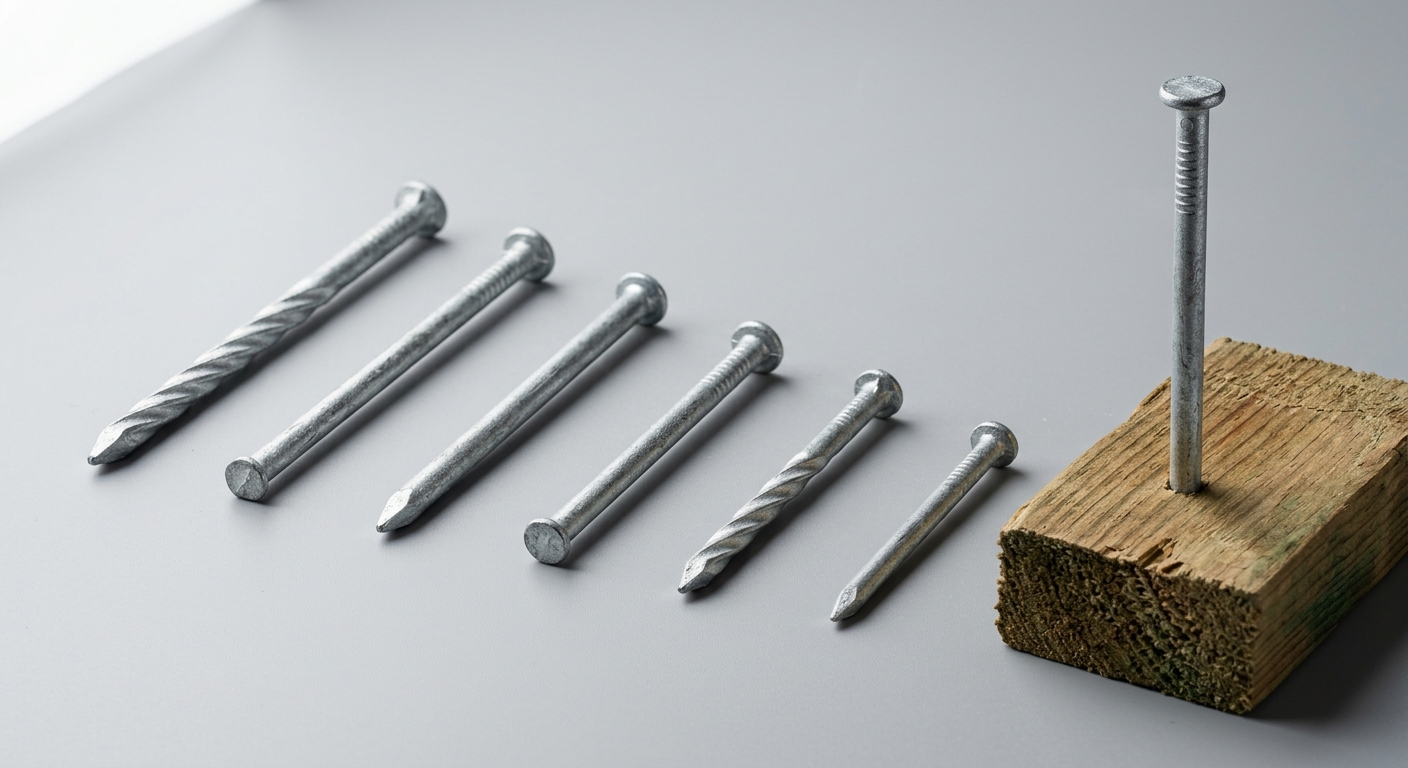
- Gładki trzon: Easiest to drive; lowest pull-out resistance. Suitable for temporary structures or light interior work.
- Ring shank: Annular rings along the shank engage timber fibres mechanically, increasing pull-out resistance by 40–70% compared to smooth shank equivalents. Preferred for decking and cladding.
- Spiral/helical shank: Rotational engagement during driving; excellent pull-out resistance in green or wet timber. Commonly specified for structural framing and treated timber applications.
Hot-dip galvanised nails with ring or spiral shanks are compatible with both hand-driving and pneumatic nail guns, though specifiers should confirm gun compatibility for the specific shank diameter and coating thickness combination to avoid feed jams.
3. Compliance Standards & Specification Requirements
3.1 Key International Standards Buyers Must Reference
Procurement teams sourcing galvanised nails for exterior timber applications must verify compliance against the relevant coating standards for their target market:
- ISO 1461: Specifies hot-dip galvanising requirements for iron and steel articles. Sets minimum average coating thickness by material category and defines testing protocols for coating adhesion and uniformity.
- ASTM A153 / A153M: The North American benchmark for zinc coatings on iron and steel hardware. Class D (applicable to nails and fasteners) requires a minimum zinc coating of 1.0 oz/ft² (≈ 305 g/m², approximately 43 µm average).
- BS EN 14592: The European standard for timber fasteners, including nails. Specifies corrosion protection classes (Class 1 through Class 3) mapped to exposure categories, with Class 3 (HDG to EN ISO 1461) required for permanently exposed exterior applications.
Buyers should request test certificates confirming coating class compliance—not simply product labelling—when sourcing at volume.
3.2 Timber Treatment Compatibility: ACQ, CCA & Tanalised Wood
Preservative-treated timber introduces a specific and often underestimated corrosion risk. Modern copper-based preservatives—particularly ACQ (Alkaline Copper Quaternary) and legacy CCA (Chromated Copper Arsenate)—are significantly more corrosive to zinc than untreated timber. The elevated copper ion concentration in treated wood accelerates zinc consumption through galvanic interaction, dramatically shortening the effective service life of inadequately coated fasteners.
Industry guidance from major treated timber manufacturers and standards bodies is consistent: hot-dip galvanised nails meeting ASTM A153 Class D or equivalent are the minimum specification for use with ACQ or CCA-treated timber. Electro-galvanised nails should not be used. For highly corrosive preservative systems or coastal environments, stainless steel fasteners may be the more appropriate long-term specification, despite the cost premium.
Tanalised timber (a proprietary preservative brand widely used in the UK and European markets) carries equivalent guidance: HDG to EN ISO 1461 is the stated minimum for exterior applications.
4. Application Scenarios & Procurement Criteria
4.1 Matching Nail Specification to End-Use: Decking, Cladding & Structural Framing
Different exterior timber applications demand different nail specifications:
- Decking: High moisture exposure, foot traffic loading, and frequent wet-dry cycling. Specify HDG ring-shank nails, minimum 45 µm coating. Length should achieve a minimum 2.5× board thickness penetration into the joist.
- Cladding and weatherboard: Aesthetic sensitivity to staining is high. HDG ring-shank nails are standard; stainless steel is preferred for premium hardwood cladding where tannin reactivity is a concern.
- Structural framing (outdoor structures, pergolas, decking subframes): Spiral shank HDG nails provide maximum withdrawal resistance in treated timber. Where structural load calculations apply, nail schedules should reference the shear and withdrawal values certified by the manufacturer.
- Fencing: Lower aesthetic requirement but long-term exposure. HDG smooth or ring-shank nails are cost-effective; verify coating class matches the fence post treatment type.
4.2 What B2B Buyers Should Verify Before Ordering at Volume
Before committing to volume procurement of galvanised carbon steel nails, buyers should validate the following:
- Mill certification: Request third-party test reports confirming coating thickness (average and minimum) per the applicable standard—not self-declared datasheets alone.
- Coating uniformity: HDG nails should exhibit consistent zinc coverage across the full shank length, including the point and head. Uneven coating is a quality indicator and a performance risk.
- Packaging for site conditions: Nails delivered to outdoor construction sites are exposed to moisture before installation. Specify moisture-resistant packaging (sealed polybags within cartons) to prevent white rust formation on the zinc surface during storage.
- MOQ and lead time: HDG nails involve a more complex manufacturing process than EG. Confirm minimum order quantities, production lead times, and batch consistency for large project requirements.
- Shank profile and length range availability: Ensure the supplier can provide the specific shank geometry and length range required across the project scope without substitutions that could affect holding performance.
FAQ
Q1: What is the minimum zinc coating thickness required for nails used in permanently exposed outdoor timber?
For permanently exposed exterior timber applications, the minimum accepted zinc coating thickness is 45 µm average (hot-dip galvanised), as specified under ISO 1461 and ASTM A153 Class D. Electro-galvanised coatings (≤ 12 µm) are not suitable for this exposure class and should not be specified for outdoor use.
Q2: Can hot-dip galvanised carbon steel nails be used with ACQ-treated decking boards without accelerated corrosion risk?
HDG nails meeting ASTM A153 Class D or BS EN ISO 1461 are the industry-accepted minimum for use with ACQ-treated timber. The copper content in ACQ accelerates zinc consumption relative to untreated wood, so the thicker zinc layer of HDG nails is essential. For highly aggressive environments or long design lives, stainless steel fasteners provide additional margin. Electro-galvanised nails must not be used with ACQ-treated timber.
Q3: How does shank profile affect the long-term holding power of galvanised nails in weathered timber?
Smooth-shank nails rely primarily on friction for withdrawal resistance, which decreases as timber dries, shrinks, and the shank corrodes. Ring-shank nails provide mechanical interlock with timber fibres, maintaining pull-out resistance significantly better over time—particularly in decking applications where cyclic loading is constant. Spiral-shank nails offer comparable or superior withdrawal resistance in green or treated timber. For any permanent exterior application, ring or spiral shank profiles are strongly preferred over smooth shank.
Wnioski
A galvanised carbon steel nail can reliably survive outdoor timber environments—but only when the zinc coating method, thickness, and substrate specification are correctly matched to the exposure class and timber treatment type. Hot-dip galvanised nails with ring or spiral shanks represent the technically sound, commercially viable solution for the majority of exterior construction and landscaping applications. Electro-galvanised products, while lower in cost, do not provide adequate protection for permanent exterior exposure and should not be substituted.
For procurement teams, the process is clear: verify coating grade against ISO 1461, ASTM A153, or BS EN 14592 before ordering; confirm compatibility with the specific timber treatment in use; and validate mill certifications rather than relying on product labelling alone. Specifying correctly at the procurement stage eliminates far greater costs in remediation, structural repair, and reputational risk downstream.