
Abstract
For construction procurement teams evaluating fastening solutions across roofing, decking, and structural timber applications, the galvanised carbon steel nail represents a well-established convergence of mechanical performance and corrosion resistance. Unlike generic wire nails, these fasteners are engineered to withstand cyclic moisture exposure, wind uplift forces, and the chemical aggression of treated timber preservatives — all while maintaining a cost structure that supports large-volume project budgets.
This article examines the material science behind galvanised carbon steel nails, their dimensional and compliance specifications, and their suitability across key construction scenarios. It also addresses the procurement variables that matter most to B2B buyers: coating grade selection, compatibility with regional standards, MOQ thresholds, and total cost of ownership compared to stainless steel alternatives. Whether you are sourcing for residential roofing contractors, commercial decking suppliers, or structural framing operations, this guide provides the technical and commercial clarity needed to make an informed fastener specification decision.
What Makes a Galvanised Carbon Steel Nail Suitable for Structural Fastening
Base Material & Galvanisation Process
The structural integrity of a galvanised carbon steel nail begins with its substrate. Most commercially available nails in this category use low-to-medium carbon steel wire — typically Q195 or Q235 grade — which provides a tensile strength range of 350–550 MPa before galvanisation. This base steel offers adequate ductility to resist brittle fracture under dynamic loading while maintaining the hardness required for clean penetration into dense timber substrates.
The galvanisation method applied to the nail determines its long-term corrosion performance far more than the base steel grade alone. Two primary processes are used in the industry:
- Hot-dip galvanising (HDG): The nail is immersed in molten zinc at approximately 450°C, producing a metallurgically bonded zinc-iron alloy layer. This process yields coating thicknesses of 45–85 microns (equivalent to 320–600 g/m²), making it the preferred choice for exterior and high-humidity environments.
- Electro-galvanising: Zinc is deposited electrochemically, producing a thinner, more uniform coating of 5–25 microns. While aesthetically cleaner, electro-galvanised nails offer significantly lower corrosion resistance and are generally unsuitable for exposed roofing or ground-contact applications.
For roofing and structural timber fastening, hot-dip galvanised nails are the industry standard. The thick zinc layer forms a sacrificial barrier that continues to protect the steel substrate even when the coating is mechanically abraded during installation.
Mechanical Performance Under Load
Beyond corrosion resistance, a galvanised carbon steel nail must perform reliably under three principal load types encountered in roofing and timber construction:
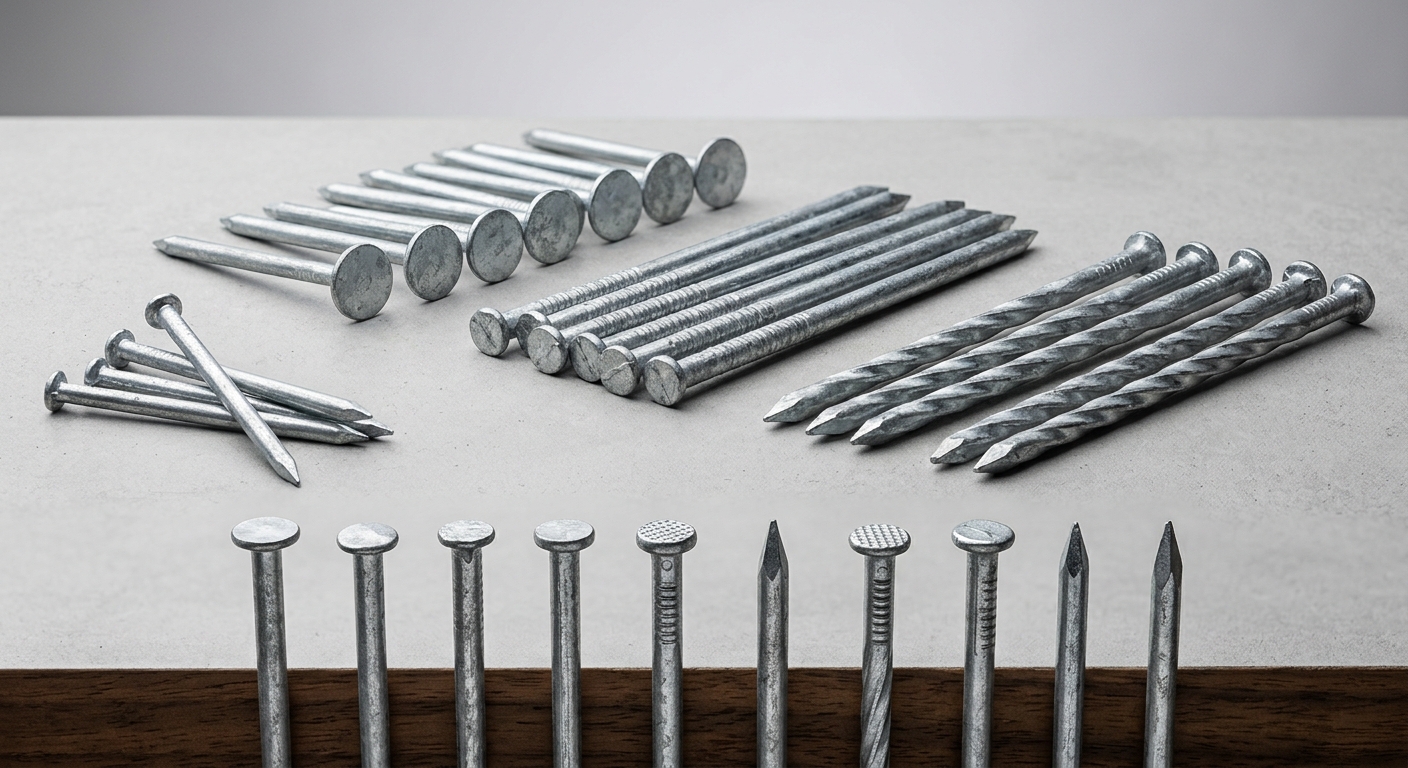
- Withdrawal resistance: The force required to pull the nail axially from the timber. Ring-shank and spiral-shank nails increase withdrawal resistance by 30–60% compared to smooth-shank equivalents, making them critical for roof sheathing in high-wind zones.
- Shear strength: Lateral loads applied perpendicular to the nail axis, typical in joist connections and wall framing. Carbon steel nails with diameters of 3.1–4.5 mm provide lateral shear values of 800–1,800 N depending on timber density and embedment depth.
- Tensile strength: Axial pull-out resistance under uplift loading. Hot-dip galvanised nails retain full tensile strength post-coating, as the HDG process does not meaningfully embrittle the steel at standard nail dimensions.
These mechanical properties, combined with the corrosion barrier, make the galvanised carbon steel nail a structurally dependable fastener for applications where failure is not an option.
Technical Specifications & Compliance Standards
Dimensional Parameters & Coating Grades
Galvanised carbon steel nails are manufactured across a broad dimensional range to serve different structural functions. Shank geometry is a primary selection variable, with three main profiles available:
| Nail Type | Shank Style | Length Range (mm) | Diameter (mm) | Zinc Coating Grade | Recommended Application |
|---|---|---|---|---|---|
| Roofing Nail | Smooth / Ring | 25–75 | 2.5–3.1 | G90 / HDG 45µm+ | Roof sheathing, felt underlays |
| Decking Nail | Ring / Spiral | 50–90 | 3.1–3.8 | G90 / HDG 60µm+ | Hardwood & softwood decking |
| Framing Nail | Smooth / Ring | 65–130 | 3.3–4.5 | G60 / HDG 45µm | Wall framing, floor joists |
| Joist Hanger Nail | Short Smooth | 38–50 | 3.1–3.3 | HDG 45µm+ | Metal connector plates |
| Structural Timber Nail | Spiral | 75–150 | 4.0–5.0 | HDG 85µm | Engineered wood, LVL beams |
Zinc coating grades follow regional classification systems: G60 (180 g/m² total coating) and G90 (275 g/m²) per ASTM A153, while ISO 1461 specifies minimum average coating thicknesses of 45–85 microns depending on steel thickness. For coastal or chemically aggressive environments, G90 or ISO 1461 Class C is the minimum acceptable specification.
Industry & Regional Compliance
Procurement teams sourcing galvanised nails for cross-border supply chains must verify compliance with the applicable regional standard:
- ASTM F1667 (USA): Covers driven fasteners including nails and spikes; references ASTM A153 for zinc coating on hardware.
- BS 1202 (UK/Commonwealth): Specifies nail dimensions, tolerances, and material requirements for steel wire nails; widely referenced in UK building regulations.
- EN 10230-1 (Europe): European standard for steel wire nails covering material, dimensions, and surface treatments including galvanisation.
- AS 3566 (Australia): Specifies corrosion resistance classes for fasteners used in Australian construction environments, including Class 3 and Class 4 for exterior and treated timber use.
Suppliers targeting EU, US, or Australian markets should be able to provide third-party test certificates confirming coating weight, dimensional compliance, and material grade. This documentation is increasingly required by tier-1 construction contractors and building code inspectors.
Application Scenarios — Roofing, Decking & Timber Work
Roofing & Decking Fastening Requirements
Roofing applications impose the most demanding combination of environmental and mechanical stresses on any fastener. A galvanised carbon steel nail used in roof sheathing or tile battening must resist:
- Wind uplift forces: In cyclone or high-wind design zones, ring-shank nails with HDG coating are mandatory in many building codes. Their enhanced withdrawal resistance prevents sheathing separation under negative pressure loading.
- Moisture cycling: Roofing substrates expand and contract with temperature and humidity changes. The ductility of carbon steel allows the nail to flex marginally without fracturing, unlike harder stainless alternatives.
- Compatibility with treated timber: Modern preservative-treated timber uses ACQ (Alkaline Copper Quaternary) or CCA (Chromated Copper Arsenate) formulations. These copper-based preservatives are chemically aggressive to zinc coatings. For ACQ-treated timber, a minimum G90 or HDG 60-micron coating is required; for highly concentrated treatments, stainless steel or hot-dip galvanised nails with 85-micron coatings are recommended.
For decking, spiral-shank nails in HDG 60-micron+ coating are the preferred specification. The spiral shank resists the seasonal movement of decking boards, reducing surface nail pop — a common aesthetic and structural complaint in lower-specification installations.
Structural Timber & Frame Construction
In structural framing, galvanised carbon steel nails are used in high-volume applications where both speed of installation and connection integrity are critical. Key use cases include:
- Joist hanger and connector nailing: Short, large-diameter HDG nails are specified by metal connector manufacturers (e.g., Simpson Strong-Tie) for use with galvanised hanger plates. Mismatched fastener coatings can create galvanic corrosion at the interface.
- Load-bearing wall framing: Standard 90–130 mm smooth or ring-shank nails are used in stud-to-plate connections. Carbon steel’s ductility allows nail-gun installation without splitting kiln-dried framing lumber.
- Engineered wood products (LVL, I-joists, glulam): Spiral-shank nails are preferred for their superior withdrawal resistance in the denser, more uniform grain structure of engineered timber. Smooth-shank nails can lose significant holding power in LVL under sustained load.
Commercial Value & Procurement Considerations
Cost-Performance Ratio vs. Stainless Steel Alternatives
Stainless steel nails (Type 304 or 316) offer superior corrosion resistance in the most aggressive environments — marine exposure, direct ground contact, or high-concentration treated timber. However, the price premium is substantial: stainless steel nails typically cost 4–8× more per kilogram than hot-dip galvanised equivalents.
For the majority of roofing, decking, and structural framing projects, HDG carbon steel nails deliver a service life of 25–50 years in moderate environments — fully adequate for the design life of most residential and commercial structures. The total cost of ownership calculation strongly favours galvanised carbon steel when:
- The project is not in a marine or coastal splash zone
- Treated timber uses standard ACQ/CCA concentrations (not industrial-grade)
- Volume requirements exceed 500 kg, where per-unit price differences compound significantly
A practical procurement approach is to specify HDG G90 or 60-micron nails as the standard, reserving stainless steel only for identified high-risk connection points such as balustrade fixings or exposed coastal fascia boards.
Sourcing, MOQ & Packaging for B2B Buyers
For construction distributors and project procurement teams, the following commercial parameters are standard for galvanised carbon steel nails sourced from established manufacturers:
- MOQ: Typically 1–5 metric tonnes per specification (nail type, size, coating grade). Some suppliers offer mixed-SKU container loads for distributors.
- Packaging formats: Loose bulk (25 kg cartons or fibre drums), collated strips (plastic or paper-tape for pneumatic nailers), and coil formats for roofing nailers. Collated formats carry a 10–20% price premium over loose bulk.
- Lead time: Standard production lead times range from 15–30 days ex-factory for established specifications; custom dimensions or coating grades may require 45–60 days.
- Private label: Most mid-to-large manufacturers support OEM/private-label packaging with custom branding, minimum quantities typically starting at 5 tonnes per SKU.
- Certification documentation: Request mill certificates, zinc coating test reports, and dimensional inspection reports as standard deliverables with each shipment.
FAQ
Q1: What zinc coating thickness is required for roofing nails used in coastal or high-humidity environments?
For coastal environments within 500 metres of the shoreline, or in tropical high-humidity zones, a minimum HDG coating of 85 microns (ISO 1461 Class C) or ASTM A153 Class D (610 g/m²) is recommended. Standard G90 coatings may be insufficient where salt-laden air accelerates zinc depletion. In marine splash zones, stainless steel Type 316 is the correct specification.
Q2: Are galvanised carbon steel nails compatible with ACQ-treated timber without accelerated corrosion risk?
Standard electro-galvanised nails are not suitable for ACQ-treated timber — the copper compounds in ACQ accelerate zinc corrosion. Hot-dip galvanised nails with a minimum G90 or 60-micron coating provide acceptable compatibility for standard ACQ concentrations. For heavy-duty ACQ treatments (above 0.4 kg/m³ retention), specify HDG 85-micron or stainless steel fasteners per manufacturer guidance and local building code requirements.
Q3: What is the standard MOQ and lead time for bulk orders of galvanised nails for construction projects?
Most manufacturers set MOQs at 1–5 metric tonnes per nail specification. For standard hot-dip galvanised nails in common sizes (e.g., 75 × 3.1 mm ring shank), production and shipping lead times are typically 20–35 days from order confirmation. Buyers consolidating multiple specifications into a full container load (FCL, approximately 18–22 tonnes) can often negotiate preferential pricing and reduced per-SKU MOQs.
Conclusion
The galvanised carbon steel nail is not a commodity fastener — it is a precision-specified construction component whose performance depends on the correct combination of base steel grade, galvanisation method, coating thickness, and shank geometry for each application. For roofing, decking, and structural timber fastening, hot-dip galvanised nails with G90 or 60–85 micron coatings deliver the corrosion resistance, withdrawal strength, and mechanical ductility that these environments demand.
From a procurement standpoint, galvanised carbon steel nails offer the most defensible cost-performance balance for the vast majority of construction applications — providing 25–50 year service life at a fraction of the cost of stainless steel alternatives. Procurement decision-makers should prioritise suppliers who can provide full coating certification, dimensional compliance documentation, and flexible packaging formats to support both project-specific and distribution-scale purchasing requirements.
Specifying the right galvanised nail at the outset eliminates the risk of premature fastener failure, costly remediation, and warranty liability — making it one of the highest-leverage specification decisions in any structural build.