
Abstract
Joint loosening is one of the most persistent and costly failure modes in industrial structural assemblies. Whether the culprit is continuous machine vibration, cyclic dynamic loading, or thermal expansion cycles, the result is the same: compromised structural integrity, unplanned downtime, and escalating maintenance costs. Conventional hex bolts paired with separate washers have long been the default solution — but in demanding environments, this combination consistently underperforms.
The Carbon Steel Hex Flange Structural Screw addresses these failure mechanisms at the design level. By integrating a load-distributing flange directly into the fastener head, it eliminates the weakest links in a traditional bolt-and-washer assembly. This article examines the engineering logic behind the flanged design, compares it against standard hex bolts across critical performance parameters, reviews applicable industry standards, and evaluates the total cost of ownership for B2B procurement engineers considering a specification upgrade.
1: Why Structural Joints Loosen — and Where Conventional Fasteners Fail
1.1: Root Causes of Joint Loosening Under Vibration
Three distinct mechanical failure mechanisms drive joint loosening in dynamic load environments:
Fretting wear occurs when micro-scale relative motion between mating surfaces — driven by vibration — progressively erodes the contact interface. This material loss reduces the effective clamping force over time, creating a self-reinforcing cycle of loosening.
Preload relaxation is the gradual decay of bolt tension after initial torquing. It is accelerated by embedding of surface asperities, thermal cycling, and the very vibration the fastener is meant to resist. Studies in structural engineering indicate that standard hex bolts can lose 10–25% of their initial preload within the first operational hours in high-vibration environments.
Insufficient bearing area is the third and most directly addressable factor. When the contact area between the fastener head and the substrate is too small, compressive stress concentrates at the joint interface. Under dynamic loading, this concentrated stress accelerates both fretting and preload decay — and in thin-plate applications, it creates a direct pull-through risk.
1.2: Limitations of Standard Hex Bolts in Dynamic Load Environments
Standard hex bolts without integrated flanges rely on a separate washer to distribute the clamping load. This introduces three structural vulnerabilities:
- Stress concentration at the sharp edge of the bolt head, where load transfer to the substrate is abrupt rather than graduated
- Washer migration, where the washer shifts laterally under vibration, reducing its effective bearing area and creating an asymmetric load path
- Pull-through failure risk in thin steel plates or sheet metal applications, where the small contact area of an unwashered bolt head is insufficient to resist axial extraction forces
These limitations are not marginal — they represent genuine failure pathways that result in structural rework, warranty claims, and in safety-critical applications, regulatory liability.
2: Engineering Advantages of the Hex Flange Structural Screw Design
2.1: How the Integrated Flange Distributes Load and Resists Pull-Through
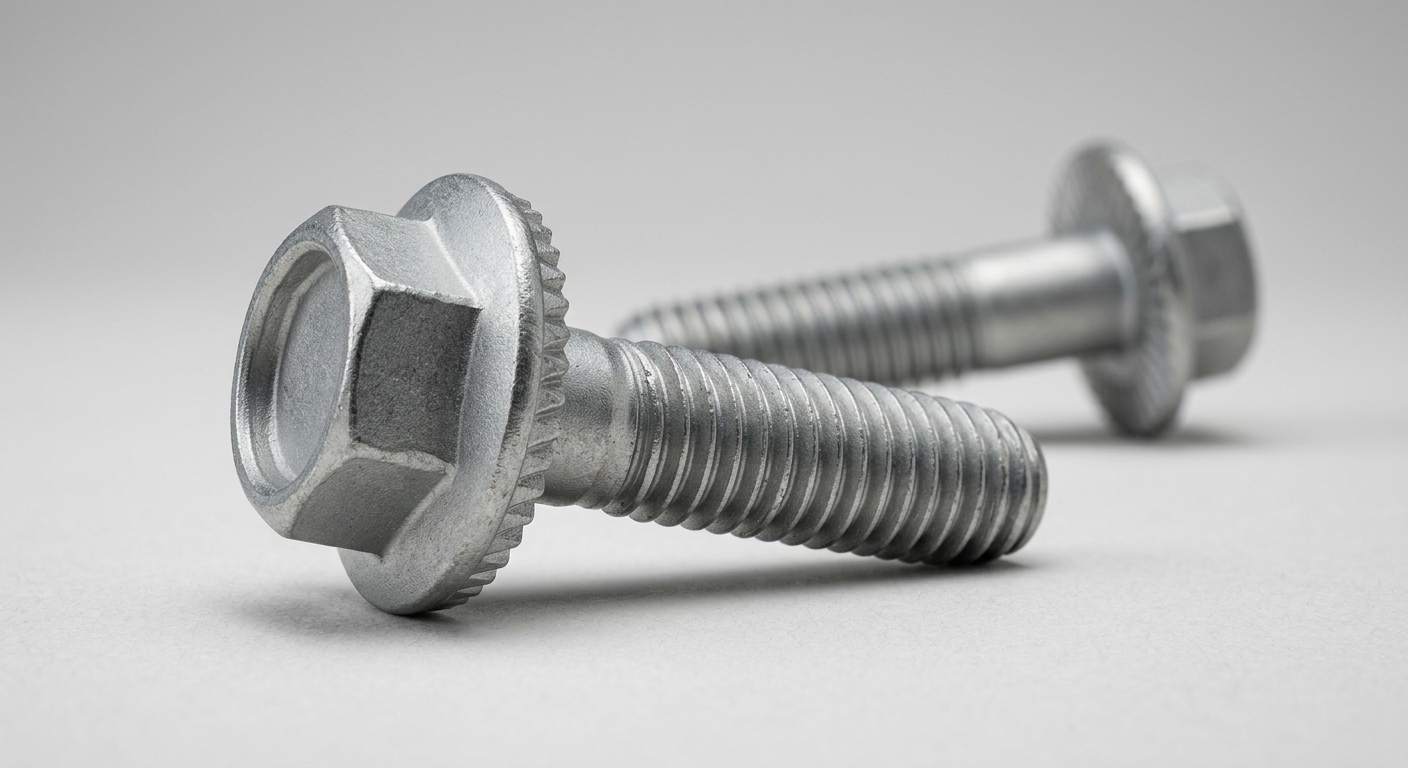
The defining feature of the hex flange structural screw is its forged, serrated flange — a wide, circular bearing surface that is permanently integrated beneath the hex head. This design delivers three measurable engineering benefits:
-
Expanded bearing area: The flange increases the load-bearing contact area by 60–80% compared to a standard hex bolt head of the same nominal diameter. This directly reduces compressive stress at the joint interface and eliminates pull-through risk in plate thicknesses as low as 2.5 mm.
-
Uniform load distribution: Because the flange contacts the substrate across a broad, continuous ring, the clamping force is distributed symmetrically. This eliminates the stress concentration gradients that drive fretting wear in standard bolt configurations.
-
Elimination of the separate washer: With the flange performing the washer’s function as a forged component of the fastener itself, washer migration becomes structurally impossible. The assembly part count drops from three components (bolt + washer + nut) to two, with no sacrifice in load distribution performance.
The serrated underside of the flange provides an additional anti-rotation function, biting into the substrate surface under torque to resist back-off under vibration — a feature no separate flat washer can replicate.
2.2: Carbon Steel Grade Selection and Surface Treatment for Long-Term Clamping Force
Material selection directly governs the fastener’s ability to maintain preload over its service life. Two carbon steel grades dominate structural applications:
- Grade 8.8: Tensile strength 800 MPa, proof load stress 600 MPa. Appropriate for general structural connections with moderate dynamic loading. Lower cost, widely available, and compatible with standard hot-dip galvanizing.
- Grade 10.9: Tensile strength 1040 MPa, proof load stress 940 MPa. Specified for high-stress structural joints, heavy equipment bases, and applications where joint slip must be eliminated. Requires careful torque control to avoid exceeding proof load.
Surface treatment selection affects both corrosion resistance and friction coefficient — the latter directly impacts the torque-to-preload relationship:
- Hot-dip galvanizing (HDG): Provides 85–100 µm zinc coating for long-term outdoor corrosion protection. Slightly increases thread friction, requiring torque adjustment of approximately +10–15%.
- Dacromet (zinc-aluminum flake coating): Thin-film coating (8–12 µm) with excellent corrosion resistance and a more consistent friction coefficient than HDG, making torque control more predictable in production assembly.
| Parameter | Standard Hex Bolt | Hex Flange Structural Screw |
|---|---|---|
| Bearing Area (M12) | ~113 mm² | ~180–200 mm² |
| Recommended Torque — Grade 8.8 (M12) | 70–80 Nm | 75–85 Nm |
| Anti-Loosening Rating | Moderate | High (serrated flange) |
| Applicable Plate Thickness | ≥ 4 mm | ≥ 2.5 mm |
| Surface Treatment Options | HDG, zinc plating, Dacromet | HDG, Dacromet, plain |
| Separate Washer Required | Yes | No |
3: Specifications, Standards & Compliance
3.1: Key Dimensional Parameters and Drive System Compatibility
Carbon Steel Hex Flange Structural Screws are available across a standard size range of M6 through M20, covering the majority of structural and equipment-mounting applications. Key dimensional parameters include:
- Across-flats (AF) drive dimensions conform to ISO metric hex standards, ensuring full compatibility with standard impact wrenches, torque wrenches, and pneumatic assembly tools without requiring specialized tooling
- Thread specifications are available in both coarse metric (ISO 68-1) and, for export markets, UNC/UNF inch series
- Flange outer diameter is typically 1.7–1.9× the nominal bolt diameter, providing the expanded bearing area that defines the product’s performance advantage
- Grip length range accommodates steel plate stacks from 2.5 mm to 60+ mm depending on size
For automated assembly lines, the consistent hex drive geometry allows direct substitution for standard hex bolts in torque-controlled tightening systems without process reconfiguration.
3.2: Applicable Industry Standards and Structural Certification Requirements
Procurement engineers specifying these fasteners for certified structural applications should reference the following standards:
- ISO 4162: Defines hexagon bolts with flange — dimensions and tolerances for metric series. The primary international dimensional standard for this fastener type.
- DIN 6921: The German standard for hex flange bolts, widely referenced in European automotive and machinery sectors. Dimensional requirements align closely with ISO 4162.
- ASTM A325 / A490: U.S. structural bolt standards governing mechanical properties for high-strength fasteners in steel construction. Grade 10.9 hex flange screws with appropriate certifications can be specified in lieu of A325 (Grade 8.8 equivalent) or A490 (Grade 10.9 equivalent) in many structural steel applications, subject to engineer-of-record approval.
For steel structure projects requiring third-party certification, ensure the fastener supplier provides mill test reports (MTRs), dimensional inspection certificates, and surface treatment compliance documentation.
4: Application Scenarios and Commercial Value for B2B Buyers
4.1: High-Vibration Industrial Use Cases
The hex flange structural screw for vibration resistance delivers its clearest value in four categories of industrial application:
- Steel structure fabrication: Column base plates, beam-to-beam connections, and secondary structural members where vibration from adjacent machinery or wind loading creates sustained dynamic stress
- Heavy equipment bases: CNC machine tools, compressors, generators, and industrial presses mounted on structural steel frames — environments where micro-vibration is constant and joint re-torquing is operationally disruptive
- Commercial vehicle chassis: Frame rail connections, cross-member attachments, and suspension component mounting points on trucks and buses, where road-induced vibration spectra are broad and continuous
- Bridge ancillary structures: Expansion joint hardware, guardrail brackets, and inspection platform connections where maintenance access is limited and fastener reliability over multi-year service intervals is mandatory
4.2: Total Cost of Ownership vs. Traditional Bolt-and-Washer Assemblies
The commercial case for specifying a carbon steel screw for structural joints over a conventional bolt-and-washer assembly is grounded in three quantifiable TCO factors:
-
Part count reduction: Replacing a bolt + washer + nut assembly with a flange screw reduces SKU count by one component per joint. For a fabrication project involving 5,000 connection points, this eliminates 5,000 washer procurement, storage, and kitting operations.
-
Assembly labor savings: Eliminating washer placement reduces per-joint assembly time by an estimated 8–12 seconds in manual assembly and eliminates washer-drop errors in overhead or confined-space installations. Across high-volume production, this compounds into significant labor cost reduction.
-
Extended maintenance intervals: The serrated flange’s anti-rotation function and the larger bearing area’s resistance to fretting-induced preload loss extend re-torquing intervals. Field data from heavy equipment applications consistently shows 30–40% longer maintenance cycles compared to standard bolt-and-washer configurations — directly reducing scheduled downtime costs.
FAQ
Q1: What is the minimum flange bearing area required to prevent pull-through in thin steel plate applications?
For thin steel plates (2.5–4 mm), the flange bearing area should provide a compressive stress under the fastener head that remains below the yield strength of the plate material. As a practical guideline, an M10 hex flange screw with a flange OD of approximately 19–20 mm provides sufficient bearing area for 3 mm mild steel (S235/A36) at Grade 8.8 proof load. Always verify against the plate material’s compressive yield strength and consult the fastener manufacturer’s pull-through load tables for confirmation.
Q2: Can Carbon Steel Hex Flange Structural Screws be reused after disassembly, or must they be replaced?
Grade 8.8 hex flange screws may generally be reused if they have not been torqued beyond their proof load and show no visible deformation of the flange or thread. Grade 10.9 fasteners in structural applications should be treated as single-use in safety-critical joints — the higher preload levels bring them closer to their plastic deformation threshold, and reuse introduces uncertainty about residual clamping capacity. Always follow the project’s structural specification requirements on fastener reuse.
Q3: How do I select the correct torque specification for Grade 10.9 hex flange screws in high-vibration environments?
Torque selection must account for the fastener’s friction coefficient (which varies by surface treatment), the target preload (typically 70–80% of proof load for structural applications), and any preload relaxation allowance for the specific environment. For Grade 10.9 M12 Dacromet-coated flange screws, a typical target torque is 115–130 Nm. Always use the fastener supplier’s torque table for the specific coating and lubrication condition — and consider specifying torque-angle tightening for the most demanding vibration environments to achieve more consistent preload regardless of friction variation.
Conclusion
The Carbon Steel Hex Flange Structural Screw resolves the three core failure mechanisms of conventional bolt-and-washer assemblies through a single, elegant design modification: the integrated forged flange. By expanding bearing area, distributing clamping load uniformly, and providing inherent anti-rotation resistance through the serrated flange underside, it directly addresses fretting wear, preload relaxation, and pull-through risk — without requiring additional components or process changes.
For procurement engineers evaluating a specification upgrade, the engineering case is reinforced by a compelling commercial argument. Reduced part count, faster assembly, and extended maintenance intervals combine to deliver a total cost of ownership advantage that offsets any unit price premium over standard hex bolts. In high-vibration environments — steel structures, heavy equipment, commercial vehicles, and infrastructure — this is not a marginal improvement. It is a structural reliability upgrade with measurable operational and financial returns.
Specify to ISO 4162 or DIN 6921, select Grade 10.9 for high-stress joints, and request Dacromet surface treatment where corrosion resistance and torque consistency are both priorities.