


Аннотация
Fastener corrosion is an overlooked risk in construction projects. Although nails represent a small part of material costs, the wrong fastener choice can lead to rust staining, wood damage, warranty issues, and costly repairs.
This guide explains why standard and galvanized nails fail in harsh environments and how гвозди из нержавеющей стали provide better corrosion resistance and long-term durability. It covers 304 vs. 316 stainless steel nails, application-specific specifications, and key factors for contractors, engineers, and procurement teams.
For projects exposed to moisture, salt, or pressure-treated lumber, choosing the right stainless steel fastener is not just an upgrade — it is a practical way to reduce maintenance costs and prevent corrosion-related failures.
1. Why Nails Rust — and Why It Costs More Than You Think
1.1 Why Fasteners Corrode: The Science Behind Nail Rust
Nail rust is more than a surface appearance problem — it is a corrosion process that begins when steel, moisture, oxygen, and chemicals such as salt or acidic wood compounds interact. In carbon steel nails, iron gradually oxidizes and forms rust, which expands and can damage surrounding wood fibers, reduce holding strength, and create visible stains on siding, decking, and other finished surfaces.
Several environmental factors accelerate fastener corrosion:
- Moisture and humidity cycles: Repeated wet and dry conditions allow oxygen and water to continuously react with the metal surface, speeding up corrosion.
- Chloride exposure: Saltwater environments and coastal air contain chloride ions that can break down protective coatings and increase the risk of rust.
- Acidic wood and preservatives: Cedar, redwood, and copper-based pressure-treated lumber can accelerate corrosion by attacking standard steel and zinc coatings.
The cost of corrosion often extends far beyond the fastener itself. A rusted nail can cause staining, wood damage, maintenance issues, and costly repairs, especially when replacement requires removing finished surfaces.
1.2 Why Standard and Galvanized Nails May Fail
Hot-dip galvanized (HDG) nails provide better corrosion protection than untreated steel nails and remain suitable for many general applications. However, their zinc coating can gradually deteriorate in aggressive environments.
The zinc layer on galvanized nails works as a sacrificial barrier, meaning it is consumed over time to protect the underlying steel. In pressure-treated lumber containing copper-based preservatives, this protective layer can degrade faster, reducing the service life of the fastener.
Another common issue occurs during installation. When galvanized nails are driven with pneumatic tools, the coating on the shank may be damaged, exposing bare steel at stress points where corrosion can begin.
For projects involving coastal exposure, high humidity, or treated lumber, relying only on galvanized nails may increase the risk of premature corrosion. In these environments, гвозди из нержавеющей стали provide a more reliable long-term solution due to their inherent corrosion resistance.
2. Stainless Steel Nails — Grade Selection and Key Specifications
2.1 304 vs. 316 Stainless Steel Nails: Which Grade Should You Choose?
Unlike galvanized nails that rely on a sacrificial zinc coating, stainless steel nails achieve corrosion resistance through a passive chromium oxide layer that naturally protects the surface. For most construction applications, the two commonly specified grades are 304 and 316 stainless steel nails.
Grade 304 stainless steel nails (18% chromium, 8% nickel) are the standard choice for general exterior and interior applications. They provide excellent resistance to atmospheric corrosion and are commonly used for roofing, siding, flooring, and outdoor projects in areas with normal moisture exposure. However, 304 stainless steel nails are not the best option for environments with prolonged salt exposure or aggressive chemicals.
Grade 316 stainless steel nails (with added molybdenum) provide enhanced corrosion resistance, especially against chlorides and saltwater exposure. They are recommended for coastal construction, marine applications, high-humidity environments, and projects using copper-based pressure-treated lumber.
In practical purchasing decisions, the choice between 304 and 316 stainless steel nails depends mainly on the project environment. For inland applications with limited moisture exposure, 304 offers a strong balance between performance and cost. For coastal areas, treated lumber, or marine-related projects, 316 stainless steel nails are the more reliable long-term choice.
2.2 Key Specifications to Check Before Ordering Stainless Steel Nails
Selecting the correct grade is only the first step. Procurement teams should also verify the following specifications before purchasing гвозди из нержавеющей стали:
- Diameter and gauge: Choose the appropriate shank diameter based on load requirements, material thickness, and applicable construction standards.
- Length: Ensure sufficient penetration into the receiving material to achieve reliable holding strength.
- Тип головки: Flat, clipped, or offset heads should match the application and the requirements of pneumatic nailers or installation tools.
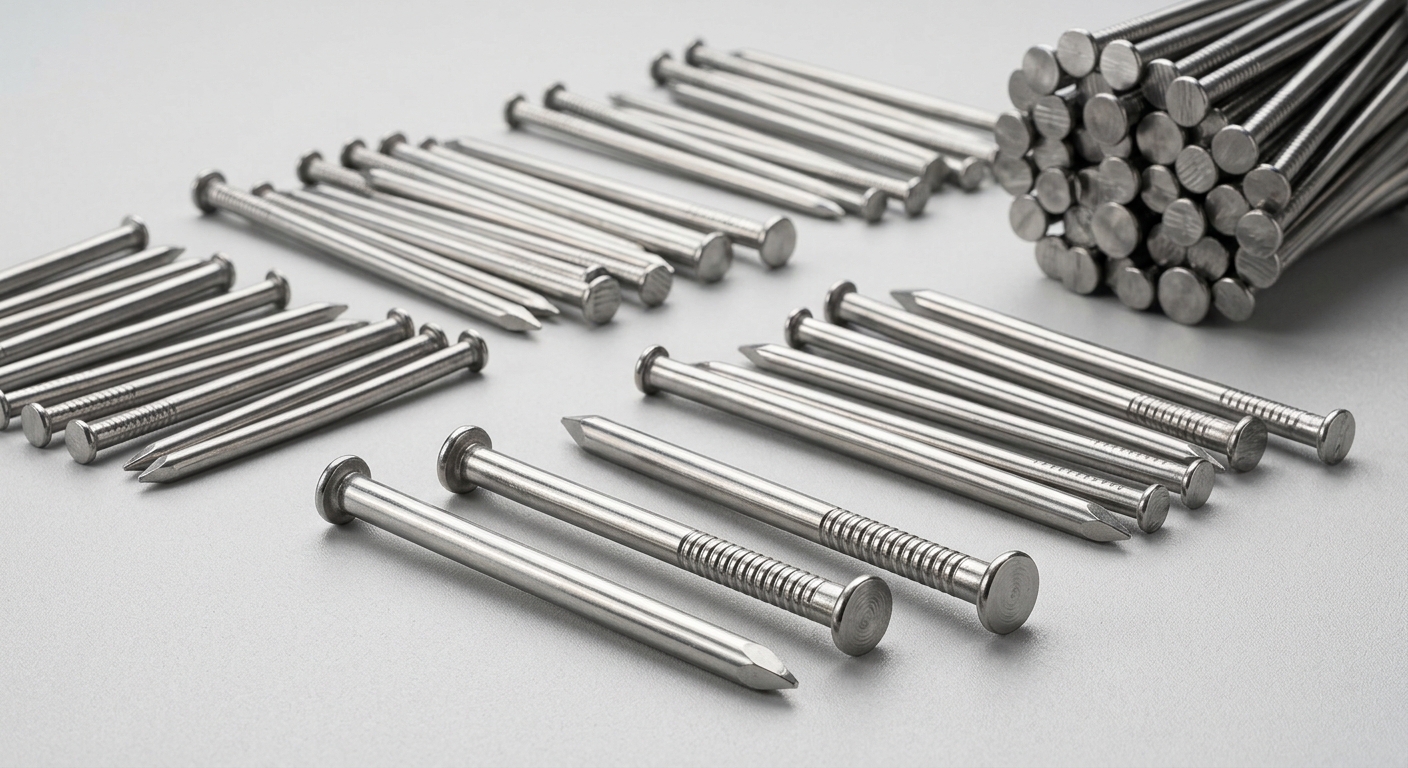
- Shank profile: Ring-shank and spiral-shank stainless steel nails provide higher withdrawal resistance than smooth-shank options, making them suitable for decking, siding, and structural applications.
- Compliance standards: Verify applicable standards such as ASTM F1667 and request material documentation when required, especially for large-scale or corrosion-sensitive projects.
Choosing the right combination of stainless steel nail grade, size, and design helps ensure long-term performance and reduces the risk of premature fastener failure.
| Specification Dimension | Carbon Steel Nail | Горячее цинкование | Нержавеющая сталь 304 | Нержавеющая сталь 316 |
|---|---|---|---|---|
| Base Material / Coating | Low-carbon steel, bare | Steel + zinc (45–85 µm) | 18Cr-8Ni alloy | 16Cr-10Ni-2Mo alloy |
| Salt Spray Resistance (ASTM B117) | <24 hours | 200–400 hours | 500–600 hours | >1,000 hours |
| Compatible with ACQ Lumber | Нет | Limited (accelerated depletion) | Да | Yes (recommended) |
| Suitable Environment Grade | Dry interior only | Inland/low humidity | General exterior | Coastal / marine / treated wood |
| Approx. Price Range ($/1,000 pcs) | $8–$15 | $18–$35 | $45–$80 | $70–$130 |
| Key Compliance Standard | ASTM F1667 | ASTM A153 / F1667 | ASTM F1667 / ISO 1891 | ASTM F1667 / ISO 1891 |
3. Application-Specific Stainless Steel Nails Recommendations
3.1 High-Corrosion Environments: Coastal, Marine, and Pressure-Treated Wood Applications
For projects exposed to saltwater, high humidity, or copper-based pressure-treated lumber, choosing the right гвозди из нержавеющей стали is critical for long-term durability. Coastal construction, marine structures, and treated wood applications typically require fasteners with higher corrosion resistance than standard galvanized nails can provide.
Recommended specifications for coastal and marine applications:
- Grade: 316 stainless steel nails for superior chloride and saltwater resistance
- Shank: Ring-shank profile for decking, siding, and structural fastening applications
- Diameter: Select according to load requirements and local building standards
- Length: Ensure adequate penetration into the supporting structure for reliable holding strength
- Verification: Request material certificates and grade documentation for corrosion-sensitive projects
For docks, boat houses, and other marine-related structures with direct saltwater exposure, higher-performance stainless materials may be considered for critical connections. However, 316 stainless steel nails remain the preferred choice for most coastal residential and commercial construction projects.
3.2 General Construction and Exterior Applications
For general construction projects without direct marine exposure, 304 stainless steel nails provide an excellent balance between corrosion resistance, durability, and cost. They are commonly used for roofing, exterior siding, hardwood flooring, and other applications where long-term appearance and fastener reliability are important.
Compared with hot-dip galvanized nails, 304 stainless steel nails offer better resistance to coating damage during installation because their corrosion protection comes from the material itself rather than a surface coating.
Common applications include:
- Roofing and roof sheathing: Reliable fastening performance for exterior building systems
- Exterior siding and cladding: Helps prevent visible rust staining on finished surfaces
- Hardwood decking and flooring: Provides long-term corrosion resistance in moisture-prone areas
Although stainless steel nails have a higher upfront cost than galvanized alternatives, the reduced risk of corrosion-related repairs and replacement makes them a cost-effective choice for long-term projects.
3.3 Common Types of Stainless Steel Nails for Different Applications
Stainless steel nails are available in different designs to meet specific construction requirements. Selecting the right nail type helps improve holding strength, installation efficiency, and long-term performance.
Common types include:
Stainless Steel Roofing Nails
Designed for roofing systems where corrosion resistance and weather exposure are major concerns. They are commonly used for shingles, roof sheathing, and exterior roofing applications.
Stainless Steel Siding Nails
Used for exterior cladding, fiber cement siding, and wood siding installations. Their corrosion resistance helps prevent rust staining on visible surfaces.
Stainless Steel Decking Nails
Typically available with ring-shank or spiral-shank designs to provide stronger holding power for hardwood and outdoor decking applications.
Stainless Steel Finishing Nails
Used for trim, molding, and interior woodworking projects where appearance and corrosion resistance are important.
Choosing the right stainless steel nail type based on the application ensures better installation performance and reduces the risk of premature fastener failure.
4. Total Cost of Ownership — Why Stainless Steel Nails Are a Smarter Long-Term Investment
4.1 Rework Costs vs. Fastener Upgrade: Understanding the Real Value
Fasteners usually represent only a small portion of total construction costs, which is why many projects prioritize lower upfront pricing when selecting nails. However, the initial savings from standard or galvanized nails can quickly disappear when corrosion leads to staining, repairs, or replacement work.
Consider a coastal decking project where galvanized nails fail due to long-term moisture and salt exposure. The resulting costs may include:
- Deck removal and replacement labor
- Replacement of stained or damaged boards
- Additional maintenance and warranty costs
- Project delays and customer dissatisfaction
Compared with the potential expense of corrosion-related repairs, upgrading to 316 stainless steel nails typically represents a relatively small additional investment. For contractors, engineers, and procurement teams, selecting corrosion-resistant fasteners is not simply about material cost — it is a decision that reduces long-term maintenance risks and protects project value.
How to Choose a Reliable Stainless Steel Nails Supplier
When sourcing stainless steel nails for commercial projects, buyers should evaluate more than product pricing. A reliable supplier should provide:
- Material verification: Confirm stainless steel grade documentation, such as 304 or 316 certification.
- Quality consistency: Ensure stable dimensions, surface finish, and mechanical performance across production batches.
- Compliance support: Check whether products meet relevant standards such as ASTM F1667.
- Customization capability: For specific applications, suppliers should support different lengths, diameters, head styles, and packaging requirements.
Working with an experienced stainless steel nails supplier helps reduce procurement risks and ensures consistent fastener performance across large-scale projects.
ЧАСТО ЗАДАВАЕМЫЕ ВОПРОСЫ
Q1: What is the difference between stainless steel nails and galvanized nails for pressure-treated lumber?
Galvanized nails rely on a sacrificial zinc coating that reacts chemically with the copper compounds in ACQ and CA pressure-treated lumber, accelerating zinc depletion and leading to premature failure. Stainless steel nails — particularly 316 grade — are chemically inert to these preservatives and provide a stable, long-term connection without coating degradation. For any pressure-treated application, 316 stainless is the technically correct and increasingly code-required specification.
Q2: Do stainless steel nails meet building code requirements for coastal construction?
Yes. Grade 316 stainless steel nails satisfy the fastener requirements of the Florida Building Code, IRC R317.3, and most HVHZ-specific local amendments. Always verify with the applicable jurisdiction, as some coastal counties have adopted more stringent local amendments. Request product data sheets confirming ASTM F1667 compliance and mill certificates for grade verification.
Q3: How do I calculate the right nail length and gauge for my specific application?
As a general rule, nail length should allow penetration of at least 10× the shank diameter into the receiving member for smooth-shank nails (6× for ring-shank). For structural connections, consult the AWC National Design Specification (NDS) withdrawal and lateral load tables using the specific gravity of your lumber species. When in doubt, a ring-shank 316 stainless nail in the next size up provides a conservative safety margin with no structural downside.
ЧАСТО ЗАДАВАЕМЫЕ ВОПРОСЫ
Fastener corrosion is a predictable and preventable problem. With the right specification, гвозди из нержавеющей стали can eliminate common corrosion risks in coastal construction, exterior applications, and pressure-treated lumber projects.
Choosing the right fastener comes down to three factors: corrosion resistance, application requirements, and long-term cost performance. Compared with galvanized alternatives, 304 and 316 stainless steel nails provide more reliable protection where moisture, salt, or treated wood exposure creates higher corrosion risks.
Selecting the correct stainless steel nail grade during the procurement stage is always more cost-effective than dealing with repairs after corrosion occurs. If your project requires durable corrosion-resistant fasteners, contact our team for grade recommendations, product specifications, and sourcing support.