
Аннотация
Exterior cladding systems are long-term investments, yet their longevity is routinely compromised by a component that accounts for less than 1% of total project cost: the fastener. Substandard nails cause corrosion, structural loosening, and surface staining, three systemic failure modes that cost the construction industry billions annually in remediation and warranty claims.
This article addresses those failure modes directly. It examines how high-grade гвозди из нержавеющей стали—selected by material grade, geometry, and compliance standard—deliver measurable performance advantages over galvanized or carbon steel alternatives. Whether you are specifying fasteners for a coastal residential development, an industrial facade retrofit, or a large-scale fiber cement cladding project, the technical and commercial case for stainless steel nails is compelling. Procurement managers and project engineers will find here a structured reference for grade selection, regulatory compliance, application matching, and lifecycle cost justification.
1. Why Fastener Choice Defines Cladding Longevity
1.1 The Hidden Cost of Corrosion in Exterior Cladding
Standard iron nails and hot-dip galvanized nails are widely used in exterior cladding installations due to their low upfront cost. However, their corrosion pathway creates a cascade of structural and aesthetic failures that far outweigh initial savings.
When zinc coatings on galvanized nails degrade—typically within 7–12 years in moderate-humidity environments and as few as 3–5 years in coastal zones—the underlying steel oxidizes rapidly. This oxidation process generates iron oxide expansion, which physically splits the cladding board at the nail hole. The resulting micro-fractures allow moisture ingress, accelerating rot in timber substrates and delamination in fiber cement panels.
Simultaneously, iron oxide leaches outward, producing the characteristic rust streaking visible on countless building facades. This staining is not merely cosmetic: it signals active fastener failure and triggers expensive remediation cycles. A mid-rise residential project with 40,000 corroded nails may require full re-cladding within 15 years—a cost that dwarfs the original fastener budget by a factor of 50 or more.
The structural consequence is equally serious. As corroded nails lose cross-sectional integrity, their withdrawal resistance drops below design thresholds. In wind-load events, cladding panels fixed with degraded fasteners are at risk of partial or complete detachment, creating both safety hazards and significant liability exposure for contractors and developers.
1.2 How Stainless Steel Nails Break the Corrosion Chain
Stainless steel nails resist corrosion through a fundamentally different mechanism than zinc coating. The chromium content (minimum 10.5% by mass) reacts with atmospheric oxygen to form a continuous, self-repairing passive oxide layer—typically 1–3 nanometers thick—that acts as an electrochemical barrier against moisture, chloride ions, and acidic compounds.
This passivation layer is not a consumable coating. Unlike galvanizing, it does not deplete over time; minor surface abrasions from installation are re-passivated spontaneously in the presence of oxygen. This self-healing property is the primary reason stainless steel nails for exterior cladding consistently outperform coated alternatives across 25–50 year service windows.
A further advantage is chemical compatibility with wood tannins. Many high-value cladding timbers—western red cedar, oak, and tropical hardwoods—contain tannic acid, which reacts aggressively with iron and galvanized surfaces to produce black staining. Stainless steel is chemically inert to tannins, preserving both the fastener integrity and the natural appearance of the cladding surface.
2. Material Grades & Technical Specifications
Selecting the correct stainless steel grade for exterior cladding nails is not a cosmetic decision—it is an engineering one. The two primary grades in use are AISI 304 (A2) and AISI 316 (A4), with meaningful performance differences in aggressive environments.
| Grade | Ni Content | Mo Content | Salt Spray Test (hrs) | Recommended Environment | Typical Cladding Type |
|---|---|---|---|---|---|
| Горячее цинкование | — | — | 500–1,000 | Low-humidity inland | General timber |
| 304 SS (A2) | 8–10.5% | None | 1,000–2,000 | Inland / suburban | Timber, fiber cement |
| 316 SS (A4) | 10–14% | 2–3% | 2,000–5,000+ | Coastal / industrial | All cladding types |
| Dual-Hardened 316 | 10–14% | 2–3% | 5,000+ | Severe marine/chemical | Composite, hardwood |
2.1 304 vs. 316 Stainless Steel: Grade Selection for Coastal & Industrial Environments
Grade 304 stainless steel nails provide excellent corrosion resistance in suburban and inland environments where chloride exposure is minimal. Their 8–10.5% nickel content stabilizes the austenitic structure, and the self-passivating chromium layer handles typical rainfall and humidity cycling without degradation.
However, in coastal environments within 1–5 km of saltwater, or in industrial zones with airborne sulfur dioxide or chlorine compounds, Grade 316 is the specified minimum. The critical differentiator is molybdenum: 316’s 2–3% Mo addition significantly enhances resistance to pitting corrosion initiated by chloride ions. Pitting is the failure mode most commonly overlooked in coastal projects—it occurs beneath the passive layer and is invisible until structural damage is already advanced.
For projects within 500 meters of breaking surf or in chemical processing facility facades, dual-hardened 316 stainless steel nails with enhanced tensile strength (minimum 800 MPa) should be specified to handle both corrosion and mechanical load demands simultaneously.
2.2 Nail Geometry & Surface Treatment for Cladding Retention
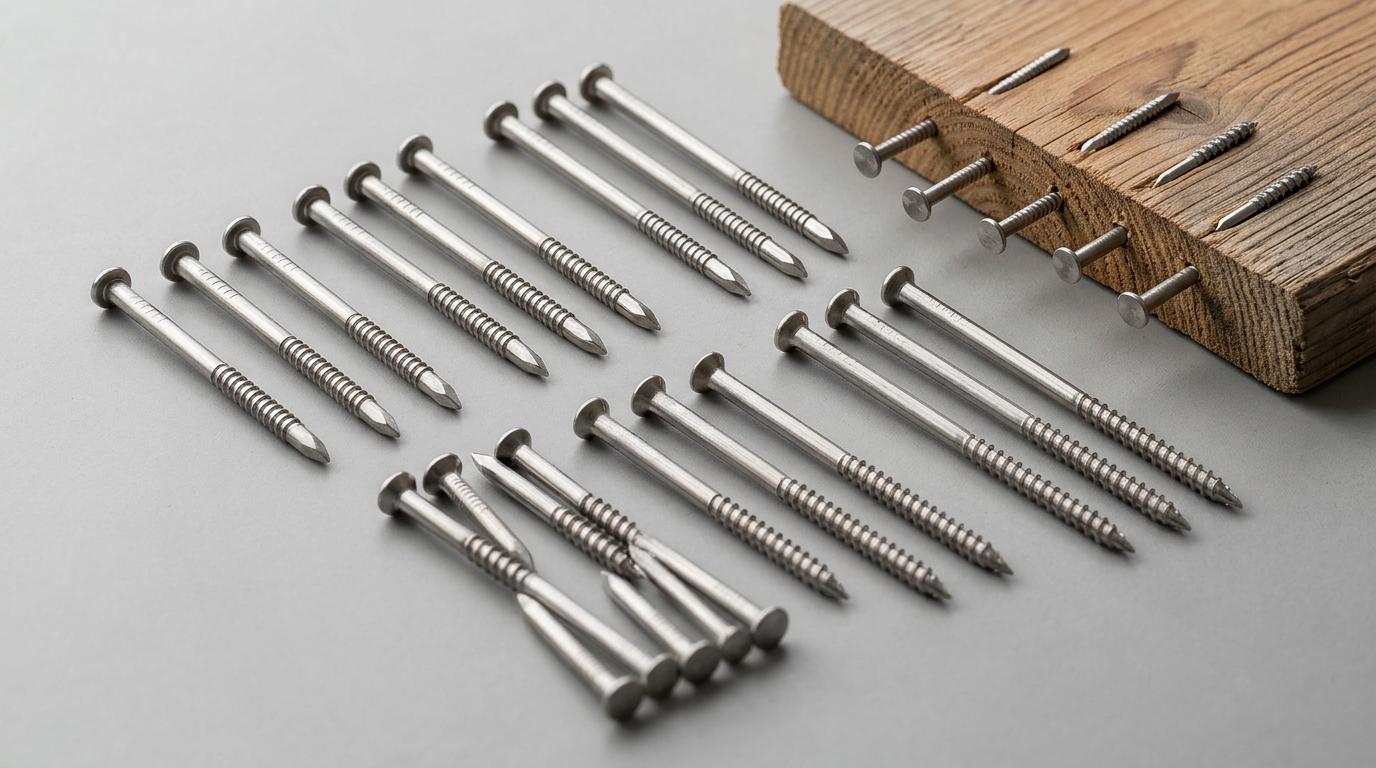
Withdrawal resistance—the force required to pull a nail from its substrate—is the primary mechanical parameter for cladding fasteners. Smooth-shank nails provide the lowest withdrawal resistance and are generally unsuitable for exterior cladding applications subject to thermal cycling and wind load.
Ring-shank (annular) nails offer 40–60% greater withdrawal resistance than smooth-shank equivalents of identical diameter, achieved through mechanical interlock between the annular rings and wood fibers. Screw-shank (helical) nails provide comparable or superior withdrawal resistance with the additional advantage of reduced splitting in dense hardwoods.
Head geometry matters equally. Flat-head nails are standard for most cladding substrates, providing a broad bearing surface to prevent pull-through. Countersunk (lost-head) nails are preferred for visible face applications where surface finish is critical, allowing the nail to sit flush or slightly below the cladding surface and be filled for a seamless appearance.
3. Compliance Standards & Industry Certifications
3.1 Key International Standards Governing Stainless Steel Nails for Cladding
Three standards frameworks govern the specification of stainless steel nails for exterior cladding in major construction markets:
- ASTM F1667 (USA): Covers driven fasteners including nails, specifying material, dimensional tolerances, and mechanical properties. Procurement teams should verify compliance with Type 316 stainless steel requirements under this standard for coastal applications.
- EN ISO 3506 (Europe): Defines mechanical properties of corrosion-resistant stainless steel fasteners. A2-70 and A4-80 property classes directly correspond to 304 and 316 grades with defined tensile and yield strength thresholds.
- AS 3566 (Australia/New Zealand): Specifically addresses self-drilling and driven fasteners for external cladding, with Class 3 and Class 4 corrosion resistance ratings aligned to environmental exposure categories.
A compliant procurement checklist should include: mill test certificates confirming alloy composition, third-party salt spray test reports per ISO 9227, and dimensional compliance documentation per the applicable fastener standard.
3.2 Building Code Requirements for Exterior Cladding Fasteners
The International Building Code (IBC) Section 1403 mandates that exterior wall cladding fasteners meet corrosion resistance requirements appropriate to the exposure category of the building location. In practice, this means that projects in high-humidity, coastal, or chemically aggressive environments must specify fasteners with documented corrosion resistance—a requirement that standard galvanized nails frequently fail to satisfy after initial inspection cycles.
Local amendments to IBC in coastal U.S. states (Florida, California, Hawaii) and equivalent codes in the UK, Australia, and the EU increasingly mandate stainless steel fasteners as a baseline for any cladding installation within defined coastal proximity zones. Non-compliant fastener specification is a documented cause of failed building inspections and voided cladding system warranties. Specifying certified stainless steel nails for exterior cladding at the design stage eliminates this risk entirely.
4. Application Scenarios & Commercial Value
4.1 Best-Fit Cladding Materials: Timber, Fiber Cement & Composite Panels
Different cladding substrates demand different nail specifications:
Timber cladding (softwood and hardwood): Ring-shank 316 stainless steel nails in 2.8–3.3 mm diameter are the industry standard for softwood species (pine, cedar, spruce). For dense hardwoods (ipe, teak, oak), pre-drilling with screw-shank 316 nails prevents splitting while maximizing withdrawal resistance. The chemical inertness of stainless steel to tannins is particularly valuable here.
Fiber cement panels: These substrates require nails with high hardness to penetrate without pre-drilling in most thicknesses. Dual-hardened 316 stainless steel nails with a Vickers hardness of 300+ HV are recommended. Flat-head geometry distributes load across the panel face, preventing surface fracture at the fastener point.
Composite and engineered panels: Manufacturer specifications for composite cladding systems frequently mandate stainless steel fasteners as a warranty condition. Screw-shank 316 nails provide the combination of corrosion resistance and pull-through resistance required by most composite panel technical datasheets.
4.2 Total Cost of Ownership: Stainless Steel Nails vs. Alternative Fasteners
A 20-year lifecycle cost model for a 500 m² exterior cladding project illustrates the commercial case clearly:
| Cost Factor | Galvanized Nails | 316 Stainless Steel Nails |
|---|---|---|
| Initial fastener cost | $180 | $520 |
| Replacement at Year 10–12 | $4,200 (labor + materials) | $0 |
| Stain remediation (Year 8–15) | $1,800 | $0 |
| Re-cladding risk (Year 15–20) | $18,000+ (probability-weighted) | Negligible |
| 20-Year Total | ~$24,000+ | ~$520 |
The $340 premium for stainless steel nails on this project delivers a return on investment that no alternative fastener strategy can match. Beyond direct cost, the reputational value of a cladding system that remains structurally sound and aesthetically clean after two decades is a significant commercial differentiator for contractors and developers in competitive markets.
ЧАСТО ЗАДАВАЕМЫЕ ВОПРОСЫ
Q1: What nail grade is recommended for timber cladding in coastal or high-humidity environments?
Grade 316 (A4) stainless steel nails are the minimum specification for coastal environments within 5 km of saltwater, and for any project in tropical high-humidity zones. The molybdenum content in 316 SS provides the chloride pitting resistance that 304 SS cannot reliably deliver in these conditions. For marine exposure under 500 meters, specify dual-hardened 316 with documented salt spray test results exceeding 3,000 hours per ISO 9227.
Q2: Can stainless steel nails cause galvanic corrosion when used with aluminum or zinc-coated cladding systems?
Galvanic corrosion requires an electrolytic pathway between dissimilar metals. In most exterior cladding applications, stainless steel nails are embedded in a non-conductive substrate (timber or fiber cement), which breaks the galvanic circuit. Where direct metal-to-metal contact occurs—such as aluminum-framed composite panel systems—the use of isolating washers or specifying matched-metal fasteners is advisable. Consult the cladding system manufacturer’s technical documentation for specific guidance.
Q3: How do I verify that stainless steel nails meet local building code requirements before procurement?
Request the following documentation from your supplier: (1) mill certificates confirming alloy composition to AISI 316 or 304 standards; (2) salt spray test reports per ISO 9227 from an accredited third-party laboratory; (3) dimensional compliance certificates per ASTM F1667, EN ISO 3506, or AS 3566 as applicable to your market. Cross-reference the fastener’s corrosion resistance class against your local building code’s exposure category requirements before finalizing the procurement order.
Заключение
The evidence across material science, compliance frameworks, and lifecycle economics converges on a single conclusion: stainless steel nails are not a premium option for exterior cladding—they are the technically correct specification. The corrosion chain that destroys galvanized fasteners within a decade does not apply to passivated stainless steel. The tannin staining that degrades timber cladding aesthetics is eliminated. The structural withdrawal resistance required by modern wind-load codes is met and maintained across the full design life of the building.
For procurement managers, the grade selection framework is straightforward: 304 SS for inland and suburban projects, 316 SS as the baseline for any coastal or industrial exposure, and dual-hardened 316 for severe marine environments. Match nail geometry—ring-shank or screw-shank—to substrate density and required withdrawal resistance, and verify compliance documentation against ASTM F1667, EN ISO 3506, or AS 3566 before purchase.
The right fastener selection at the specification stage costs a fraction of a percent of total project value. The wrong selection can cost the entire project. For exterior cladding that performs as designed for 25 years and beyond, stainless steel nails are the only logical choice.