


Resumo
For procurement engineers, contractors, and construction buyers, fastener selection is rarely just about unit price — it’s about lifecycle cost, structural integrity, and compliance risk. The debate between pregos de aço inoxidável and galvanized nails is one of the most consequential material decisions in outdoor and marine construction.
Galvanized nails have served the industry for decades, offering a cost-effective corrosion barrier through zinc coating. However, that barrier has a finite lifespan. Stainless steel nails, by contrast, derive their corrosion resistance from the alloy itself — a fundamental material advantage that translates into measurably longer service life, reduced maintenance, and stronger compliance positioning.
This article provides a data-driven comparison across four critical dimensions: material composition and corrosion mechanism, environmental performance benchmarks, applicable standards and grade selection, and total cost of ownership across a 10–25 year project lifecycle. Whether you are specifying fasteners for coastal decking, ACQ-treated lumber, or high-humidity roofing systems, this guide delivers the technical framework to make a defensible procurement decision.
1: Understanding the Core Difference — Material Composition & Corrosion Mechanism
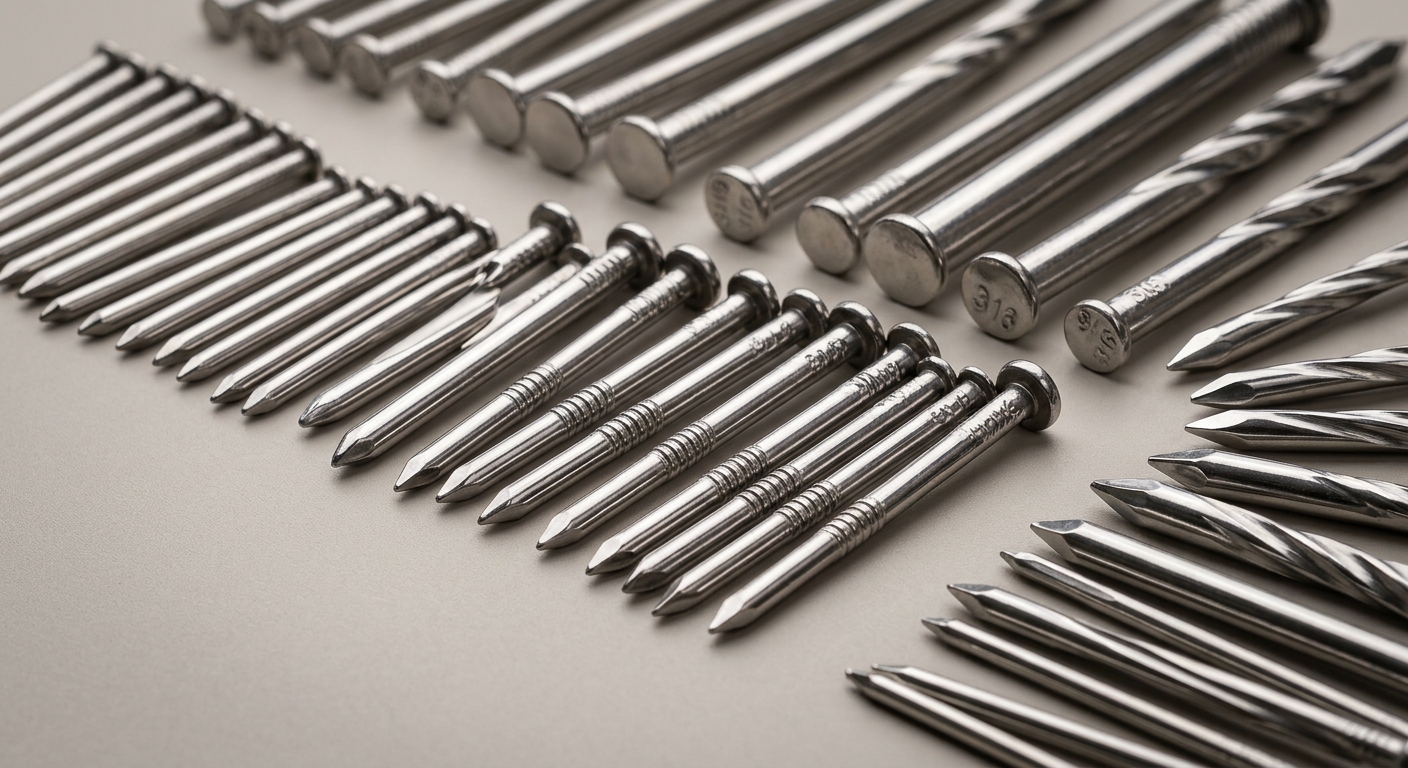
1.1: How Stainless Steel Nails Resist Rust at the Molecular Level
Stainless steel nails achieve corrosion resistance through a passive oxide layer — a thin, self-repairing film of chromium oxide (Cr₂O₃) that forms spontaneously when chromium content exceeds 10.5% by mass. Unlike a surface coating, this layer is intrinsic to the alloy. When scratched or abraded during installation, it regenerates in the presence of oxygen, maintaining continuous protection throughout the fastener’s service life.
The two most commercially relevant grades are 304 stainless steel (18% chromium, 8% nickel) and 316 stainless steel (16% chromium, 10% nickel, 2% molybdenum). The molybdenum addition in 316 significantly enhances resistance to chloride-induced pitting — the dominant failure mode in marine and coastal environments. For applications where salt spray or chemical exposure is a factor, 316-grade stainless steel nails are the engineering-specified choice.
1.2: Types of Galvanized Nails and Their Coating Limitations
Galvanized nails rely on a sacrificial zinc coating that corrodes preferentially to protect the underlying steel substrate. Two coating methods are commercially available:
- Hot-dipped galvanized (HDG): Zinc coating thickness of 1.0–2.0 oz/ft² (305–610 g/m²). More durable and better suited for outdoor exposure.
- Electro-galvanized (EG): Zinc coating of 0.1–0.3 oz/ft² — significantly thinner, appropriate only for interior or dry applications.
The critical limitation is zinc depletion. In aggressive environments — marine spray, ACQ-treated lumber, high-humidity tropical climates — HDG zinc coatings can deplete within 5–15 years, after which the base steel corrodes rapidly. Cut edges and nail points, where coating is thinnest, are the first failure points. Once zinc is exhausted, structural holding power degrades, and visible rust staining begins — a warranty and aesthetic liability in finished construction.
Stainless Steel Nails vs. Galvanized Nails — Key Performance Comparison
| Tipo de unha | Base Material | Coating/Alloy | Salt Spray Rating (hrs) | Expected Lifespan (years) | Typical Application |
|---|---|---|---|---|---|
| Aço inoxidável 304 | SS304 Alloy | Passive Cr₂O₃ layer | 500–1,000+ | 50–75+ | General outdoor, decking, siding |
| Aço inoxidável 316 | SS316 Alloy | Passive Cr₂O₃ + Mo | 1,000–2,000+ | 75–100+ | Marine, coastal, chemical exposure |
| Hot-Dipped Galvanized | Carbon Steel | Zinc (1.0–2.0 oz/ft²) | 500–800 | 15–30 | General outdoor, treated lumber |
| Electrogalvanizado | Carbon Steel | Zinc (0.1–0.3 oz/ft²) | 96–200 | 3–8 | Interior, dry environments only |
2: Performance Benchmarks — Durability, Load, and Environmental Testing
2.1: Corrosion Resistance Data Across Key Environments
Environmental context determines which fastener fails first. Standardized salt spray testing (ASTM B117) provides a comparative baseline: 316 stainless steel nails routinely exceed 1,000 hours without red rust formation, while hot-dipped galvanized nails typically show zinc degradation at 500–800 hours and base steel corrosion shortly thereafter.
In real-world conditions, the performance gap widens:
- Marine and coastal environments: Airborne chloride concentrations accelerate zinc depletion in galvanized nails by 2–4× compared to inland sites. 316 stainless steel nails show no measurable degradation under equivalent exposure over 20-year field studies.
- ACQ and CA pressure-treated lumber: Alkaline copper quaternary (ACQ) treatments are highly corrosive to zinc coatings — zinc reacts with the copper compounds, accelerating depletion. The American Wood Protection Association (AWPA) and major building codes explicitly recommend or mandate stainless steel fasteners for ACQ-treated applications.
- High-humidity and tropical climates: Continuous moisture exposure without drying cycles eliminates the self-limiting behavior of zinc corrosion. Galvanized nails in these environments can show visible rust within 5–7 years.
2.2: Mechanical Strength and Holding Power Over Time
Tensile strength of 304 stainless steel nails (minimum 70,000 psi yield) is comparable to or exceeds that of galvanized carbon steel nails at installation. However, the divergence occurs over time.
As galvanized nails corrode, the nail shank diameter reduces — directly diminishing shear resistance and withdrawal strength. A 5% shank diameter reduction from corrosion can produce a 10–15% loss in lateral load capacity. In structural decking or roofing applications, this degradation creates progressive load redistribution that may not be visible until failure.
Stainless steel nails retain their original cross-sectional geometry throughout their service life. Independent testing in coastal residential construction has demonstrated that 316 stainless steel nails maintain >95% of original withdrawal strength after 25 years, while HDG nails in equivalent conditions retained 60–75% — with significant variance depending on microclimate exposure.
3: Compliance, Standards & Grade Selection Guide
3.1: Industry Standards Governing Nail Material Specifications
Fastener material selection is not purely a performance preference — it is increasingly a code requirement. Key standards include:
- ASTM A153: Specifies zinc coating requirements for hot-dipped galvanized fasteners. Compliance does not guarantee suitability for all environments.
- ASTM F1667: Covers driven fasteners including nails, defining dimensional and mechanical property requirements. Does not specify corrosion resistance by environment.
- ICC International Residential Code (IRC) Section R317: Mandates corrosion-resistant fasteners for exterior applications, pressure-treated lumber, and within 300 feet of tidal water. In many jurisdictions, “corrosion-resistant” is interpreted to require hot-dipped galvanized at minimum, with stainless steel required or strongly recommended for coastal zones.
- AWPA M6 Standard: Specifically identifies stainless steel (Type 304 or 316) as the preferred fastener material for ground-contact ACQ-treated lumber.
Procurement teams should verify local amendments to model codes — several coastal states and municipalities have adopted stainless steel mandates that exceed base IRC requirements.
3.2: Choosing the Right Grade — 304 vs. 316 Stainless Steel Nails
Grade selection should follow a structured environmental assessment:
| Condition | Recommended Grade |
|---|---|
| General outdoor, non-coastal | Aço inoxidável 304 |
| Within 1 mile of saltwater | Aço inoxidável 316 |
| ACQ/CA pressure-treated lumber | 304 minimum; 316 preferred |
| Marine structures, docks, piers | Aço inoxidável 316 |
| Chemical or industrial exposure | Aço inoxidável 316 |
| Interior or dry environments | Galvanized acceptable |
The molybdenum content in 316 is the decisive factor for chloride-rich environments. Specifying 304 where 316 is warranted is a common and costly error — one that typically surfaces as premature staining, structural callbacks, or warranty claims within the first decade.
4: Application Scenarios & Total Cost of Ownership
4.1: When Stainless Steel Nails Are the Non-Negotiable Choice
Certain application categories present corrosion conditions that galvanized nails cannot reliably withstand over a full project lifecycle:
- Composite and hardwood decking: ACQ-treated substructure combined with moisture cycling demands 304 or 316 stainless steel nails to prevent fastener corrosion and surface staining.
- Cedar and redwood siding: The natural tannins in these species react with zinc and iron, producing black staining. Stainless steel nails are the only fastener type that eliminates this reaction.
- Coastal roofing systems: Wind-driven salt spray penetrates roofing assemblies. Fastener corrosion in roofing is a latent failure mode that may not manifest until water intrusion causes structural damage.
- Marine and waterfront structures: Docks, boardwalks, and seawalls require 316 stainless steel nails as the baseline specification. Galvanized fasteners in tidal zones may require replacement within 5–10 years.
- Pressure-treated lumber (ACQ/CA): As noted in Section 3.1, this is a near-universal stainless steel specification requirement.
4.2: Calculating Long-Term Value Beyond Unit Price
Stainless steel nails carry a unit price premium of 3–8× over hot-dipped galvanized, depending on grade and diameter. This comparison, however, is misleading without lifecycle context.
Consider a 500 sq ft coastal deck project:
- Fastener cost (galvanized): ~$80–120
- Fastener cost (316 stainless): ~$350–500
- Cost delta: ~$270–380
Against this delta, weigh the replacement scenario: galvanized fastener failure in a coastal deck typically requires full board removal, fastener replacement, and board reinstallation — a labor-intensive process with material costs of $2,000–6,000 depending on deck complexity, plus potential warranty liability if the structure is part of a commercial or multi-family project.
Over a 25-year lifecycle, stainless steel nails deliver a documented ROI advantage in any application where galvanized failure probability exceeds 30% — which includes all marine, coastal, and ACQ-treated applications. For B2B buyers managing portfolio risk across multiple projects, the calculus is straightforward: stainless steel nails are a cost-control measure, not a premium expense.
FAQ
Q1: How long do stainless steel nails last compared to galvanized nails in outdoor applications?
In standard outdoor environments, hot-dipped galvanized nails typically last 15–30 years before significant corrosion affects structural performance. Grade 304 stainless steel nails are rated for 50–75+ years under equivalent conditions, while 316 stainless steel nails can exceed 75–100 years in most non-marine environments. In marine or coastal settings, the gap is even more pronounced — galvanized nails may fail within 5–15 years, while 316 stainless steel nails maintain structural integrity indefinitely under normal service conditions.
Q2: Are stainless steel nails required by code for pressure-treated lumber or coastal construction?
Yes, in many jurisdictions. The IRC and AWPA standards recommend or mandate corrosion-resistant fasteners for ACQ/CA-treated lumber, and numerous coastal building codes specify stainless steel explicitly. Always verify local amendments — requirements vary by state and municipality, and non-compliance can create liability exposure during inspections or insurance claims.
Q3: Is the higher upfront cost of stainless steel nails justified for residential decking projects?
For any deck using ACQ-treated lumber, cedar, redwood, or located within coastal proximity, yes — unequivocally. The labor cost of fastener replacement alone typically exceeds the stainless steel premium by a factor of 5–10×. For interior or fully protected applications with no moisture exposure, galvanized nails may be sufficient. The decision should be driven by environmental classification, not unit price alone.
Conclusão
The performance gap between stainless steel nails and galvanized nails is not marginal — it is structural and measurable across every relevant dimension: corrosion resistance, mechanical retention, code compliance, and lifecycle cost. Galvanized nails remain a viable fastener for interior and low-exposure applications where zinc depletion timelines align with project service expectations. However, for outdoor, coastal, marine, and ACQ-treated lumber applications, they represent a deferred cost, not a savings.
Grade selection logic is straightforward: 304 stainless steel nails for general outdoor and non-coastal applications; 316 stainless steel nails wherever chloride exposure, chemical contact, or marine proximity is a factor. Procurement teams that internalize this framework will reduce warranty callbacks, simplify compliance documentation, and deliver structures that meet their designed service life.
In demanding B2B construction applications, stainless steel nails are not the premium option — they are the correct specification.