
Streszczenie
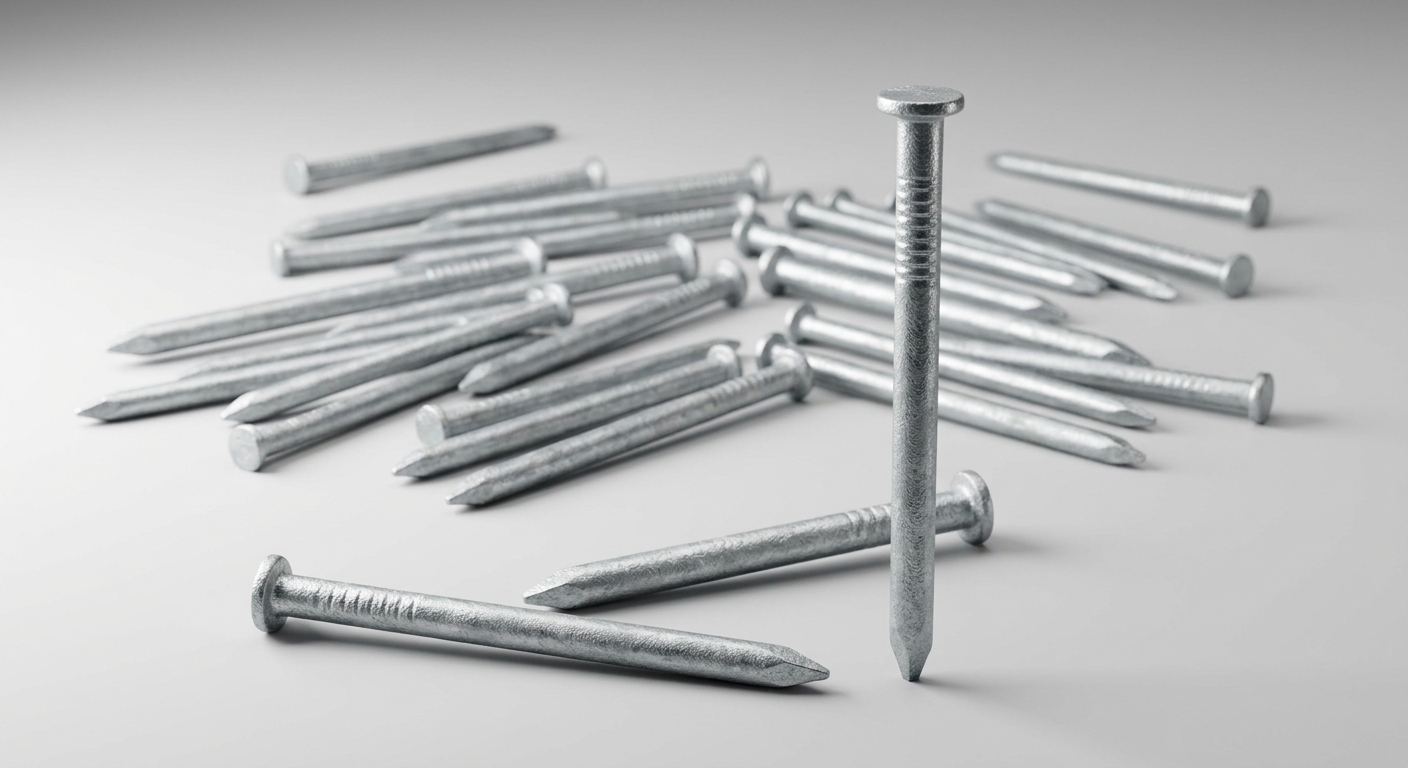
For procurement managers and construction engineers working in moisture-exposed environments, selecting the right Ocynkowane gwoździe ze stali węglowej is essential to preventing premature corrosion, structural failures, and costly repairs.
This guide explains how to specify, install, and maintain galvanised carbon steel nails for wet and outdoor applications, covering coating types, ASTM A153 and BS EN ISO 1461 standards, timber compatibility, and installation practices.
Designed for decking, timber structures, and coastal projects, this guide helps buyers choose corrosion-resistant fasteners and optimize long-term performance.
1. Understanding Galvanised Carbon Steel Nails: Coating Types & Corrosion Resistance
1.1 Hot-Dip vs. Electro-Galvanised: Coating Differences in Wet Environments
The galvanisation process directly affects the corrosion resistance and service life of Ocynkowane gwoździe ze stali węglowej in moisture-exposed applications. The two main methods — hot-dip galvanising and electro-galvanising — provide significantly different levels of protection.
Hot-dip galvanising coats nails in molten zinc at approximately 450°C, creating a zinc-iron alloy layer with strong adhesion and enhanced durability. With typical coating thicknesses of 45–85 µm (330–610 g/m²), hot-dip galvanised nails are widely used for outdoor applications such as decking, fencing, and coastal construction.
Electro-galvanising applies a thinner zinc coating through an electrochemical process, typically 5–25 µm (35–180 g/m²). While it provides a smooth appearance, its lower corrosion resistance makes it suitable mainly for indoor or sheltered applications with limited moisture exposure.
For wet conditions, hot-dip galvanised nails are the preferred specification rather than an upgrade option, while electro-galvanised nails may experience visible rust much earlier under continuous moisture exposure.
1.2 Key Industry Standards: ASTM A153, BS EN ISO 1461 & Buyer Requirements
Commercial buyers should verify galvanised nail quality through recognized coating standards, including:
- ASTM A153: Defines zinc coating requirements for galvanised steel products in North American markets.
- BS EN ISO 1461: Specifies minimum coating thickness, adhesion, and quality requirements for hot-dip galvanised coatings.
Before bulk purchasing, buyers should request mill test certificates (MTCs), coating thickness reports, and third-party salt spray test results according to ISO 9227. These documents help confirm that Ocynkowane gwoździe ze stali węglowej meet the required corrosion protection level for the intended environment.
| Galvanising Type | Zinc Thickness (µm) | Coating Weight (g/m²) | Salt Spray Resistance (hrs) | ISO 9223 Corrosion Class | Typical Application |
|---|---|---|---|---|---|
| Electro-galvanised | 5–25 | 35–180 | 96–240 | C1–C2 | Interior framing, dry sheltered areas |
| Hot-dip galvanised (standard) | 45–65 | 330–470 | 500–1,000 | C3–C4 | Outdoor decking, fencing, roofing |
| Hot-dip galvanised (heavy) | 65–85 | 470–610 | 1,000–2,000 | C4–C5 | Marine-adjacent, ground contact, ACQ timber |
2. Selecting the Right Galvanised Nail for Moisture-Exposed Applications
2.1 How Long Do Galvanised Carbon Steel Nails Last in Wet Conditions?
The service life of galvanised carbon steel nails in wet conditions depends primarily on zinc coating thickness, environmental exposure, installation quality, and contact materials. Unlike stainless steel fasteners, galvanised nails rely on a sacrificial zinc layer that gradually corrodes to protect the underlying carbon steel.
Under typical outdoor conditions, hot-dip galvanised carbon steel nails can provide 15–30 years of service life when correctly specified and installed. However, the actual lifespan varies significantly depending on corrosion exposure class:
| Environment | Expected Service Life | Recommended Specification |
|---|---|---|
| Sheltered outdoor areas (ISO C2–C3) | 15–30 years | Standard hot-dip galvanised nails (45–65 µm coating) |
| Exterior exposed environments (ISO C3–C4) | 10–20 years | Hot-dip galvanised nails with enhanced coating thickness |
| Coastal or high-humidity environments (ISO C4–C5) | 5–15 years | Heavy hot-dip galvanised nails (65–85 µm) or stainless steel alternatives |
| Direct ground contact or marine exposure | Highly variable | Heavy galvanised coatings or Grade 316 stainless steel |
The main factor determining longevity is zinc coating performance. A thicker hot-dip galvanised coating provides a larger zinc reserve, extending corrosion protection before the carbon steel core is exposed. In contrast, electro-galvanised nails with thinner coatings may show visible corrosion within months when continuously exposed to moisture.
Material compatibility also affects service life. When used with pressure-treated timber, especially ACQ-treated lumber containing higher copper concentrations, standard galvanised coatings may deteriorate faster due to galvanic corrosion. In these applications, heavy hot-dip galvanised nails manufactured to ASTM A153 requirements are typically recommended.
Installation practices are equally important. Over-driven nails, damaged zinc coatings, mixed-metal connections, and incorrect nail selection can significantly reduce expected service life by creating early corrosion initiation points.
For procurement teams, the correct approach is not selecting the cheapest galvanised nail but matching coating grade, nail design, and material compatibility with the actual moisture exposure level of the project.
2.2 Specification Checklist: Shank Type, Diameter, Length & Zinc Grade for Wet Conditions
Selecting the correct Ocynkowane gwoździe ze stali węglowej specification for wet environments requires evaluating shank design, dimensions, and zinc coating level. These factors directly affect withdrawal resistance, corrosion protection, and long-term fastening performance.
Shank geometry is particularly important where timber expands and contracts through repeated moisture cycles:
- Smooth shank: Provides the lowest withdrawal resistance and is suitable mainly for applications with limited movement and lower lateral loads.
- Ring shank (annular): Delivers approximately 40–60% higher withdrawal resistance than smooth shank nails, making it suitable for decking, subflooring, and timber structures exposed to repeated wetting and drying.
- Screw/spiral shank: Provides the highest holding strength and is recommended for demanding structural applications where long-term load retention is required.
For diameter and length selection, Ocynkowane gwoździe ze stali węglowej should generally provide sufficient embedment into the receiving member. As a guideline, nail length should be at least 2.5 times the thickness of the top member, with a minimum embedment depth of 40 mm. Proper sizing helps prevent joint loosening caused by timber movement in wet conditions.
Zinc coating selection should match the corrosion exposure level:
- C3 environments (sheltered outdoor areas): Standard hot-dip galvanised coatings around 45 µm are typically suitable.
- C4–C5 environments (coastal areas, ground contact, and high-humidity industrial applications): Heavy hot-dip galvanised coatings with at least 65 µm thickness or enhanced ASTM A153 Class C protection are recommended.
2.3 Material Compatibility: Pressure-Treated Timber, Composite Decking & ACQ Lumber
Material compatibility is a critical consideration when specifying Ocynkowane gwoździe ze stali węglowej for treated timber applications. Modern preservatives such as Alkaline Copper Quaternary (ACQ) and Copper Azole (CA) provide effective wood protection but contain copper compounds that can accelerate zinc corrosion.
Standard electro-galvanised nails are generally unsuitable for ACQ-treated timber because copper ions can increase zinc dissolution and shorten fastener service life. For ACQ and CA lumber applications, hot-dip galvanised nails meeting ASTM A153 requirements are the minimum recommended specification, with heavy coatings preferred for ground-contact environments.
Some building specifications, including IRC Section R317, require corrosion-resistant fasteners such as hot-dip galvanised or stainless steel products for treated wood applications.
Composite decking requires additional consideration because thermal expansion differs from natural timber. Ring shank or screw shank Ocynkowane gwoździe ze stali węglowej with durable hot-dip coatings help maintain holding strength during repeated temperature and moisture changes.
3. Installation Best Practices in Wet & Outdoor Environments
3.1 Pre-Installation Preparation: Moisture, Tools & Conditions
Proper installation is essential to maximizing the service life of Galvanised Carbon Steel Nails in wet environments. Timber moisture content should be below 19% before permanent fastening, as excessive moisture can cause shrinkage, reduced holding strength, and water-trapping gaps.
Avoid installing galvanised nails in frozen timber, as impact damage may create micro-cracks in the zinc coating. Ideal installation conditions are 5°C–35°C with relative humidity below 85%.
When using pneumatic nail guns, adjust pressure carefully to avoid over-driving. Nails should sit flush or slightly proud of the timber surface to prevent coating damage and exposed steel. Hand installation may be preferred for inspection-critical applications.
3.2 Driving Techniques & Common Corrosion Risks
The zinc coating on Ocynkowane gwoździe ze stali węglowej acts as a sacrificial corrosion barrier. Any damage during installation can accelerate zinc consumption and shorten service life.
Recommended practices include:
- Drive nails perpendicular to the surface to minimize coating stress.
- Pre-drill hardwoods to prevent shank deformation and zinc coating cracks.
- Avoid mixing galvanised nails with stainless steel, aluminium, or copper components to prevent galvanic corrosion.
- Do not cut nails before installation, as exposed steel ends can corrode rapidly.
- Avoid reused nails, as bent shanks may indicate hidden coating damage.
4. Long-Term Performance & Maintenance in High-Moisture Settings
4.1 Inspection Cycles & Early Signs of Coating Failure
Regular inspection helps identify coating degradation before structural problems occur. The two main corrosion indicators are:
White rust: A white zinc oxide deposit indicating early zinc oxidation. It is not usually a structural concern but shows that the protective zinc layer is being consumed.
Red rust: Brown-red iron oxide staining indicating zinc depletion and exposed steel corrosion. Fastener replacement or structural assessment may be required.
Recommended inspection intervals:
- C3 environments: Annual visual inspection; detailed assessment every 3 years.
- C4–C5 environments: Bi-annual visual checks with annual detailed inspection.
4.2 Commercial ROI: Why Higher Zinc Coatings Reduce Lifecycle Costs
Upgrading from electro-galvanised to heavy hot-dip galvanised nails typically increases fastener costs by 15–30%, but significantly reduces long-term repair risks.
For commercial decking or timber projects, the cost of replacing failed fasteners — including labour, damaged materials, and warranty claims — can exceed the initial savings from lower-grade nails.
For C4 and C5 exposure environments, selecting the appropriate zinc coating for Ocynkowane gwoździe ze stali węglowej should be considered a risk management decision rather than a material cost decision.
FAQ
Q1: What zinc coating grade is required for nails used in direct ground contact or marine environments?
For direct ground contact or marine-adjacent applications (ISO 9223 Class C5), specify hot-dip galvanised nails with a minimum coating weight of 610 g/m² per ASTM A153 Class C, or consider upgrading to stainless steel (Grade 316) for fully submerged or tidal zone applications where zinc consumption rates exceed practical service life.
Q2: Can standard galvanised carbon steel nails be used with ACQ pressure-treated lumber, or is a higher zinc specification needed?
Standard electro-galvanised nails must not be used with ACQ lumber. The minimum acceptable specification is hot-dip galvanised per ASTM A153, with heavy-coating grades (610 g/m²) required for ground-contact ACQ applications. Many current building codes explicitly mandate this — verify local code requirements before specifying.
Q3: How can buyers verify the galvanisation quality of nails before bulk procurement?
Request batch-specific mill test certificates confirming zinc coating weight per ASTM A153 or BS EN ISO 1461. Additionally, require third-party salt spray test reports (ISO 9227) showing minimum hours to first red rust. For high-volume procurement, commission independent laboratory verification of coating thickness using magnetic gauge testing on a representative sample from each production lot.
Wnioski
Selecting the right Ocynkowane gwoździe ze stali węglowej for wet environments requires matching zinc coating, nail design, and material compatibility with the actual corrosion conditions. Compliance with standards such as ASTM A153 and BS EN ISO 1461, combined with proper installation and inspection practices, helps maximize service life and reduce maintenance risks.
For C4 and C5 exposure environments, heavy hot-dip galvanised nails are not simply an upgrade — they are a practical specification for long-term reliability. Contact our team for technical guidance on selecting the right Ocynkowane gwoździe ze stali węglowej for your project requirements.