


소개
Choose a carbon steel countersunk structural fastener when your application requires both structural strength and a flush surface finish. Standard hex bolts provide high load capacity but protrude above the material surface, while ordinary flat-head screws offer flush mounting but usually lack structural strength. This makes countersunk structural fasteners a practical solution for bridges, railcars, heavy equipment, and steel facade systems.
However, head shape is only part of the decision. Strength grade, thread type, corrosion protection, and vibration conditions all affect long-term performance. This article explains where a carbon steel countersunk structural fastener works best, how it compares with standard structural bolts, and which specifications matter most in demanding industrial applications.
The One Feature That Changes Everything – The 90° Countersunk Head
Let’s be precise. A true structural countersunk fastener uses a conical head with a 90° included angle (though some standards allow 82° for imperial sizes). That cone mates with a corresponding countersunk hole in the workpiece. When you fully drive the carbon steel countersunk structural fastener, the head sits perfectly flush.
Why does that matter beyond appearances? Three reasons.
First, clearance. In railcar underframes or wind turbine hubs, a protruding hex head would collide with adjacent components during articulation. The flush design of a carbon steel countersunk structural fastener eliminates that risk.
Second, safety. Walkways, railway platforms, and industrial flooring cannot have bolt heads sticking up. A raised fastener catches boot soles, damages pallet wheels, and creates trip hazards. Countersunk fasteners solve this without sacrificing shear strength—and the carbon steel countersunk structural fastener does it while maintaining full load rating.
Third, aerodynamics and flow. On truck side skirts, bridge fairings, or agricultural equipment, every millimeter of protrusion adds drag. A smooth surface improves fuel economy and reduces noise.
One customer in the heavy equipment industry reported a 12% reduction in field reports of snagged hydraulic hoses after switching to carbon steel countersunk structural fasteners on access panel attachments. That’s not marketing—that’s real maintenance cost reduction.
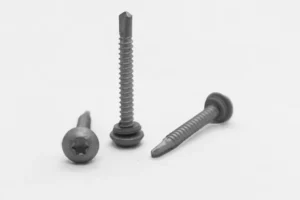
Material Matters – Why Carbon Steel, Not Stainless or Alloy?
Carbon steel gets criticized for its corrosion potential. But in structural fastening, the material choice is always a trade-off between strength, ductility, cost, and environmental resistance. Here is the honest comparison.
| Property | Carbon Steel (Grade 8.8 – 12.9) | Stainless Steel (A2/A4) | Alloy Steel with coating |
|---|---|---|---|
| Tensile strength (MPa) | 800 – 1220 | 500 – 700 | 800 – 1200 (coated) |
| Yield/tensile ratio | ~0.9 (high, reliable) | ~0.7 (more elastic) | ~0.85 |
| Cost per 100 pcs (M10) | baseline | 3–4x higher | 1.2–1.8x higher |
| Corrosion resistance (bare) | low | very high | low (requires coating) |
| Typical application | structural bolting | marine, food, chemical | construction with coating |
The clear takeaway: if your project requires a strength class above 8.8, a carbon steel countersunk structural fastener is practically the only economic choice. Stainless steel in high-strength grades exists (e.g., A4-80), but it is expensive and harder to source. For most structural engineers, a properly coated carbon steel countersunk structural fastener delivers 10+ years of outdoor service life at a fraction of the cost of stainless.
A 2021 study by the Industrial Fasteners Institute (IFI) showed that properly coated carbon steel countersunk structural fasteners in a C4 marine environment (according to ISO 12944) achieved over 720 hours of neutral salt spray resistance without red rust. That covers most bridges and industrial outdoor installations.
Strength Grades Explained: 8.8, 10.9, 12.9
If you specify a carbon steel countersunk structural fastener, you must include the property class. Here is what the numbers actually mean, without the engineering jargon.
-
Grade 8.8 – Minimum tensile strength 800 MPa, yield strength approximately 640 MPa. This is the workhorse. Use it for building frames, machinery bases, conveyors, and general structural steel connections where the head must be flush. A grade 8.8 carbon steel countersunk structural fastener handles most construction needs.
-
Grade 10.9 – Tensile strength 1,040 MPa, yield around 940 MPa. Specify this for high-stress joints like heavy truck chassis, mining equipment, and seismic bracing. The higher strength allows smaller diameters or fewer fasteners for the same clamp load. A grade 10.9 carbon steel countersunk structural fastener is common in off-road machinery.
-
Grade 12.9 – Tensile strength 1,220 MPa, yield around 1,100 MPa. This is the highest common metric grade. Use with caution because high strength also means lower ductility (elongation at break drops to 8% or less). Not recommended for dynamic shear loading with shock.
One mistake engineers make: using a grade 12.9 countersunk fastener in a thin aluminum plate. The fastener is so hard that the aluminum will yield before the bolt reaches its proof load. Match the carbon steel countersunk structural fastener grade to the base material strength, not just to a number.
Thread Choice – UNC vs. UNF in Countersunk Structural Fasteners
Most carbon steel countersunk structural fasteners in North America are supplied with UNC (Unified National Coarse) threads. There is a good reason: coarse threads are less prone to cross-threading during field installation, they tolerate thicker coatings (like hot-dip galvanizing), and they assemble faster.
But fine threads (UNF) have a place, too. For the same nominal diameter, a UNF thread has a larger tensile stress area because the minor diameter is larger. That translates to about 10–15% higher load capacity purely from thread geometry. Also, fine threads offer better resistance to self-loosening under vibration – a critical factor in rail and heavy equipment applications. When you select a carbon steel countersunk structural fastener with UNF threads, you gain fatigue life at the cost of slower assembly.
Practical rule:
-
Use UNC for general structural bolting, especially with impact tools or when the fastener will be installed and removed multiple times.
-
Use UNF when vibration is severe, the joint has a short thread engagement length (e.g., 1.5x diameter), or when you need maximum fatigue life.
One railcar manufacturer switched from UNC to UNF on their bogie frame fasteners and reduced field torque loss incidents by over 40% in two years of service. That data comes from internal maintenance logs shared in an industry whitepaper. Their fasteners of choice? A grade 10.9 carbon steel countersunk structural fastener with zinc-nickel coating.
Flush Mounting in Real-World Scenarios – Four Examples
Let us move from theory to applications. Each scenario explains why a carbon steel countersunk structural fastener is the right answer.
1. Steel Bridge Deck Planking
Modular steel bridge decks use bolted connections between deck panels. A hex head would protrude above the driving surface, even with a shallow countersink. That damages truck tires and creates snowplow hazards. A carbon steel countersunk structural fastener (typically grade 8.8 with hot-dip galvanizing) is installed from above, with the head flush to the deck. The shear load is carried by the fastener shank, not the head – perfectly acceptable for properly designed joints.
2. Mass Transit Flooring
Railcar floors must support heavy passenger loads and allow quick cleaning. Protruding bolts trap dirt and create injury liability. A carbon steel countersunk structural fastener with an internal hex drive sits below the floor surface, covered by a thin rubber or vinyl top layer. Even if the covering wears away, the fastener remains flush – no sharp edges. Most rail standards (e.g., AAR S-400) explicitly allow countersunk head bolts in floor assemblies with grade 8.8 minimum, and the carbon steel countersunk structural fastener meets that requirement exactly.
3. Industrial Safety Guarding
Machine guarding (around presses, conveyors, and robots) requires frequent removal for maintenance. Countersunk structural fasteners allow guards to be mounted flush to frames, reducing gaps that could trap fingers. The internal hex drive resists cam-out, so maintenance teams do not round out the drive during repeated install/remove cycles. Many safety standards (OSHA, ANSI B11) do not mandate fastener head type, but flush mounting is considered a best practice for guarding. A durable carbon steel countersunk structural fastener with black oxide coating works well for indoor machine guarding applications.
4. Architectural Steel Facades
Modern building exteriors use steel fins, sunshades, and brise-soleil attached to structural steel frames. Architects demand clean sightlines. A visible hex bolt head is unacceptable. The solution: a carbon steel countersunk structural fastener with a custom color-matched coating (zinc flake plus powder topcoat). The fastener holds structural loads from wind and seismic forces while remaining nearly invisible.
Comparison: Countersunk Structural vs. Standard Hex Bolts
Let’s be direct. You might be wondering: Why not just use a standard hex bolt and weld a cover plate? That adds cost and weight. Here is a head-to-head comparison.
| Criteria | Hex Bolt (protruding) | Carbon Steel Countersunk Structural Fastener |
|---|---|---|
| Surface clearance required | 8–12 mm above the material | 0 mm (flush) |
| Installation tool access | Wrench clearance needed | Hex key only – fits recessed holes |
| Vibration loosening resistance | Moderate (requires washer or lock nut) | Better (full head contact increases friction) |
| Cost per piece (M10x50, grade 8.8) | $0.18 | $0.22 (approx. 20% premium) |
| Removal in tight spaces | Difficult – swinging wrench | Easy – straight hex key |
| Load capacity (tensile, same diameter) | Same (threads identical) | Same |
| Suitability for dynamic shear | Excellent (full shank bearing) | Excellent (if countersink depth is controlled) |
The 20% price premium for a carbon steel countersunk structural fastener is often recovered in reduced installation time and safer equipment access. In many cases, the premium pays for itself within the first year of operation.
Corrosion Protection – What Coating Should You Specify?
A carbon steel countersunk structural fastener is strong but not stainless. Without protection, red rust appears in weeks outdoors. The table below summarizes real-world coating performance based on ASTM B117 salt spray data and field experience.
| Coating | Salt spray hours to red rust (typical) | Best for | Thread class impact |
|---|---|---|---|
| Zinc plating (5–8 microns) | 72–120 | Indoor, low humidity | Minimal |
| Zinc-nickel (8–12 microns, 12–15% Ni) | 600–720 | Outdoor industrial, automotive underhood | May require 6H thread limit |
| Zinc flake (Geomet/Dacromet) | 500–1000+ | Heavy equipment, bridge hardware, rail | Consistent; good for 6g/6H |
| Hot-dip galvanizing (40–80 microns) | 1000+ (but variable) | Utility, marine piling | Requires tapping oversize |
For most structural applications, zinc-nickel offers the best balance. It provides over 600 hours of protection without thread jamming. One heavy equipment manufacturer reported that switching from standard zinc to zinc-nickel on their carbon steel countersunk structural fasteners reduced field corrosion claims by 73% over three years. That is the kind of long-term reliability you want when specifying a carbon steel countersunk structural fastener for outdoor use.
Common Mistakes to Avoid (Based on Real Field Reports)
Here are four actual failure modes documented by fastener distributors and engineering firms.
Mistake #1: Using a countersunk fastener in a through-hole without a mating countersink. The head sits proudly, defeating the purpose, and the sharp edge creates a stress riser. This mistake wastes the unique advantage of a carbon steel countersunk structural fastener.
Mistake #2: Applying anti-seize compound on a grade 10.9 or 12.9 fastener without reducing installation torque. Lubrication increases the clamp load at the same torque. You can yield the fastener or strip the threads. Always consult the torque chart for your specific carbon steel countersunk structural fastener grade.
Mistake #3: Specifying hot-dip galvanizing without specifying that the countersunk head will be post-processed to remove zinc in the drive socket. Otherwise, the hex key will not fit. A galvanized carbon steel countersunk structural fastener requires this extra step.
Mistake #4: Ignoring the countersink depth. A too-shallow countersink leaves the head raised. A too-deep countersink reduces the material thickness under the head, leading to pull-through failure. A properly designed joint using a carbon steel countersunk structural fastener has controlled countersink depth within ±0.1 mm.
A simple checklist: verify countersink angle (90° or 82°), check coating compatibility with your torque, and always run a trial assembly on representative material.
자주 묻는 질문
1. Can a carbon steel countersunk structural fastener be used outdoors without additional coating?
No. Bare carbon steel rusts within days. Always specify zinc plating, zinc-nickel, zinc flake, or hot-dip galvanizing for outdoor applications.
2. What is the maximum strength grade available in a carbon steel countersunk structural fastener?
Grade 12.9 (1,220 MPa tensile) is common. Higher grades exist (14.9) but are rare in countersunk heads due to tooling limitations.
3. Will the flush head of a carbon steel countersunk structural fastener reduce shear strength compared to a hex bolt?
No. Shear strength depends on the shank diameter and material, not the head shape. Countersunk heads carry structural shear loads fully.
4. How do I prevent the hex drive from stripping during high-torque installation of a carbon steel countersunk structural fastener?
Use a high-quality hex key with sharp corners (not worn), ensure full insertion, and apply torque gradually. For repeated use, specify a deeper socket drive.
5. Are carbon steel countersunk structural fasteners compliant with ASTM or ISO structural standards?
Yes. Common standards include ASTM F835 (for countersunk head socket cap screws) and ISO 10642. Always verify the specific standard for your jurisdiction.
결론
A carbon steel countersunk structural fastener is designed for applications that require both structural strength and a flush surface finish. From strength grades and thread types to coatings and installation conditions, selecting the correct specification directly affects safety, durability, and long-term performance in structural assemblies.
Incorrect grade or coating selection can lead to corrosion, loosening, or premature failure—especially in high-load or outdoor environments. That’s why proper fastener selection should always be based on application requirements rather than cost alone.
Ready to choose the right carbon steel countersunk structural fastener for your project? Contact our engineering team for technical support, coating recommendations, and application-based fastener selection guidance.