


If you are fastening outdoor structures such as decking, siding, fencing, or roofing, choosing the right stainless steel nail grade is critical for long-term performance. In most exterior applications, 300 series stainless steel nails, especially 304 and 316 stainless steel nails, provide better corrosion resistance and durability than 400 series options. However, 400 series stainless steel nails still have advantages in specific situations where higher hardness, strength, or cost efficiency matters. Understanding the differences between these stainless steel fasteners helps contractors and buyers select the right solution for their project environment.
What Actually Makes a Stainless Steel Nail “Stainless”?
Before comparing 300 series and 400 series stainless steel nails, it is important to understand why stainless steel provides corrosion resistance and how alloy composition affects performance.
Stainless steel gets its corrosion resistance from chromium. When chromium content reaches approximately 12% or higher, it reacts with oxygen to form a thin, invisible, self-healing chromium oxide layer on the surface. This passive film helps prevent rust by protecting the underlying metal from moisture and oxidation. Without this protective layer, steel fasteners would gradually corrode when exposed to outdoor conditions.
The difference between 300 series stainless steel nails and 400 series stainless steel nails comes from their chemical composition. The amount of nickel and other alloying elements directly affects corrosion resistance, hardness, and suitability for different fastening applications.
The 300 Series: Austenitic Stainless Steel
The 300 series belongs to the austenitic stainless steel family. These alloys contain both chromium and nickel, with grade 304 typically containing around 18% chromium and 8% nickel, which is why it is commonly called “18-8 stainless steel.”
Nickel stabilizes the austenitic structure and improves corrosion resistance, toughness, formability, and weldability. For outdoor fastening projects such as decking, siding, and fencing, 304 stainless steel nails provide reliable long-term protection against moisture and weather exposure.
Grade 316 offers enhanced corrosion resistance by adding approximately 2–3% molybdenum. This improves resistance to chlorides and salt exposure, making 316 stainless steel nails the preferred choice for coastal, marine, and other high-corrosion environments.
In their annealed condition, 300 series stainless steel nails are generally non-magnetic, although cold working during manufacturing may introduce slight magnetic properties.
The 400 Series: Martensitic and Ferritic Stainless Steel
The 400 series includes martensitic and ferritic stainless steel grades. These alloys typically contain chromium (around 12–14% for grade 410) but little or no nickel, resulting in a different structure compared with the 300 series.
This composition allows 410 stainless steel nails to be heat-treated for higher hardness and strength. They are often selected for applications where driving performance, wear resistance, or mechanical strength is more important than maximum corrosion protection.
However, the lower nickel content also means reduced corrosion resistance compared with 304 and 316 stainless steel nails. In environments with continuous moisture, salt spray, or chemical exposure, 400 series fasteners may be more likely to develop staining or corrosion over time.
400 series stainless steel nails are magnetic and usually more cost-effective because they require less nickel, which is one of the more expensive alloying elements in stainless steel production.
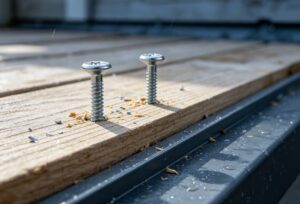
Corrosion Resistance: The Decisive Factor for Outdoor Use
Outdoor environments can be extremely challenging for fasteners. Moisture, temperature changes, UV exposure, salt spray, and chemical pollutants can gradually damage metal components. For exterior construction projects, corrosion resistance is not simply an added benefit—it is a key factor in determining the service life of a ステンレス釘.
How the Two Series Compare in Wet Conditions
For applications exposed to moisture or chemicals, 300 series stainless steel nails generally provide superior corrosion resistance compared with 400 series options.
The reason lies in their alloy composition. The combination of chromium and nickel in 300 series stainless steel helps create a more stable passive oxide layer, providing stronger protection against corrosion. Grade 304 contains approximately 18% chromium, while grade 410 contains around 12–14% chromium. The higher chromium content, combined with nickel, improves the durability of the protective surface layer.
Although 400 series stainless steel nails can resist corrosion under certain conditions, they are typically better suited for dry environments or applications with limited exposure. When continuously exposed to moisture, salt, or chemicals, 400 series fasteners are more likely to develop visible surface staining or red rust over time.
Salt spray testing provides a useful comparison of corrosion performance. According to accelerated corrosion tests based on standards such as ASTM B117 and ISO 9227, lower-alloy stainless grades may show staining earlier under salt fog exposure, while higher-alloy 300 series stainless steel fasteners can maintain corrosion resistance for significantly longer periods. However, these tests are designed for comparison purposes and do not directly represent every real-world installation condition.
In practical applications, properly selected 316 stainless steel nails are widely used in coastal and marine environments because their molybdenum content improves resistance to chloride-induced pitting.
What This Means for Your Project
For outdoor projects such as decking, siding, fencing, and roofing, 300 series stainless steel nails are usually the preferred choice because they provide reliable protection against rain, humidity, and long-term weather exposure. Choosing the correct stainless steel grade also helps prevent rust stains on wood, siding, and other finished surfaces.
For coastal areas or locations exposed to salt spray, 316 stainless steel nails are often recommended because their added molybdenum provides enhanced chloride resistance.
By comparison, 400 series stainless steel nails are more suitable for indoor applications, dry environments, or projects where hardness and cost efficiency are more important than maximum corrosion resistance.
Strength and Hardness: Where 400 Series Excels
Corrosion resistance is a major factor when selecting a ステンレス釘, but it is not the only performance requirement. In certain applications, mechanical strength, hardness, and driving performance may be more important.
Heat Treatment and Hardness
Because 400 series stainless steel nails contain little or no nickel, they can be heat-treated to achieve higher hardness levels than 300 series austenitic stainless steels.
For example, 410 stainless steel nails can provide greater hardness and wear resistance than typical 304 or 316 stainless steel fasteners. In applications where tensile strength, shear resistance, or improved driving performance is required—such as heavy-duty fastening or connections involving harder materials—410 stainless steel may be a suitable option.
Work Hardening in 300 Series
Unlike 400 series stainless steel, the 300 series cannot be hardened through heat treatment. However, it can gain additional strength through cold working, a manufacturing process that mechanically strengthens the material. Some 304 stainless steel fasteners are cold-worked during production to improve thread strength and overall durability.
Even with work hardening, 300 series stainless steel nails generally cannot achieve the same hardness level as heat-treated 400 series fasteners. This represents the primary trade-off between these two stainless steel grades: 300 series provides better corrosion resistance, while 400 series offers higher hardness.
When Hardness Matters Outdoors
For most outdoor fastening projects, including decking, fencing, siding, and roofing, the mechanical strength of 304 and 316 stainless steel nails is sufficient for normal installation requirements. In these applications, corrosion resistance is usually more important than maximum hardness.
However, when fastening into harder materials, penetrating thicker metal, or handling high-shear applications, 400 series stainless steel nails may provide better driving performance and holding strength. Some self-drilling fasteners use hardened 410 stainless steel components because of their improved hardness and wear resistance.
The best choice depends on the specific application environment. Selecting a harder fastener grade can be beneficial, but corrosion resistance should not be compromised unless the project conditions require additional mechanical strength.
Side-by-Side Comparison: 300 Series vs 400 Series Stainless Steel Nails
| 特徴 | 300 Series (304 / 316) | 400 Series (410 / 430) |
|---|---|---|
| 耐腐食性 | Excellent—superior in wet, salty, and chemically aggressive environments | Moderate—suitable for dry or low-moisture conditions |
| Nickel Content | ~8–10% (304); provides corrosion stability | Little or none |
| Chromium Content | ~18% (304); ~50% more than 410 | ~12–14% (410) |
| Magnetic | Non-magnetic (except when cold worked) | Magnetic |
| Heat Treatable | いいえ | Yes—can be hardened significantly |
| Hardness | Moderate; work-hardened during fabrication | High; can reach HRC 36–42 or higher |
| コスト | Higher (304 is roughly 50% more expensive than 410 in raw material) | Lower—more cost-effective |
| Best Use | Outdoor, coastal, marine, high-moisture, chemical exposure | Indoor, dry environments, light outdoor exposure, strength-critical applications |
Cost Considerations: Upfront Price vs Long-Term Value
Cost is an important consideration when choosing a ステンレス釘. In terms of upfront pricing, 400 series stainless steel nails are generally more cost-effective than 300 series options because of their different alloy compositions and lower nickel content.
Raw Material Cost Differences
The main price difference comes from material composition. 304 stainless steel nails typically contain around 8% nickel, while 410 stainless steel nails contain little or no nickel. Since nickel is a relatively expensive alloying element, 300 series stainless steel usually has a higher raw material cost compared with 400 series grades.
For projects where corrosion exposure is limited and budget control is a priority, 400 series stainless steel nails can be a practical choice. However, selecting fasteners based only on initial price may increase long-term costs if the application environment exceeds the corrosion resistance of the material.
Total Cost of Ownership
The lowest purchase price does not always deliver the lowest overall cost. A more important consideration is how the ステンレス釘 performs throughout the service life of the structure.
When 400 series stainless steel nails are used in environments with frequent moisture, salt exposure, or chemical contact, corrosion-related issues such as staining, maintenance requirements, and replacement costs may reduce their initial price advantage. The labor involved in replacing failed fasteners, along with possible damage to surrounding materials, can significantly increase total project expenses.
Although 300 series stainless steel nails usually require a higher upfront investment, their improved corrosion resistance can provide longer-lasting performance in demanding outdoor applications. Over the entire service life of a project, choosing the correct stainless steel grade can help reduce maintenance needs and improve overall cost efficiency.
For commercial and industrial projects, long-term reliability is often more important than the lowest initial cost. Replacing fasteners on large structures can increase labor expenses, interrupt operations, and introduce additional safety risks. Selecting the right 300 series stainless steel nail grade is therefore a practical approach to improving durability and reducing lifecycle costs.
Application Scenarios: Which Nail for Which Job?
Choosing the right ステンレス釘 depends largely on the installation environment, exposure conditions, and required service life. While 300 series stainless steel nails are preferred for most demanding outdoor applications, 400 series stainless steel nails can still be suitable when corrosion exposure is limited and higher hardness or cost efficiency is required.
When to Choose 300 Series Stainless Steel Nails
- Coastal construction – For projects near the ocean, especially areas exposed to salt spray, 316 stainless steel nails are typically recommended because their molybdenum content provides improved chloride resistance.
- Decking and exterior framing – Rain, snow, and humidity require the corrosion resistance of 304 or 316 stainless steel nails to maintain long-term fastening performance.
- Roofing and siding – Exterior fasteners are continuously exposed to weather conditions, and rust staining on finished surfaces can affect both appearance and maintenance costs.
- Pressure-treated lumber – Modern wood preservatives such as ACQ and CA can accelerate fastener corrosion. 300 series stainless steel nails provide better protection for these chemically treated materials.
- Marine environments – Docks, piers, and boat-related structures typically require 316 stainless steel nails due to their resistance to chloride exposure.
- Food processing or chemical exposure – 304 and 316 stainless steel grades are commonly selected because of their resistance to many chemicals and corrosive substances.
When 400 Series Stainless Steel Nails Might Work
- Indoor applications – Dry, controlled environments where moisture exposure is minimal and corrosion resistance is less critical.
- Temporary outdoor structures – For short-term installations with limited weather exposure, 400 series stainless steel nails may provide a cost-effective solution.
- Strength-critical, low-corrosion applications – When higher hardness and mechanical strength are more important than maximum corrosion resistance, 410 stainless steel nails can be a suitable choice.
- Budget-sensitive projects with limited exposure – Covered outdoor areas with minimal moisture may allow the use of 400 series fasteners when project conditions permit.
A Note on Grade 316 vs 304 Within the 300 Series
すべてではない 300 series stainless steel nails provide the same level of corrosion protection. Grade 304 is the most commonly used option, offering reliable corrosion resistance for general outdoor applications. Grade 316 includes molybdenum, which provides enhanced protection against chlorides and salt exposure.
For coastal and marine projects, the additional cost of 316 stainless steel nails is often justified by their improved corrosion resistance. For most inland outdoor applications, 304 stainless steel nails typically provide sufficient performance at a more economical price point.
Performance Data: What the Tests Show
| Test / Property | 300 Series (304) | 300 Series (316) | 400 Series (410) |
|---|---|---|---|
| Salt Spray (ASTM B117) – Hours to First Corrosion | ~48 hours unpassivated; up to 72+ hours passivated | 480+ hours with no visible corrosion | Staining at ~48 hours; severe pitting by 300 hours |
| Corrosion Resistance (Relative) | 素晴らしい | Outstanding—superior to 304 in salt environments | 中程度 |
| Hardness | Moderate (work-hardened) | 中程度 | High—heat treatable to HRC 36–42+ |
| Cost (Relative) | Higher | Highest | Lower—more cost-effective |
Note: Salt spray test results should be interpreted as comparative indicators rather than direct predictors of real-world service life. The ASTM B117 salt fog environment is more aggressive than most natural exposures and does not always correlate directly to long-term performance.
Why the 300 Series Is the Preferred Choice for Outdoor Use
For most outdoor fastening applications, 300 series stainless steel nails are the preferred choice because of their superior corrosion resistance and long-term durability. In environments exposed to moisture, salt, or chemicals, 304 and 316 stainless steel nails generally provide more reliable protection than 400 series stainless steel nails.
However, this does not mean that 400 series stainless steel nails have no value. Their higher hardness, mechanical strength, and lower cost make them suitable for specific applications where corrosion exposure is limited, and performance requirements are different.
The main consideration is the service environment. A fastener that develops corrosion may cause more than a visual issue—it can leave rust stains on expensive decking, damage finished surfaces, increase maintenance requirements, and create additional replacement costs over time.
For commercial and industrial projects, selecting the correct stainless steel nail grade is especially important. Large-scale repairs or fastener replacement can increase labor expenses, interrupt operations, and introduce unnecessary safety risks. Choosing 300 series for demanding outdoor applications helps ensure reliable performance throughout the expected service life of the structure.
Making the Right Choice for Your Project
Choosing between 300 and 400 series stainless steel nails depends on the application environment. For outdoor projects exposed to moisture, salt, or chemicals, 304 stainless steel nails are suitable for general use, while 316 stainless steel nails provide enhanced protection in coastal and high-chloride environments.
For dry or low-corrosion applications where hardness and cost are priorities, 400 series stainless steel nails can be a practical alternative. For most outdoor construction projects, choosing the right stainless steel grade helps improve durability and reduce long-term maintenance.
Ready to Source the Right Stainless Steel Nail for Your Project?
Selecting the correct ステンレス釘 grade ensures reliable performance and helps prevent premature corrosion. Whether you need 304 for outdoor applications or 316 for coastal projects, a professional stainless steel fastener supplier can provide the right solution for your requirements.