
Abstrak
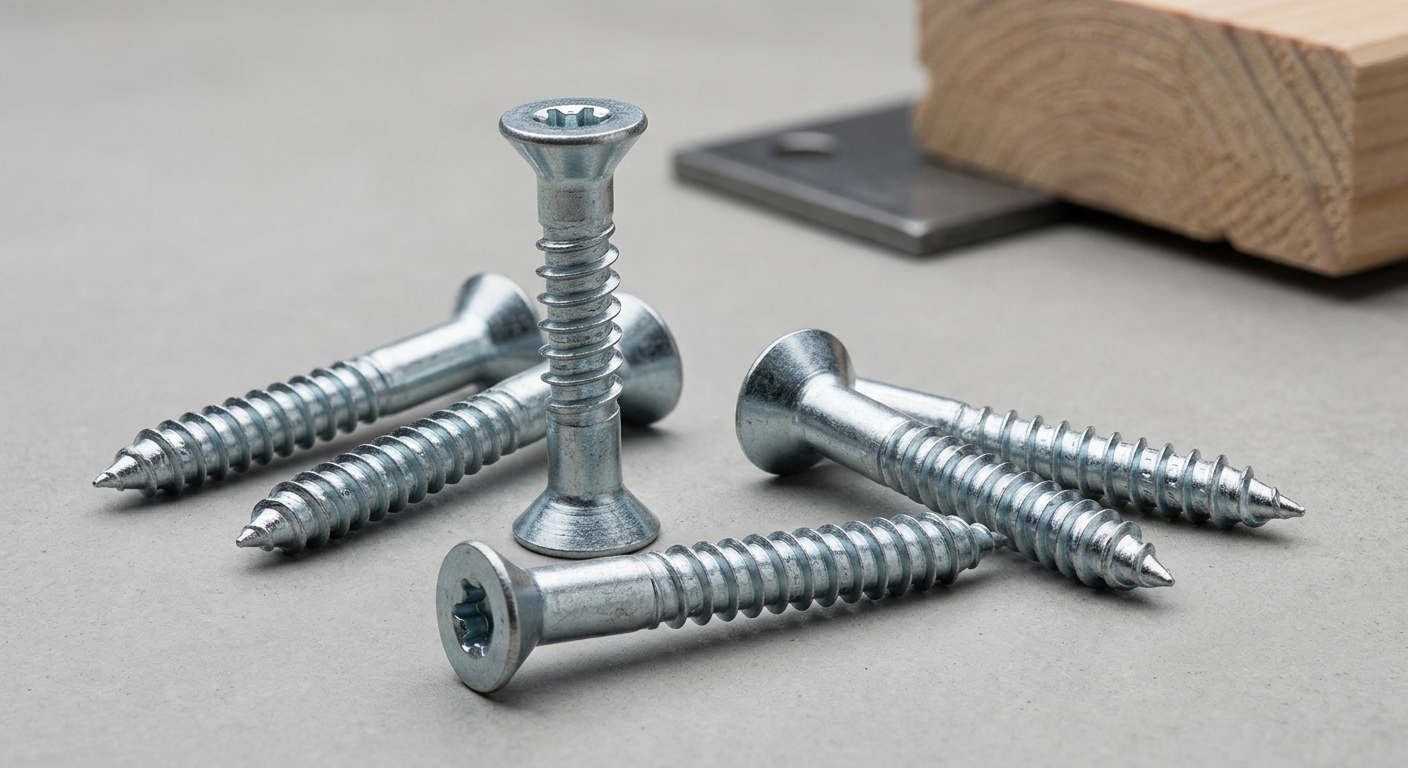
Carbon steel countersunk head structural screws occupy a specialized position in load-bearing fastener design: they must deliver high mechanical performance while maintaining a flush surface profile that eliminates protrusion in finished assemblies. For procurement engineers and structural designers, specifying these fasteners requires verified data across three critical strength parameters—shear strength, pull-out capacity, and yield load rating—rather than relying on generic tensile strength figures alone.
This article provides a technically grounded evaluation of those parameters across common carbon steel grades, explains how countersunk head geometry introduces unique structural considerations absent in hex-head or pan-head alternatives, and outlines the compliance frameworks governing structural fastener approval in engineered wood and steel connections. Coating selection and service environment compatibility are also addressed to support complete specification decisions. Whether you are designing a timber frame connection, a steel-to-steel lap joint, or a composite panel assembly, the data and analysis presented here will support defensible, code-compliant fastener selection.
1. Material Composition & Mechanical Properties of High-Tensile Carbon Steel Structural Screws
1.1 Carbon Steel Grade Selection and Tensile Strength Hierarchy
The mechanical performance of a carbon steel structural screw is fundamentally determined by its carbon content and alloying elements, which govern ultimate tensile strength (UTS), hardness, and ductility. In structural applications, the most commonly specified grades fall into two classification systems:
SAE/ASTM grades for imperial markets and ISO property classes for metric applications:
| SAE/ASTM Grade | ISO Property Class | Carbon Content (approx.) | UTS (MPa) | UTS (psi) |
|---|---|---|---|---|
| Grade 5 | 8.8 | 0.28–0.55% | 830 | 120,000 |
| Grade 8 | 10.9 | 0.28–0.55% (alloy) | 1,040 | 150,800 |
| Grade 8+ | 12.9 | 0.28–0.55% (alloy) | 1,220 | 176,900 |
Grade 8.8 carbon steel represents the baseline for most structural screw applications, offering a balanced combination of strength and toughness. Grade 10.9 is preferred in high-load steel-to-steel connections where joint slip must be minimized, while Grade 12.9 is reserved for precision-critical or dynamically loaded assemblies. Medium-carbon steels (0.35–0.55% C) with manganese additions provide the hardenability needed to achieve these strength levels through heat treatment.
1.2 Heat Treatment, Surface Hardness, and Its Effect on Load Capacity
Achieving the UTS values cited above requires a controlled quench-and-temper (Q&T) process. After thread rolling—which itself induces beneficial compressive residual stresses in the thread root—screws are austenitized, oil- or water-quenched to form martensite, then tempered to reduce brittleness while retaining core hardness.
For Grade 10.9 fasteners, Rockwell hardness typically falls in the 39–44 HRC range at the core; surface hardness may be marginally higher. This core hardness is directly relevant to structural performance under dynamic loading: a fastener with insufficient tempering will exhibit brittle fracture rather than plastic deformation under overload, eliminating any warning before joint failure.
For Grade 8.8, the tempered hardness range of 23–34 HRC provides adequate ductility for wood-to-steel connections where substrate compliance introduces load redistribution. Specifying hardness ranges—not just UTS—in procurement documents is therefore a critical quality control measure for structural applications.
2. Strength Performance: Shear, Pull-Out, and Yield Load Ratings Explained
2.1 Shear Strength and Pull-Out Capacity — Test Methods and Benchmark Values
Kekuatan geser governs fastener performance in lap joints and connections where loads act perpendicular to the screw axis. Single-shear testing per ASTM F1575 and ICC-ES AC233 applies a lateral load to a fastener installed through two overlapping members until failure. Double-shear configurations, common in three-member connections, effectively double the shear capacity.
As a practical reference, a 5/16-inch (M8) Grade 8.8 carbon steel countersunk screw delivers approximately 5.8–7.2 kN in single shear through Douglas Fir lumber. The same diameter in Grade 10.9 increases this to approximately 7.8–9.1 kN, reflecting the higher shear yield strength of the alloy.
Pull-out capacity is substrate-dependent and controlled by three variables:
- Substrate density: Higher-density wood species (e.g., Southern Yellow Pine vs. SPF) yield significantly greater thread withdrawal resistance.
- Embedment depth: Pull-out resistance scales linearly with threaded engagement length up to a threshold beyond which substrate failure governs.
- Pilot hole diameter: Oversized pilot holes reduce thread engagement and can reduce pull-out capacity by 15–30% in wood substrates.
For steel substrates, pull-out is typically governed by thread stripping rather than substrate failure, making material hardness compatibility between screw and base metal a critical selection parameter.
2.2 Yield Load Rating and Safety Factor Calculations for Structural Design
The proof load of a fastener (approximately 85–92% of yield strength) represents the maximum load the screw can sustain without permanent deformation. The yield load rating, as referenced in structural design, is the force at which the fastener begins to deform plastically—a more conservative and structurally meaningful threshold than UTS.
Per IBC and NDS (National Design Specification for Wood Construction), allowable design loads for structural screws incorporate safety factors typically ranging from 2.0 to 3.5 applied to the characteristic lateral or withdrawal value. This means a screw with a tested lateral yield value of 2.5 kN may carry an allowable design load of only 0.7–1.25 kN in a code-compliant assembly.
The countersunk head geometry introduces a specific consideration: the reduced bearing surface area of the tapered head distributes clamping force over a smaller contact zone than a flat or hex head of equivalent diameter. Under tensile loading, this concentrates stress at the countersink taper, effectively reducing the pull-through resistance compared to a pan-head fastener of the same shank diameter.
📊 Carbon Steel Countersunk Structural Screw — Strength Parameter Comparison by Grade
| Parameter | SAE Grade 5 / ISO 8.8 | SAE Grade 8 / ISO 10.9 | ISO 12.9 |
|---|---|---|---|
| Nominal Diameter | M8 / 5/16 in | M8 / 5/16 in | M8 / 5/16 in |
| Ultimate Tensile Strength | 830 MPa / 120,000 psi | 1,040 MPa / 150,800 psi | 1,220 MPa / 176,900 psi |
| Single Shear (wood) | ~5.8–6.5 kN | ~7.8–9.1 kN | ~9.5–11.0 kN |
| Pull-Out (SPF lumber, 50mm embed.) | ~3.2–4.0 kN | ~3.5–4.5 kN | ~3.8–4.8 kN |
| Yield Load Rating (design reference) | ~1.6–2.0 kN | ~2.2–2.8 kN | ~2.6–3.2 kN |
| Relevant Standard | ASTM F3125 / ISO 898-1 | ASTM F3125 / ISO 898-1 | ISO 898-1 |
Values are indicative references; project-specific testing and ICC-ES ESR listings should govern code-compliant design.
3. Countersunk Head Geometry — Structural Implications and Design Constraints
3.1 How the Flush-Head Profile Affects Bearing Stress and Joint Integrity
The countersunk head angle—standardly 82° for imperial and 90° for metric flat-head screws—determines how the head bears against the countersunk substrate. The tapered contact zone transfers both axial clamping force and lateral load through a smaller projected bearing area compared to flat-head designs.
Under tensile loading, the wedging action of the tapered head against the countersink introduces a radial stress component that can initiate substrate cracking in brittle materials (e.g., thin steel plate or dense hardwood). In engineered wood products such as LVL or cross-laminated timber (CLT), this radial stress must be evaluated against the perpendicular-to-grain tensile capacity of the substrate. Designers should verify that the countersink depth does not exceed the minimum edge distance requirements specified in applicable ESR listings.
3.2 Pilot Hole Tolerances and Installation Torque Requirements
Correct pilot hole diameter is arguably the single most critical installation variable for countersunk structural screws. A hole-to-shank diameter ratio below the recommended range causes excessive installation torque, risks drive recess stripping, and may induce splitting in wood substrates. An oversized hole reduces thread engagement and degrades both pull-out and lateral load performance.
For self-tapping carbon steel structural screws in wood, pilot hole diameters are typically 70–85% of the root diameter of the thread. In steel substrates, clearance hole tolerances follow ISO 273 or ASME B18.2.8 depending on the fit class required.
Installation torque must comply with the fastener manufacturer’s specification or the ICC-ES ESR listing value. Over-torquing a countersunk screw—particularly at Grade 10.9 or 12.9—risks torsional fracture at the drive recess, which is the weakest cross-section of the shank in a countersunk configuration.
4. Compliance Standards, Corrosion Protection, and Application Scenarios
4.1 Applicable Industry Standards and Code Compliance
Carbon steel countersunk structural screws used in engineered connections must comply with recognized standards to satisfy building code requirements:
- ASTM F3125 (Grades A325/A490): Governs high-strength structural bolts and screws for steel connections.
- ISO 898-1: Defines mechanical properties for carbon and alloy steel fasteners, property classes 4.6 through 12.9.
- ICC-ES ESR listings: Product-specific evaluation reports that provide code-compliant design values for use under IBC and IRC. ESR listings are mandatory for structural screws used in load-path connections in jurisdictions enforcing IBC.
- NDS Table 12N: Provides reference lateral design values for screws in wood-to-wood and wood-to-metal connections.
Procurement teams should request ESR documentation from suppliers when specifying structural screws for permitted construction projects, as unlisted fasteners cannot be used in engineered connections without project-specific testing.
4.2 Coating Options, Corrosion Resistance, and Service Environment Suitability
Carbon steel is inherently susceptible to corrosion; coating selection must align with service environment and substrate chemistry:
- Electroplated zinc (ASTM B633): Suitable for dry interior applications; minimum 5–8 µm thickness. Not recommended for ACQ-treated lumber or exterior exposure.
- Mechanical zinc (ASTM B695): Provides uniform coating on threaded fasteners without hydrogen embrittlement risk; suitable for moderate exterior exposure.
- Hot-dip galvanizing (ASTM A153): Minimum 43 µm coating; required for ACQ/CA-treated lumber per NDS and IRC. Coating thickness may affect thread fit and torque values.
- Geomet® / Dacromet coatings: Thin-film zinc-flake systems offering high corrosion resistance (500+ hours salt spray) with minimal dimensional impact; increasingly specified for high-humidity structural applications.
For connections involving ACQ-treated lumber, hot-dip galvanized or stainless-compatible coatings are mandatory due to the high copper and alkaline content of preservative treatments, which accelerates galvanic corrosion of bare or lightly plated carbon steel.
PERTANYAAN YANG SERING DIAJUKAN
Q1: What is the minimum shear strength requirement for carbon steel countersunk structural screws used in load-bearing wood-to-steel connections?
There is no single universal minimum; requirements are connection-specific and governed by the applicable ESR listing or engineer-of-record calculations. As a reference, ICC-ES AC233-listed structural screws for wood-to-steel applications typically demonstrate characteristic lateral values of 3.5–9.0 kN for diameters between M6 and M12. The design value after applying NDS safety factors will be substantially lower. Always reference the product-specific ESR report for code-compliant design values.
Q2: How does the countersunk head design affect pull-out capacity compared to hex-head or pan-head structural screws?
Countersunk heads exhibit lower pull-through resistance than pan or hex heads of equivalent shank diameter because the tapered bearing surface provides less projected area to resist axial tensile loads. In substrates where pull-out governs (e.g., thin steel plate, low-density wood), this difference can be 10–25%. When pull-out capacity is the critical design parameter, a hex-head or washer-head structural screw is generally preferable unless the flush-surface requirement is non-negotiable.
Q3: Which carbon steel grade and coating specification should I select for structural screws exposed to treated lumber or high-humidity environments?
Specify Grade 10.9 (SAE Grade 8) carbon steel with hot-dip galvanizing per ASTM A153 or a zinc-flake coating system rated for 500+ hours salt spray. For ACQ-treated lumber specifically, hot-dip galvanizing is the code-minimum requirement per NDS and IRC Section R317. Verify that the galvanizing thickness does not compromise thread engagement tolerances before finalizing the specification.
Kesimpulan
Carbon steel countersunk head structural screws are demonstrably strong enough for a wide range of load-bearing applications—provided that grade selection, head geometry implications, and coating specifications are matched to the actual service demands of the connection. Grade 8.8 satisfies most wood-to-steel and timber frame applications; Grade 10.9 and 12.9 are appropriate where higher shear demand or reduced joint slip is required.
The countersunk head profile delivers indispensable value in flush-surface assemblies but introduces measurable reductions in pull-through resistance and bearing area that must be accounted for in structural calculations. Pilot hole tolerances and installation torque compliance are non-negotiable installation controls that directly protect the design-rated capacity.
For procurement and engineering teams, the path to defensible fastener specification runs through three checkpoints: verified strength data from grade-compliant material, a valid ICC-ES ESR listing or equivalent third-party evaluation, and a coating system matched to the chemical and moisture demands of the service environment. Fasteners meeting all three criteria deliver both the structural performance and the regulatory compliance that modern construction demands.