
Résumé
For procurement managers and project engineers, selecting between 304 and 316 clous en acier inoxydable is a critical decision that directly impacts structural longevity and lifecycle cost. In corrosive environments — particularly coastal and marine settings — the wrong fastener grade can trigger premature structural failure, costly remediation, and code non-compliance.
Both grades belong to the austenitic stainless steel family and offer superior corrosion resistance compared to carbon steel or hot-dip galvanized alternatives. However, their performance diverges sharply once chloride exposure enters the equation. This article breaks down the metallurgical differences, quantifies corrosion resistance performance, outlines applicable compliance standards, and delivers application-specific recommendations. Whether you are specifying fasteners for an inland timber deck or a beachfront marina structure, this guide equips B2B buyers to make defensible, data-backed grade selections.
1. Metallurgical Composition & Corrosion Resistance Mechanisms
1.1 Alloy Chemistry: What Sets 304 and 316 Apart
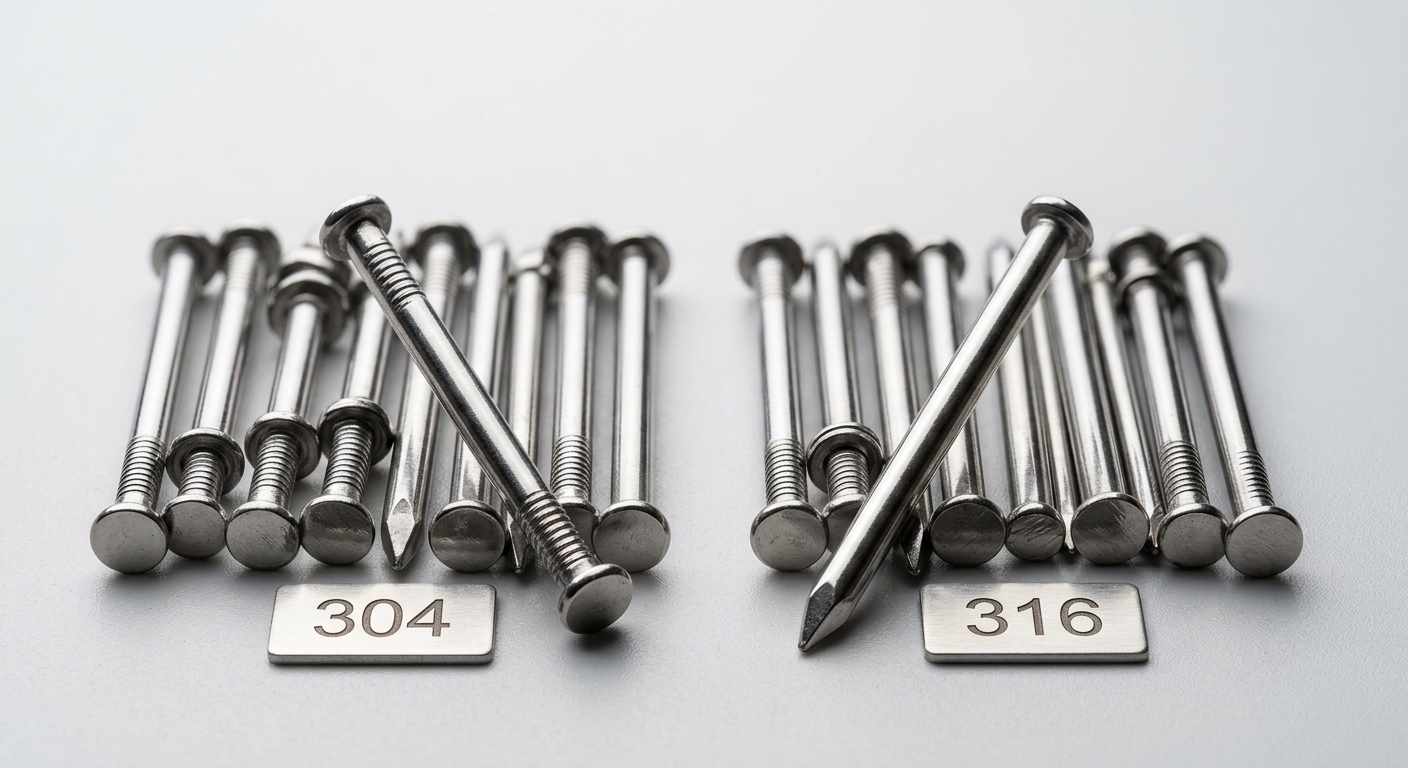
Both 304 and 316 are austenitic stainless steels, but their alloy chemistry diverges at one critical point: molybdenum (Mo) content. Grade 304 contains approximately 18% chromium and 8% nickel — a composition that delivers a stable passive oxide layer sufficient for most atmospheric and freshwater exposures. Grade 316 retains a similar chromium-nickel base but adds 2–3% molybdenum.
Molybdenum is the decisive differentiator. It reinforces the passive film at the atomic level, significantly increasing resistance to chloride-induced breakdown — the primary corrosion mechanism in marine and coastal environments. Chloride ions (Cl⁻) are aggressive film disruptors; without molybdenum, they penetrate the passive layer and initiate localized pitting. In 316, molybdenum stabilizes the passive film under chloride attack, raising the threshold at which pitting initiates by a measurable electrochemical margin.
This is not a marginal improvement. In high-chloride environments such as saltwater splash zones, brackish water exposure, or areas where deicing salts are routinely applied, 304 nails can exhibit visible pitting within 12–24 months. Under identical conditions, 316 nails maintain structural and aesthetic integrity for decades.
1.2 Corrosion Performance in Real-World Environments
The Pitting Resistance Equivalent (PRE) is the industry-standard metric for quantifying a stainless steel alloy’s resistance to chloride pitting. The formula — PRE = %Cr + 3.3×%Mo + 16×%N — translates alloy chemistry into a single comparative number. A higher PRE indicates greater resistance to pitting initiation.
| Paramètres | Acier inoxydable 304 | Acier inoxydable 316 |
|---|---|---|
| Chromium (Cr) | 18.0–20.0% | 16.0–18.0% |
| Nickel (Ni) | 8.0–10.5% | 10.0–14.0% |
| Molybdenum (Mo) | 0% | 2.0–3.0% |
| PRE Value (approx.) | ~18–20 | ~24–26 |
| Salt Spray Test (ASTM B117) | ~500–1,000 hrs | ~2,000+ hrs |
| Suitable Environment | Inland / Low-chloride | Marine / High-chloride |
| Reference Standard | ASTM A276 / ISO 3506 | ASTM A276 / ISO 3506 |
The PRE gap of approximately 6–8 points between grades translates to a roughly 2–4× improvement in pitting initiation resistance under equivalent chloride loads. For procurement teams evaluating fastener specifications, the PRE value provides an objective, chemistry-based basis for grade justification in project documentation.
2. Technical Specifications & Manufacturing Standards
2.1 Dimensional Specs, Head Types & Drive Styles
Stainless steel nails in both 304 and 316 grades are manufactured across a broad dimensional range to suit structural, finish, and specialty applications. Common wire gauges span from 11-gauge (approximately 3.05 mm diameter) for framing and sheathing applications to 16-gauge (1.6 mm) for finish and trim work. Lengths typically range from 25 mm (1 in.) to 150 mm (6 in.), with structural applications generally requiring a minimum 50 mm penetration into the receiving member.
Head type selection affects both holding capacity and application method:
- Smooth shank nails: Suitable for temporary or low-load connections; easiest to drive.
- Ring-shank (annular) nails: Provide 40–50% greater withdrawal resistance versus smooth shank — the preferred specification for decking, siding, and wind-uplift-rated assemblies.
- Screw-shank (helical) nails: Offer the highest withdrawal resistance and are commonly specified for hardwood substrates and high-vibration environments such as docks and boardwalks.
For collated nail gun applications, both 304 and 316 nails are available in paper-tape and wire-weld collation formats compatible with major pneumatic and gas-actuated nailers.
2.2 Compliance Standards & Certifications Buyers Must Verify
Specifying the correct grade is necessary but insufficient — buyers must also verify that supplied fasteners meet applicable manufacturing and compliance standards:
- ASTM F1667: The primary U.S. standard for driven fasteners, covering dimensional tolerances, mechanical properties, and material requirements for stainless steel nails.
- ISO 3506: The international standard governing mechanical properties of corrosion-resistant stainless steel fasteners, including tensile strength and hardness classifications.
- ICC-ES Evaluation Reports: Required for code-listed fastener assemblies in the U.S. ICC-ES reports confirm compliance with IBC and IRC requirements and are essential for permit-approved construction.
- Florida Building Code (FBC) & similar coastal codes: Several U.S. coastal states mandate stainless steel fasteners (minimum 316 in high-velocity hurricane zones) for exterior and structural applications within defined distances from saltwater. Buyers in these jurisdictions must confirm that fastener specifications match the applicable High-Velocity Hurricane Zone (HVHZ) requirements.
3. Application-Specific Selection Guide
3.1 304 Stainless Steel Nails: Optimal Use Cases
Grade 304 stainless steel nails deliver reliable corrosion resistance for the majority of general construction and outdoor applications where chloride exposure is low to moderate. Cost-effective and widely available, they represent the practical default for:
- Inland exterior decking and fencing: Where atmospheric moisture and occasional rain are the primary corrosion drivers, 304 provides decades of service life with no staining or structural degradation.
- Cedar, redwood, and ACQ pressure-treated lumber (non-coastal): The passive oxide layer of 304 resists the mild acidity and preservative chemistry of treated lumber in non-marine environments.
- Landscaping structures: Pergolas, garden beds, retaining wall tie-backs, and outdoor furniture framing in continental climates.
- Interior applications with occasional moisture: Bathroom framing, subfloor fastening in humid climates, and HVAC-adjacent structural work.
The price advantage of 304 over 316 — typically 20–30% lower unit cost — makes it the economically rational choice wherever chloride exposure is not a design constraint. Over-specifying 316 in low-risk environments adds cost without proportional performance benefit.
3.2 316 Stainless Steel Nails for Marine & Coastal Applications
Grade 316 is non-negotiable in environments where chloride ion concentration is elevated or where fastener replacement would require structural disassembly. The mandatory use cases include:
- Marine structures: Boat docks, floating pontoons, seawall capping, and pier decking in direct saltwater splash or immersion zones. Here, 304 will exhibit pitting within 1–3 years; 316 is engineered for multi-decade service.
- Coastal construction within 1–3 miles of saltwater: Airborne chloride deposition elevates corrosion risk even without direct water contact. Most coastal building codes and best-practice guidelines require 316 within this distance threshold.
- Swimming pool structures: Chlorinated water chemistry mimics marine chloride exposure. Fasteners in pool decking, enclosure framing, and equipment rooms should be specified as 316.
- De-icing salt exposure zones: Northern climates where road salt spray reaches structural members — bridge decking, parking structure framing, and highway signage supports — present chloride loads comparable to coastal environments.
The matching principle is straightforward: when the PRE of the environment exceeds the PRE of the fastener, corrosion is a predictable outcome, not a risk. Specify 316 wherever that threshold is in question.
4. Total Cost of Ownership & Procurement Considerations
4.1 Price Premium vs. Lifecycle Cost Analysis
Grade 316 stainless steel nails carry a procurement premium of approximately 20–40% over equivalent 304 products, driven by the higher cost of molybdenum alloying and tighter mill processing tolerances. For a large coastal construction project consuming 500,000 nails, this premium may represent a meaningful line-item increase.
However, lifecycle cost analysis consistently favors 316 in high-chloride environments. Consider the cost components of fastener failure: structural repair or replacement labor, material costs, project downtime, potential liability from code non-compliance, and reputational damage for the contractor. A single deck replacement on a coastal property — driven by corroded 304 fasteners — can cost $15,000–$50,000 or more, dwarfing the original fastener cost differential many times over.
The economic case for 316 is strongest where:
- Access for replacement is difficult (buried connections, submerged members, composite cladding systems).
- Project design life exceeds 25 years.
- Warranty or performance guarantees are contractually required.
For inland projects with standard 10–15 year maintenance cycles, 304 remains the cost-optimized choice.
4.2 Supplier Qualification & Material Traceability
Grade substitution — supplying 304 or even lower-cost ferritic stainless steel in place of specified 316 — is a documented problem in the fastener supply chain. The visual and dimensional similarity between grades makes detection difficult without documentation or testing.
Procurement teams should enforce the following verification protocols:
- Mill Test Report (MTR) requirement: Demand a certified MTR for every production lot, confirming chemical composition against ASTM A276 or equivalent. The MTR must show molybdenum content of 2.0–3.0% to confirm 316 grade.
- Heat number traceability: Ensure packaging and documentation carry the heat/lot number linking physical product to the MTR. Untraceable fasteners should be rejected regardless of label claims.
- Third-party XRF verification: For high-value or critical-path projects, portable X-ray fluorescence (XRF) analyzers can verify alloy chemistry on-site within seconds. This is standard practice in aerospace and marine procurement and increasingly adopted in coastal construction.
- Approved supplier lists: Qualify suppliers against ISO 9001 certification, documented quality management systems, and references from comparable marine or coastal projects.
FAQ
Q1: Can I use 304 stainless steel nails within 1 mile of the ocean, or is 316 mandatory?
The answer depends on jurisdiction and specific exposure conditions. Many coastal building codes — including Florida’s HVHZ provisions — mandate 316 for exterior fasteners within defined coastal zones, sometimes extending to 3 miles from saltwater. Even where codes permit 304, engineering best practice recommends 316 within 1 mile of the ocean due to elevated airborne chloride deposition. Always confirm the applicable local code requirement before specifying.
Q2: How do I verify that nails labeled “316 grade” are not actually 304 or a lower-cost substitute?
Request a certified Mill Test Report (MTR) showing chemical composition, specifically confirming 2.0–3.0% molybdenum content. For field verification, portable XRF analysis provides rapid, non-destructive alloy confirmation. Reject any lot that cannot be linked to a traceable MTR with a heat number matching the physical packaging.
Q3: What is the minimum stainless steel nail specification required by building codes for pressure-treated lumber in coastal zones?
Requirements vary by code jurisdiction, but the International Residential Code (IRC) and most coastal state codes require hot-dip galvanized or stainless steel fasteners with ACQ and CA pressure-treated lumber. In coastal high-hazard zones, 316 stainless steel is typically the minimum compliant specification. Verify against the specific edition of the applicable state or municipal building code and any ICC-ES reports governing the fastener assembly.
Conclusion
Choosing between 304 and 316 stainless steel nails is not a matter of preference — it is an engineering and compliance decision driven by chloride exposure level, substrate chemistry, and required project lifespan. The 6–8 point PRE advantage of 316, delivered by its molybdenum content, translates directly into measurable service life extension in marine and coastal environments where 304 will fail prematurely.
Procurement teams should anchor their specification process in three actions: evaluate PRE values against the project’s chloride exposure classification, require certified MTR documentation with heat-number traceability for every supplied lot, and confirm grade requirements against the applicable regional building code — particularly in coastal jurisdictions with HVHZ or equivalent designations.
The fastener is the smallest component in a structural assembly and often the first to fail. Specifying the correct stainless steel grade upfront eliminates the disproportionate downstream costs of corrosion-driven remediation and positions your project for full-lifecycle performance.