
Abstrakt
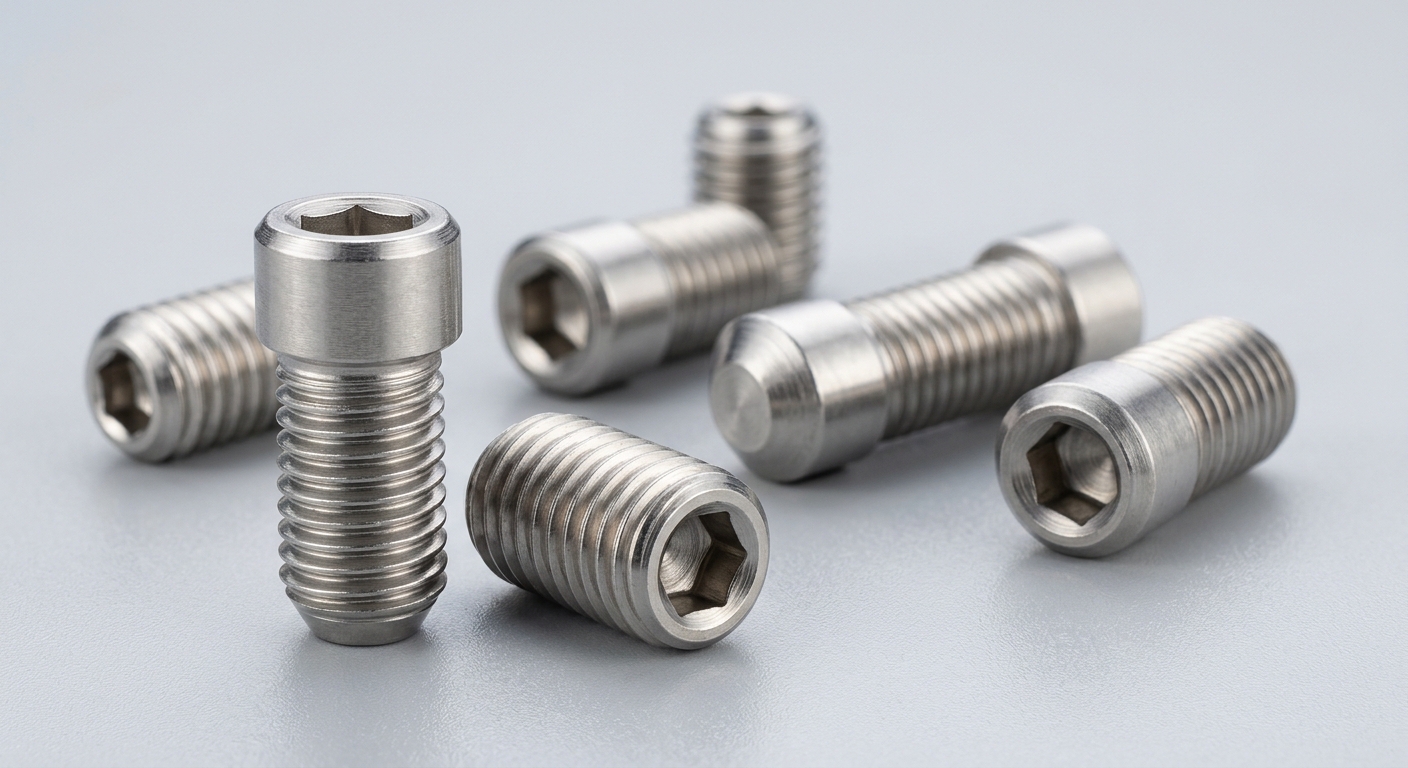
Outdoor fastening applications demand more from hardware than indoor environments ever will. Moisture, UV radiation, salt spray, and thermal cycling create conditions that rapidly degrade standard carbon steel or zinc-plated fasteners — often within a single season. The stainless steel set screw addresses these failure modes through a fundamentally different metallurgical approach: a self-regenerating chromium oxide passive layer that blocks electrochemical corrosion at the surface level.
For procurement engineers and project managers, the decision is not simply “stainless vs. non-stainless.” It is about selecting the correct grade — 304, 316, or 316L — matched to the specific environmental exposure class of the application. The wrong choice means premature failure; the right choice means a fastener that outlasts the assembly it secures. This article examines the corrosion science, grade performance differences, applicable standards, and total cost of ownership (TCO) rationale that should drive every outdoor set screw specification decision.
The Corrosion Problem — Why Outdoor Set Screws Fail
Common Failure Modes of Non-Stainless Set Screws in Outdoor Environments
Standard carbon steel and zinc-plated set screws follow a predictable degradation path when exposed to outdoor conditions. The process begins with oxidation: moisture penetrates the zinc coating through microscopic surface defects, initiating rust formation beneath the plating layer. Once the base metal is exposed, corrosion accelerates exponentially rather than linearly.
Three compounding failure mechanisms drive this progression:
- Galvanic corrosion: When a carbon steel set screw contacts a dissimilar metal — aluminum housings, brass fittings, or stainless shafts — an electrochemical cell forms. The less noble metal (typically the fastener) becomes the sacrificial anode and corrodes preferentially.
- Thread seizure: Rust accumulation within the thread engagement zone creates mechanical bonding between the screw and the mating component. In field conditions, this makes removal without damage practically impossible, turning a routine maintenance task into a costly extraction procedure.
- Cyclic stress cracking: Repeated expansion and contraction from temperature swings, combined with moisture infiltration, causes zinc coatings to micro-crack. Each cycle deepens the damage, and UV exposure further degrades organic protective coatings that might otherwise slow the process.
In coastal and industrial environments where chloride concentrations are elevated, the failure timeline compresses dramatically. Zinc-plated fasteners in salt-spray conditions can show visible corrosion within 96–200 hours — a fraction of the service life required by most outdoor assemblies.
How Stainless Steel’s Passive Layer Stops Rust at the Molecular Level
The corrosion resistance of a stainless steel set screw derives from a specific metallurgical property: when chromium content exceeds approximately 10.5% by mass, the alloy spontaneously forms a chromium oxide (Cr₂O₃) layer on its surface upon exposure to oxygen. This passive film is only 2–3 nanometers thick, yet it functions as a dense, non-porous barrier that prevents oxygen and moisture from reaching the underlying iron atoms.
The critical advantage over zinc plating or organic coatings is self-healing. If the passive layer is scratched, abraded, or damaged during installation, it reforms autonomously in the presence of atmospheric oxygen — typically within seconds to minutes. There is no coating to chip, peel, or wear through. This makes the stainless steel set screw inherently more reliable in dynamic outdoor environments where surface damage during installation or service is unavoidable.
By comparison, zinc-plated carbon steel offers sacrificial protection that is consumed over time and cannot regenerate. Once the zinc layer is depleted, base metal corrosion proceeds without restraint.
Grade Selection — Choosing the Right Stainless Steel Set Screw for Outdoor Use
304 vs. 316 Stainless Steel Set Screws — Performance Differences Outdoors
Both 304 and 316 stainless steel set screws carry the chromium oxide passive layer, but their performance diverges significantly in chloride-rich environments. The differentiating factor is molybdenum: 316 grade contains 2–3% molybdenum, which 304 does not. Molybdenum strengthens the passive film against chloride ion attack — the specific degradation mechanism behind pitting corrosion in marine and coastal settings.
In practical terms:
- 304 stainless steel set screws perform reliably in general outdoor environments — urban infrastructure, inland agricultural equipment, and covered outdoor structures. They offer an excellent cost-to-performance ratio for the majority of non-marine applications.
- 316 stainless steel set screws are the specification-grade choice for coastal installations within 1–5 km of saltwater, rooftop HVAC units exposed to industrial pollutants, and any application involving chlorinated water or chemical exposure.
- 316L (low carbon variant) provides the same chloride resistance as 316 with improved weldability and reduced risk of sensitization in heat-affected zones — relevant when set screws are used in welded assemblies.
Surface Finish and Drive Type Considerations for Outdoor Fastening
Beyond grade, two specification details significantly affect outdoor performance:
Passivation treatment: Electrochemical passivation (per ASTM A967) removes free iron from the fastener surface post-manufacturing, enhancing the density and uniformity of the chromium oxide layer. Procurement teams should confirm whether passivation is included in the supplier’s standard process or requires separate specification.
Point geometry: Cup point set screws provide the highest holding torque and are standard for shaft-locking applications. Flat point and cone point variants reduce surface damage to mating components — relevant when set screws are used against soft aluminum or coated shafts outdoors.
Drive type: Hex socket (Allen) drives are standard for set screws, but in field conditions, socket recesses can accumulate debris, moisture, and corrosion products. Specifying a broached hex socket with tight dimensional tolerances reduces this risk.
| Grade | Chromium % | Molybdenum % | Max Chloride Resistance | Typical Outdoor Application | Relativer Kostenindex |
|---|---|---|---|---|---|
| 18-8 (304) | 18% | 0% | Low–Moderate | Inland/urban structures, general hardware | 1.0× |
| 304 | 18–20% | 0% | Mäßig | Agricultural equipment, inland HVAC | 1.0× |
| 316 | 16–18% | 2–3% | Hoch | Coastal, marine, chemical environments | 1.3–1.5× |
| 316L | 16–18% | 2–3% | Hoch | Welded assemblies, high-humidity industrial | 1.4–1.6× |
Compliance, Standards & Specification Requirements
Key Industry Standards Governing Stainless Steel Set Screws
Specifying a stainless steel set screw by grade alone is insufficient for regulated procurement. The following standards define dimensional, mechanical, and material requirements:
- ASTM A276 / A276M: Covers stainless steel bar and shape stock used in fastener manufacturing, defining chemical composition tolerances for 304, 316, and 316L grades.
- ISO 4026–4029: International standards governing hexagon socket set screws with flat point, cone point, dog point, and cup point geometries — critical for cross-border procurement compatibility.
- DIN 916: German standard for hexagon socket set screws with cup point, widely referenced in European industrial procurement and OEM specifications.
- RoHS / REACH compliance: For export-oriented procurement, stainless steel set screws must be verified free of restricted substances (e.g., hexavalent chromium compounds used in some surface treatments). Suppliers serving EU markets should provide REACH SVHC declarations.
Certifications and Documentation Procurement Teams Should Require
Grade fraud — supplying 304 labeled as 316 — is a documented problem in the commodity fastener market. Procurement teams should require:
- Material Test Report (MTR): Provides heat/lot-specific chemical composition and mechanical property data from the mill. This is the primary document for verifying grade authenticity.
- Certificate of Conformance (CoC): Supplier declaration confirming compliance with specified standards and customer requirements. Should reference the applicable standard (e.g., ASTM A276, ISO 4026) and the specific lot number.
- Third-party XRF verification: For high-volume or high-criticality orders, portable X-ray fluorescence (XRF) testing provides rapid, non-destructive elemental analysis to confirm molybdenum content and distinguish 316 from 304 at goods receipt.
Application Scenarios & Commercial Value
High-Value Outdoor Use Cases Where Grade Matters Most
The stainless steel set screw appears in a wide range of outdoor assemblies where fastener failure carries disproportionate consequences:
- Marine hardware: Cleats, winches, and rigging components demand 316 grade as a minimum specification. Salt spray exposure is constant, and fastener replacement in marine environments is labor-intensive.
- Solar mounting systems: Rooftop and ground-mount solar arrays use set screws in rail clamps and module mounting hardware. A 25-year system lifespan requires fasteners that will not require replacement mid-service.
- HVAC rooftop units: Condensate, refrigerant exposure, and industrial air pollution create aggressive corrosion conditions. 316 set screws in motor shaft collars and fan assemblies reduce unplanned maintenance.
- Outdoor signage and architectural structures: Aesthetic and structural integrity requirements mean visible corrosion is unacceptable. 304 or 316 set screws maintain appearance and structural function throughout the installation’s service life.
- Agricultural equipment: Irrigation systems, field machinery, and storage structures operate in soil-contact and fertilizer-exposure conditions that rapidly degrade zinc-plated fasteners.
Total Cost of Ownership — Maintenance Savings vs. Upfront Price Premium
The 30–60% price premium of 316 over standard carbon steel set screws is frequently cited as a procurement objection. The TCO analysis consistently reverses this conclusion:
A carbon steel set screw requiring replacement every 18–24 months in a coastal installation carries labor costs that typically exceed the fastener cost by a factor of 10–50×, depending on access difficulty. A single technician-hour of maintenance labor in an industrial setting commonly costs $75–150. Multiply this across hundreds of fastener locations in a large installation, and the annual maintenance budget impact becomes the dominant cost driver — not the initial fastener price.
Specifying 316 stainless steel set screws in appropriate environments reduces replacement frequency from annual or biannual cycles to effectively zero over a 10–15 year service window. For procurement teams building a TCO justification, the ROI calculation is straightforward: higher unit cost, dramatically lower lifecycle cost.
FAQ
1. What is the best stainless steel grade for set screws used in coastal or high-humidity outdoor environments?
316 stainless steel is the standard specification for coastal environments within several kilometers of saltwater or in high-humidity industrial settings. Its molybdenum content provides resistance to chloride-induced pitting corrosion that 304 cannot match. For welded assemblies in these environments, 316L is preferred.
2. Can a stainless steel set screw cause galvanic corrosion when used with aluminum or carbon steel components outdoors?
Yes. Stainless steel is more noble than both aluminum and carbon steel on the galvanic series. When moisture bridges the contact point, the less noble material (aluminum or carbon steel) will corrode preferentially. Mitigation options include using isolation washers, applying anti-galling compound, or specifying aluminum-grade fasteners for aluminum assemblies where corrosion of the mating component is the primary concern.
3. How do I verify that a stainless steel set screw is genuinely 316 grade and not mislabeled 304?
Request a Material Test Report (MTR) referencing the specific heat number of the supplied lot and confirm molybdenum content falls within 2.0–3.0%. For incoming inspection, portable XRF analyzers provide non-destructive elemental verification at goods receipt. Avoid relying solely on supplier markings or Certificates of Conformance without MTR backup for critical applications.
Schlussfolgerung
The stainless steel set screw solves outdoor fastening failures through a combination of metallurgical design and correct grade specification. The chromium oxide passive layer provides self-healing corrosion resistance that no coating-based alternative can replicate over a full outdoor service life. Grade selection — primarily the choice between 304 and 316 — determines whether that protection is adequate for the specific chloride and humidity exposure class of the application.
For procurement teams, the specification process should extend beyond grade to include passivation confirmation, applicable dimensional standards (ISO 4026–4029, DIN 916), and documentation requirements (MTR, CoC) that verify grade authenticity. The upfront cost premium of correctly specified stainless steel set screws is consistently offset by reduced maintenance labor, eliminated replacement cycles, and avoided downtime risk — making the business case for proper specification one of the clearest ROI calculations in industrial procurement.