


Wprowadzenie
Ask any engineer about using countersunk bolts in heavy-duty structural applications, and you will often get a cautious pause. The concern is understandable: removing material for the countersunk head reduces the cross-section at the head-to-shank transition, potentially affecting strength.
Does this mean a podwójny zaczep konstrukcyjny should be avoided under high loads? The short answer is no—but only when it is properly specified and applied within the correct design limits.
Countersunk fasteners are widely used in bridge decks, truck chassis, railcar assemblies, curtain walls, and industrial machinery, where a flush surface is essential for safety, aerodynamics, or installation clearance. In these cases, the key question is not whether a countersunk structural fastener can carry a load, but under what conditions it performs reliably.
What Does “Reduced Loadability” Actually Mean for a Countersunk Structural Fastener?
The term “reduced loadability” appears in technical standards and can sound more serious than it really is. In simple terms, it refers to a reduction in tensile strength caused by the fastener’s head geometry.
The reason is straightforward. A standard hex or socket head bolt keeps a full metal cross-section at the head-to-shank transition. A countersunk structural fastener, however, uses a conical head shape and often requires internal drive features such as a hex socket. This removes material from the head, reducing the effective load-bearing area where the highest stress occurs.
Standards such as BS EN ISO 10642 recognize this effect and specify that hex socket countersunk head screws may have a minimum tensile capacity of about 80% of full-load fasteners. BS EN ISO 898-1 also classifies these as reduced loadability fasteners due to their geometry and testing requirements.
However, not all countersunk designs fall into this category. For example, EN 14399-7 structural assemblies are designed for preloaded joints and achieve full loadability. Instead of a socket, they use a different head configuration (such as a slot design) that avoids significant material removal. These systems are designed for high-strength structural use and follow Eurocode requirements for preload performance (0.7 × fub × As).
🔩 Key takeaway: Reduced loadability depends on design, not just shape. Hex socket countersunk fasteners are typically rated at about 80% tensile capacity, while preloaded structural systems under EN 14399-7 can achieve full loadability. Always select based on whether your application requires preload or not.
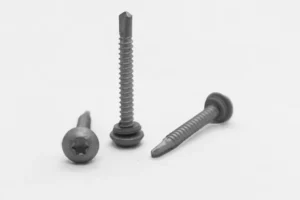
How Much Load Can a Countersunk Structural Fastener Actually Carry?
Let’s move from theory to real numbers. A countersunk structural fastener is not defined by a single load value. Its performance depends on diameter, property class, material strength, and the thickness of the connected components.
A practical example can be found in heavy-duty automotive applications. The WG9925521014 hexagon socket countersunk head screw used in SINOTRUK Howo trucks is made from SCM435 alloy steel and heat-treated to property class 10.9. It offers a minimum tensile strength of 1000 MPa and a proof load of 830 MPa (ISO 898-1), operating reliably in environments ranging from -50°C to +150°C. This type of countersunk structural fastener is used in transmission housings, differential carriers, engine covers, and chassis assemblies where high static and dynamic loads are expected.
For general structural design, BS 5950 provides reference load tables for non-preloaded countersunk bolts. As a baseline, Grade 4.6 fasteners in S355 steel can be used for comparison:
| Bolt diameter (mm) | Tensile stress area (mm²) | Tension capacity (kN) | Single shear capacity (kN) |
|---|---|---|---|
| 12 | 84.3 | 16.2 | 13.5 |
| 16 | 157 | 30.1 | 25.1 |
| 20 | 245 | 47.0 | 39.2 |
| 22 | 303 | 58.2 | 48.5 |
| 24 | 353 | 67.8 | 56.5 |
| 27 | 459 | 88.1 | 73.4 |
| 30 | 561 | 108 | 89.8 |
*Table derived from BS 5950-1:2000 countersunk bolt loading capacities*
These are not small numbers. A 20 mm diameter Grade 4.6 podwójny zaczep konstrukcyjny can carry 39.2 kN in single shear—that is roughly 4,000 kg of static load. Higher property classes (8.8, 10.9, 12.9) increase these figures proportionally.
But here is a crucial detail. The shear capacity given in such tables must be reduced for large packings, large grip lengths, or certain hole configurations like kidney-shaped slots or long joints. Always check the fine print of your design code.
For preloaded assemblies, EN 14399-7 covers thread sizes M12 to M36 with property classes 8.8/8, 8.8/10, and 10.9/10. These high-strength structural countersunk bolting assemblies are designed to achieve a preloading force of at least 0.7 × fub × As. An M20 property class 10.9 podwójny zaczep konstrukcyjny in this category develops a preload force in the range of 100–120 kN, depending on friction coefficients.
Does the Countersunk Head Reduce Bearing Capacity in the Joined Material?
Load capacity depends on both the fastener itself and the material being joined. Because a podwójny zaczep konstrukcyjny requires a tapered hole, the bearing resistance of the connected material differs slightly from that of a standard protruding-head bolt.
For countersunk bolts, bearing resistance is calculated using the effective plate thickness after countersinking. In most designs:
- Countersink depth ≈ ½ bolt diameter
- Effective thickness reduction ≈ ¼ bolt diameter
For example, a 20 mm bolt installed in a 12 mm plate reduces the effective bearing thickness by roughly 5 mm. This reduction should always be considered during structural design.
Research comparing countersunk and protruding-head bolts generally shows that countersunk joints have slightly lower bearing strength. Most studies report a reduction of approximately 10–12%, depending on the joint configuration and testing method.
Does this mean a podwójny zaczep konstrukcyjny is unsuitable for heavy loads? Not at all. Engineers typically compensate by:
- Increasing fastener diameter
- Adding more fasteners
- Selecting a higher property class
For composite materials, additional care is required. The countersunk geometry can create localized stress concentrations near the countersink entrance, increasing the risk of delamination. Proper laminate design and countersink geometry are therefore essential.
Which Applications Actually Use a Countersunk Structural Fastener for Heavy Loads?
It is easy to assume that heavy-load applications rely exclusively on protruding-head bolts. In reality, countersunk structural fasteners are widely used wherever both high strength and a flush surface are required.
Typical applications include:
- Heavy-duty trucks and commercial vehicles
- Bridge and infrastructure projects
- Aircraft and aerospace structures
- Structural steel assemblies
- Railway equipment and heavy machinery
Heavy trucking provides a practical example. The SINOTRUK Howo WG9925521014 hexagon socket countersunk head screw is manufactured from SCM435 alloy steel and heat-treated to property class 10.9. It is commonly used in transmission housings, differential carriers, engine covers, and chassis crossmembers, where components are subjected to constant vibration and shock loading.
Bridge construction also makes extensive use of countersunk fasteners. In precast steel-concrete composite bridges, LNSC systems enable efficient replacement of structural components while maintaining reliable load transfer. Likewise, HSFG bolts help prevent slip by transferring loads through friction rather than direct bearing.
Aircraft structures rely heavily on countersunk fasteners to maintain aerodynamic surfaces without sacrificing tensile or shear performance. Similar requirements can be found in rail transportation, structural steelwork, and industrial machinery.
The real-world evidence is clear: a properly specified podwójny zaczep konstrukcyjny is fully capable of handling demanding structural loads.
How Do You Select the Right Countersunk Structural Fastener for Your Heavy Load Application?
Selection involves several key questions. Here is a practical framework.
-
First, determine your load requirements.
Calculate the required tensile capacity, shear capacity, and whether slip resistance is needed. For preloaded applications requiring full loadability, specify a podwójny zaczep konstrukcyjny to EN 14399-7 (System HR). For non-preloaded applications where reduced loadability is acceptable, ISO 10642 or comparable standards apply, but remember the 0.8 reduction factor.
-
Second, select the proper property class.
Property classes for podwójny zaczep konstrukcyjny products range from 4.6 to 12.9. Higher is not always better—cost, ductility, and hydrogen embrittlement risk increase with strength. For most structural steel applications, 8.8 or 10.9 provides an optimal balance. A property class 10.9 podwójny zaczep konstrukcyjny achieves a minimum tensile strength of 1000 MPa and a proof load of 830 MPa.
-
Third, verify the head configuration.
Hexagon socket (hex key) heads are common but may have reduced loadability according to ISO 10642 (80% of full capacity). Screwdriver slot heads, per EN 14399-7, provide full loadability for preloaded assemblies. Hexalobular socket (star drive) countersunk head bolts with high head (full loadability) are available up to M10 for property classes 4.8, 8.8, and 10.9 per ISO 14582:2013. Hexalobular drive offers superior torque transfer compared to a hex socket in some applications.
-
Fourth, check the standards and markings.
Reduced loadability fasteners must be marked with a zero preceding the normal property class designation. A reduced loadability property class 8.8 fastener becomes 08.8. If you see this marking, the fastener has about 80% of the tensile capacity of its full-loadability equivalent.
-
Fifth, consider the joint materials.
The countersunk hole reduces effective bearing thickness. For thin materials or composites, this reduction can be significant. The depth of countersink is taken as half the bolt diameter, meaning the reduction in plate thickness is one-quarter of the bolt diameter. If the remaining thickness is insufficient for the required bearing load, you must increase the fastener diameter, upgrade the property class, or add more fasteners.
-
Sixth, verify preload requirements.
For preloaded assemblies according to EN 14399-7, the preloading force must reach at least 0.7 × fub × As. Achieving this requires proper torque control, and the bolting assembly must include washers according to EN 14399-5 or EN 14399-6.
-
Seventh, consider the environment.
Is corrosion resistance required? Zinc plating, zinc-nickel plating, galvanization, or stainless steel options exist. The WG9925521014 example uses zinc-nickel plating plus topcoat, achieving 720 hours of salt spray resistance. Operating temperature limits also matter—typical ranges from -50°C to +150°C for alloy steel fasteners.
How Do Countersunk and Protruding Head Structural Fasteners Compare for Heavy Loads?
The table below summarizes the key differences between a podwójny zaczep konstrukcyjny and a standard protruding head bolt for heavy load applications.
| Characteristic | Podkładka zatopiona do elementów konstrukcyjnych | Protruding Head Bolt |
|---|---|---|
| Head profile | Flush with surface | Projects above the surface |
| Head strength (non-preloaded hex socket) | Reduced to approx. 80% of full loadability | 100% loadability |
| Head strength (preloaded EN 14399-7) | Full loadability (100%) | Full loadability |
| Bearing capacity in the joint material | Reduced by 10–12% vs. protruding head | Baseline (100%) |
| Preload capability | Yes (EN 14399-7 assemblies to 0.7 fub × As) | Yes (standard assemblies) |
| Torque transfer mechanism | Internal hex or hexalobular (or slot) | External hex or internal |
| Aerodynamic/safety clearance | Excellent—no protrusion | Poor—protrusion creates a hazard |
| Assembly accessibility | Requires access from one side, typically | May require both sides |
| Koszt | Moderate—precision machining required | Lower for standard head types |
The trade-off is clear: a podwójny zaczep konstrukcyjny sacrifices 10–12% bearing capacity and potentially 20% tensile capacity (for non-preloaded hex socket versions) in exchange for a flush finish. In many applications, this trade-off is entirely acceptable—simply upsize one diameter class or increase fastener count to compensate.
For preloaded assemblies to EN 14399-7, there is effectively no strength penalty for choosing a countersunk design. The flush head comes with full loadability. The only remaining difference is the reduced bearing capacity in the joined plates, which typically amounts to 10–12% and is easily managed in design.
What Do the Standards Say About Using a Countersunk Structural Fastener Under Dynamic Loads?
Heavy loads are rarely static. Fasteners in real-world applications face vibration, fatigue cycling, impact, and repeated load changes. These dynamic conditions are more demanding than static loads, making proper joint design and installation essential.
1. Preload Matters Most
A properly preloaded countersunk structural fastener is highly resistant to self-loosening under cyclic loads. In practice, preload quality often has a greater effect on reliability than head geometry.
2. Installation Quality is Critical
- Forced assembly—pulling misaligned components together—can reduce fatigue life.
- Incorrect countersink depth, hole misalignment, or excessive installation stress may accelerate hole elongation.
- Accurate machining and smooth assembly are essential to achieve the expected performance.
3. Lessons from Aerospace
Aircraft rely on flush-head countersunk fasteners in fatigue-critical structures. Key factors influencing long-term performance include:
- Hole size and fit tolerance
- Installation force and torque control
- Surface finish and material compatibility
4. Friction and Slip Resistance
For preloaded friction-type joints, slip resistance depends on both fastener and surface characteristics. Properly designed countersunk bolts can provide reliable performance even under dynamic heavy loads.
Bottom line: A correctly specified and preloaded countersunk structural fastener performs reliably under vibration, shock, and fatigue. Fatigue failures are usually due to poor preload, inadequate hole preparation, or improper installation—not the countersunk design itself.
Making the Right Choice for Your Heavy Load Application
Let’s summarize the decision process in a clear checklist.
Choose a countersunk structural fastener (preloaded EN 14399-7 type) when:
-
You need a flush finish for safety, aerodynamics, or clearance
-
The joint requires high-strength preloading (≥ 0.7 fub × As)
-
You want full loadability with no strength penalty
-
The application is safety-critical (bridges, heavy trucks, railcars)
Choose a countersunk structural fastener (non-preloaded hex socket type) when:
-
You need a flush finish, but the preload requirements are moderate
-
You can accept the 20% tensile reduction factor (use a larger size or more fasteners to compensate)
-
The joint is primarily in shear rather than tension
Choose a protruding head bolt when:
-
You cannot accept any reduction in bearing capacity (though 10–12% is usually manageable)
-
The flush finish is not required
-
You are working with extremely thin materials, where countersinking would remove too much thickness.
✅ Final engineering takeaway: The data speaks for itself. A 20 mm property class 10.9 podwójny zaczep konstrukcyjny can achieve preload forces exceeding 100 kN. Heavy trucks, bridges, aircraft, railcars, and industrial machinery all rely on these fasteners every day. The flush finish is not a compromise—it is a design feature that, when properly specified and installed, delivers both clearance and load capacity.
Taking the Next Step: Specify With Confidence
A countersunk structural fastener can handle heavy loads when it is properly selected and installed. The key is to match the fastener to the application rather than focusing on head style alone.
Before making a final specification, remember to:
- Choose preloaded assemblies (EN 14399-7) when full loadability is required.
- Account for the 10–12% reduction in bearing capacity during joint design.
- Select the appropriate property class, typically 8.8 or 10.9, for structural applications.
- Verify compliance with relevant standards and preload requirements.
With the right design approach, a countersunk structural fastener can deliver both a flush finish and reliable structural performance. For critical applications, always review product specifications and confirm load calculations before final selection.
If you have any questions or requirements, please feel free to contact us.