
초록
Selecting the right fastener for structural applications is a decision with long-term engineering and financial consequences. For procurement managers, contractors, and project engineers, the choice between electro-galvanised and hot-dip 아연 도금 탄소강 못 is rarely straightforward. Both product types share the same base material, yet differ substantially in corrosion resistance, mechanical performance, applicable standards, and total lifecycle cost.
This article provides a systematic technical comparison of both galvanising processes, examines dimensional and compliance specifications relevant to heavy-duty structural use, maps each nail type to its optimal application environment, and delivers a procurement decision framework grounded in total cost of ownership. Whether you are sourcing fasteners for timber framing, roofing, or exposed outdoor structures, understanding these distinctions will help you avoid costly specification errors and qualify suppliers with confidence.
1: Understanding Galvanised Carbon Steel Nails: Coating Types & Core Differences
1.1: Electro-Galvanised vs Hot-Dip Galvanised — How the Process Defines Performance
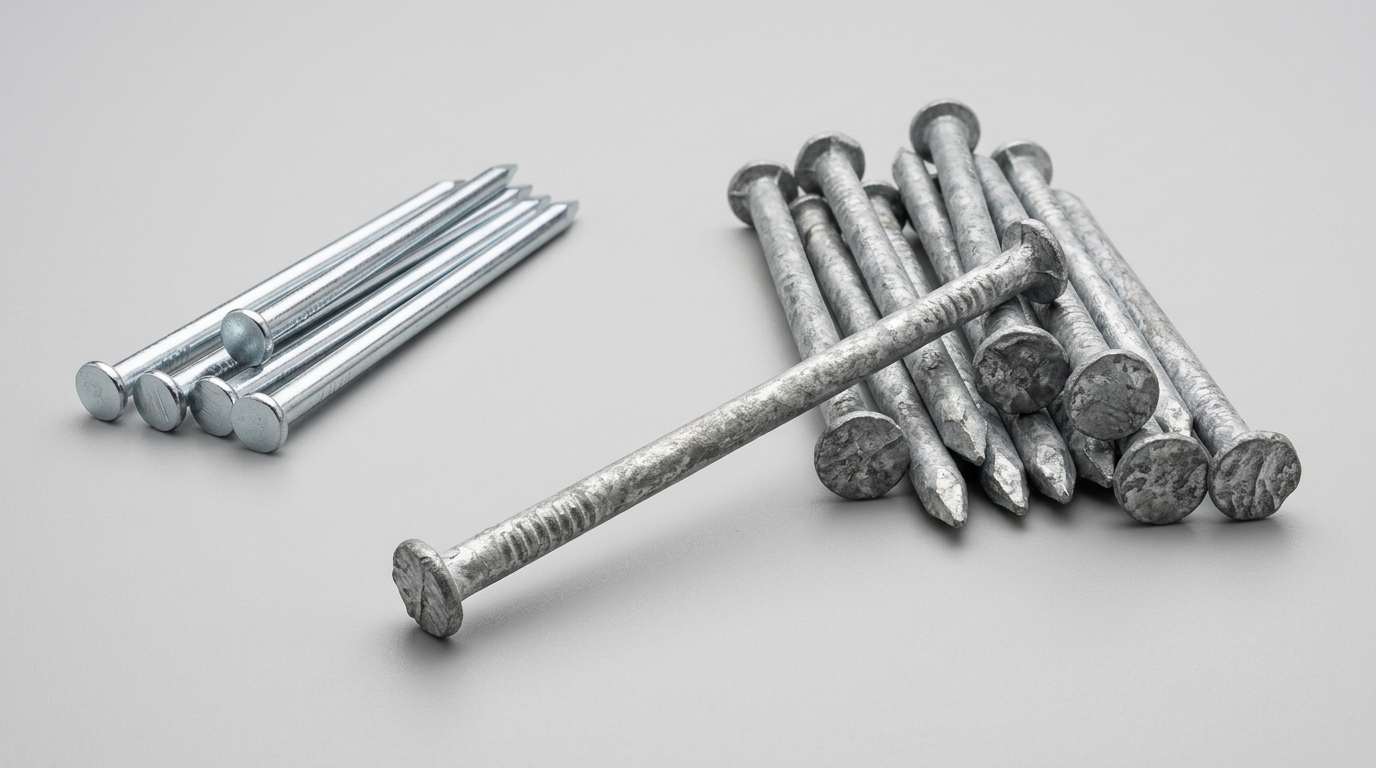
The galvanising method is the single most important variable determining a nail’s corrosion resistance and suitability for structural use.
Electro-galvanising applies zinc through electrochemical deposition. Steel nails are submerged in a zinc salt electrolyte bath, and a direct electrical current drives zinc ions onto the surface. The result is a thin, uniform coating typically ranging from 5 to 15 microns (µm). The finish is smooth and dimensionally consistent, making electro-galvanised nails well-suited for interior applications where aesthetics and tight tolerances matter. However, the relatively thin zinc layer offers limited protection in moisture-rich or chemically aggressive environments — salt spray resistance typically falls between 96 and 200 hours under ASTM B117 testing conditions.
Hot-dip galvanising immerses cleaned steel nails into a molten zinc bath at approximately 450°C. The zinc metallurgically bonds with the steel substrate, forming a multi-layer zinc-iron alloy structure beneath an outer pure-zinc layer. Coating thickness ranges from 45 to 85 µm or higher, delivering salt spray resistance exceeding 500 hours and in many cases surpassing 1,000 hours. This process produces a slightly rougher surface with superior adhesion and cathodic protection — critical attributes for outdoor, structural, and high-humidity applications.
1.2: Carbon Steel Substrate — Grade Selection and Mechanical Properties
The substrate beneath the zinc coating is equally critical. Galvanised carbon steel nails are manufactured from either low-carbon steel (Grade 1008–1022) or medium-carbon steel (Grade 1035–1045), each offering distinct mechanical profiles.
Low-carbon variants provide tensile strengths of approximately 350–500 MPa, offering good ductility and resistance to bending during pneumatic nailing. They are the standard choice for general framing and sheathing applications. Medium-carbon steel nails achieve tensile strengths of 600–900 MPa with higher hardness (Vickers hardness 180–250 HV), making them suitable for dense hardwoods, engineered lumber, and applications requiring superior shear resistance.
For heavy-duty structural projects, specifying medium-carbon substrate with hot-dip galvanising delivers the optimal balance of mechanical load capacity and environmental durability.
| 매개변수 | Electro-Galvanised Carbon Steel Nail | Hot-Dip Galvanised Carbon Steel Nail |
|---|---|---|
| Zinc Coating Thickness (µm) | 5–15 | 45–85+ |
| Salt Spray Resistance (hrs) | 96–200 | 500–1,000+ |
| Tensile Strength (MPa) | 350–900 (grade dependent) | 350–900 (grade dependent) |
| Applicable Environment Class | C1–C2 (indoor/dry) | C3–C5 (outdoor/corrosive) |
| Relative Unit Cost Index | 1.0배(기준) | 1.4–1.8× |
2: Technical Specifications & Compliance Standards for Structural Applications
2.1: Key Dimensional Standards and Load-Bearing Specifications
Galvanised carbon steel nails for structural use are manufactured across a broad dimensional range. Common shank diameters span 2.0 mm to 6.0 mm, with lengths from 40 mm to 150 mm. Head types include flat, clipped, and D-head profiles, each optimised for specific nailer systems or hand-drive applications.
Load-bearing performance is defined by two primary metrics: lateral (shear) load resistance and withdrawal (pull-out) resistance. For a 3.1 mm × 90 mm hot-dip galvanised ring-shank nail in structural timber (density class C24), typical design values under EN 1995-1-1 (Eurocode 5) reach approximately 1.1–1.4 kN lateral load per nail. Ring-shank and spiral-shank profiles increase withdrawal resistance by 30–60% compared to smooth-shank equivalents, making them the preferred choice for roof decking, joist hangers, and shear wall applications.
Nail geometry also influences driving performance. Hardened steel tips with optimised point angles (typically 25–32°) reduce splitting in dense substrates and improve penetration consistency in pneumatic applications.
2.2: Compliance Requirements for Heavy Duty and Structural Projects
Procurement for structural projects demands verifiable compliance with recognised international standards:
- ISO 1461 / EN ISO 1461: Governs hot-dip galvanised coatings on fabricated iron and steel articles. Specifies minimum average coating thickness based on material thickness — a mandatory reference for European structural specifications.
- ASTM A153: The North American standard for zinc coating on iron and steel hardware. Class D (for nails and fasteners) requires a minimum average coating of 10.7 µm (Class D) for electro-galvanised and 43 µm for hot-dip applications.
- EN 14592: European standard for timber fasteners, including nails used in load-bearing timber structures. Compliance is required for CE marking in the EU market.
- BS 1202: British standard specifying wire nails, including galvanised variants for construction use.
When sourcing for export markets or regulated construction sectors, always request third-party test certificates referencing these standards, not just supplier declarations.
3: Application Scenarios — Matching Nail Type to Project Environment
3.1: Indoor Structural vs Outdoor/Exposed Environment Use Cases
Electro-galvanised carbon steel nails are appropriate for controlled interior environments classified as corrosivity category C1–C2 (ISO 9223). Typical applications include:
- Interior timber wall framing in climate-controlled buildings
- Subfloor sheathing in dry conditions
- Interior partition wall assembly
- Furniture and cabinetry structural joints
In these environments, the thinner zinc coating provides adequate protection against incidental moisture exposure while keeping procurement costs lower. The smooth surface finish also reduces friction during pneumatic driving, improving cycle rates on high-volume framing operations.
Hot-dip galvanised nails are the standard specification for any application involving outdoor exposure, weather cycling, or sustained humidity — environments classified C3 and above:
- Roof decking and sarking boards
- Timber cladding and façade systems
- Deck framing and garden structures
- Structural timber connections in open-sided buildings
3.2: Corrosive and High-Humidity Environments — When Hot-Dip Galvanising Is Non-Negotiable
Two scenarios make hot-dip galvanised nails a non-negotiable specification requirement rather than a preference.
Pressure-treated timber (ACQ/CA lumber): Modern alkaline copper quaternary (ACQ) and copper azole (CA) preservatives are significantly more corrosive to zinc than older CCA formulations. Industry guidelines — including those from the American Wood Protection Association (AWPA) and UK Timber Research and Development Association (TRADA) — explicitly require hot-dip galvanised or stainless steel fasteners when connecting ACQ/CA-treated lumber. Electro-galvanised nails will experience accelerated zinc depletion and premature corrosion failure in this context.
Coastal and marine-adjacent environments: Salt-laden air accelerates zinc consumption dramatically. In environments within 1–5 km of the coastline (C4–C5 classification), hot-dip galvanised nails with a minimum 85 µm coating thickness — or stainless steel alternatives — are required to achieve design service life. Using electro-galvanised nails in these conditions can reduce effective service life from 25+ years to under 5 years.
4: Commercial Value & Procurement Decision Framework
4.1: Total Cost of Ownership — Unit Price vs Long-Term Corrosion Risk
The unit price premium for hot-dip galvanised nails over electro-galvanised equivalents (typically 40–80% higher per kilogram) frequently drives procurement decisions toward the lower-cost option. This is a quantifiable risk when the application environment is mismatched.
Consider a simplified TCO model for an outdoor deck structure using 50 kg of fasteners:
- Electro-galvanised nails: Lower initial cost, but potential corrosion failure within 5–8 years in C3 environments. Replacement involves labour, material, and potential structural remediation — conservatively 8–12× the original fastener cost.
- Hot-dip galvanised nails: Higher initial investment, but 25–40 year service life in the same environment with zero maintenance intervention.
The break-even analysis consistently favours hot-dip galvanised nails for any outdoor or semi-exposed structural application. For indoor, dry-environment projects with no chemical exposure, electro-galvanised nails deliver appropriate performance at lower cost — making them the commercially rational choice in that specific context.
4.2: Supplier Qualification and Bulk Sourcing Considerations
When sourcing galvanised carbon steel nails at volume, evaluate suppliers against the following criteria:
- Minimum Order Quantities (MOQ): Reputable manufacturers typically offer MOQs from 1 tonne for standard specifications, with custom dimensions requiring higher minimums (3–5 tonnes).
- Packaging formats: Options include bulk (25–50 kg bags), box (1–5 kg retail), and collated coil/strip formats for pneumatic nailer compatibility. Confirm packaging aligns with your site logistics.
- Lead times: Standard stock items ship within 2–4 weeks; custom specifications (non-standard length/diameter combinations or special coatings) require 6–10 weeks production lead time.
- Documentation: Require EN ISO 1461 or ASTM A153 third-party test reports, material certificates (mill certificates confirming steel grade), and, where applicable, CE Declaration of Performance under EN 14592.
- Coating thickness verification: Request coating thickness measurement reports (per ASTM E376 or ISO 2178) rather than relying solely on process declarations.
자주 묻는 질문
Q1: What is the minimum zinc coating thickness required for galvanised nails used in structural timber framing?
For structural timber framing in outdoor or exposed conditions, ASTM A153 Class D requires a minimum average of 43 µm for hot-dip galvanised nails. EN ISO 1461 specifies a minimum local coating thickness of 45 µm for steel articles under 6 mm. For ACQ/CA-treated lumber, many building codes and manufacturer guidelines specify a minimum of 60 µm or require stainless steel alternatives.
Q2: Can electro-galvanised carbon steel nails be used with pressure-treated (ACQ) lumber in outdoor applications?
No. ACQ and CA preservatives contain copper compounds that accelerate galvanic corrosion of thin zinc coatings. Industry standards (AWPA, ICC building codes) explicitly prohibit electro-galvanised fasteners with ACQ/CA lumber in exposed or wet-service conditions. Hot-dip galvanised nails meeting ASTM A153 Class D or stainless steel (Type 304/316) are the compliant alternatives.
Q3: How do I verify that a supplier’s hot-dip galvanised nails meet ASTM A153 or EN ISO 1461 compliance?
Request the following documentation: (1) a third-party laboratory test report referencing ASTM A153 or EN ISO 1461 with batch-specific coating thickness measurements; (2) a mill certificate confirming the carbon steel substrate grade; (3) for EU markets, a CE Declaration of Performance under EN 14592 if the nails are specified for load-bearing structural use. Cross-reference reported coating thickness values against the standard’s minimum requirements and verify that the testing laboratory holds accreditation under ISO/IEC 17025.
결론
For heavy-duty structural applications, hot-dip galvanised carbon steel nails are the technically and commercially superior choice in any environment involving outdoor exposure, moisture cycling, pressure-treated lumber, or coastal conditions. Their metallurgically bonded zinc coating, compliance with ISO 1461 and ASTM A153, and 25–40 year service life deliver a total cost of ownership that consistently outperforms the apparent savings of electro-galvanised alternatives.
Electro-galvanised carbon steel nails retain genuine commercial value in dry, interior structural applications — C1/C2 environments — where their lower unit cost and smooth driving characteristics align with project requirements and budget constraints.
The procurement decision framework is clear: match coating type to environment classification first, verify compliance documentation second, and evaluate unit cost last. Suppliers who can provide third-party certified test reports, flexible packaging formats, and consistent coating thickness across production batches represent the lowest-risk sourcing partners for volume structural fastener procurement.
Specifying the right galvanised carbon steel nail from the outset eliminates downstream liability, reduces maintenance costs, and ensures your structural connections perform for the full design service life of the project.