
Résumé
Stainless steel nails are the fastener of choice across wet timber applications — from coastal decking to pressure-treated structural framing — yet specifying “stainless” without qualifying the grade is a procurement error with measurable consequences. A 304-grade nail driven into ACQ-treated lumber in a marine environment will exhibit accelerated corrosion within months. A correctly specified 316-grade ring-shank nail in the same environment will outlast the timber itself.
This article examines the metallurgical mechanism that gives stainless steel its corrosion resistance, the specific chemical and environmental conditions that can override that protection, and the specification parameters procurement teams need to evaluate when sourcing stainless steel nails for wet or treated timber. Whether the application is residential decking, engineered cladding, or marine dock construction, the grade and geometry of the fastener are not interchangeable decisions.
1: Why Stainless Steel Nails Resist Rust — The Science Behind the Protection
1.1: The Passive Layer Mechanism
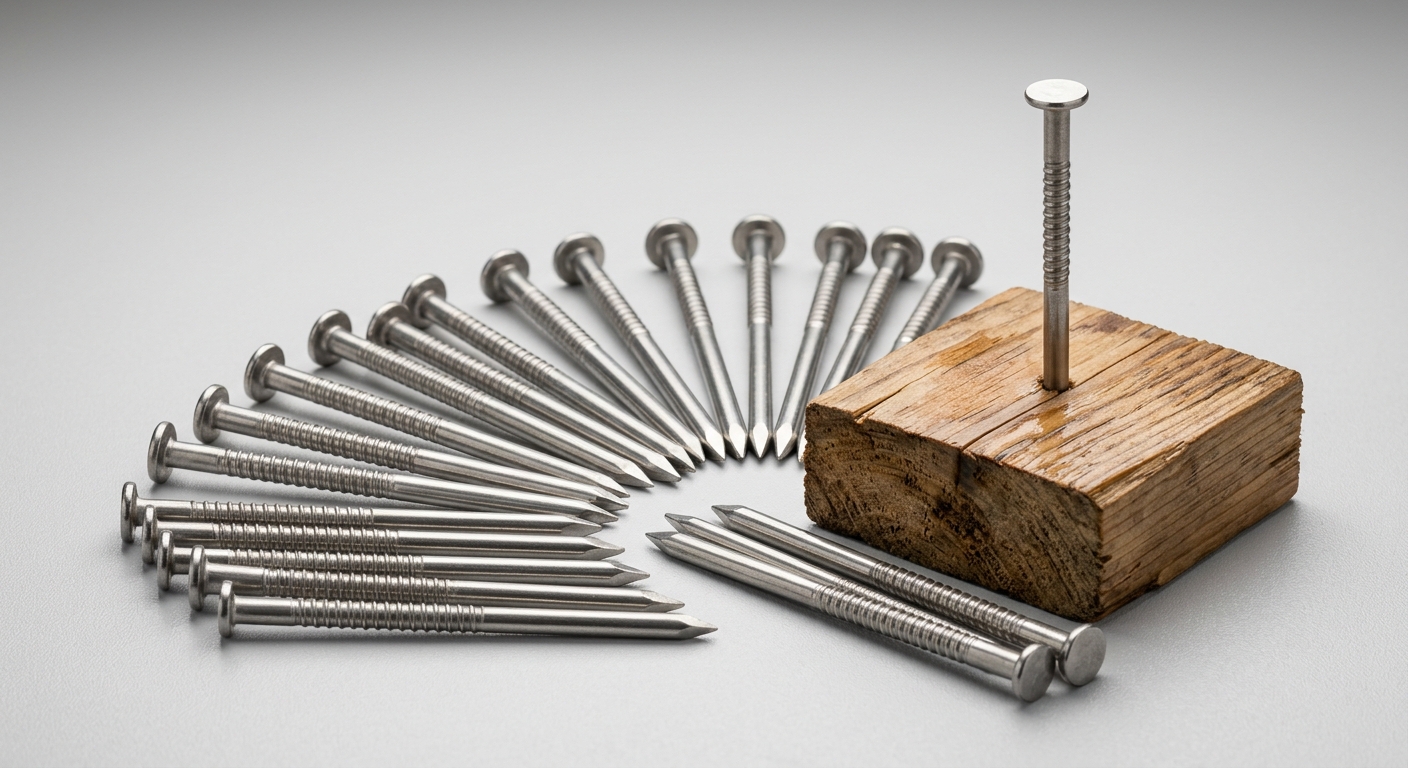
The corrosion resistance of a clou en acier inoxydable does not come from a surface coating applied during manufacturing — it is intrinsic to the alloy’s chemistry. When chromium content exceeds approximately 10.5% by mass, the steel spontaneously forms a chromium oxide (Cr₂O₃) layer at its surface upon exposure to oxygen. This passive film is typically 1–5 nanometers thick, invisible to the naked eye, and chemically inert against water, dilute acids, and most organic compounds found in timber.
What makes this mechanism commercially significant is its self-healing property. When a stainless steel nail is driven into timber — mechanically abrading its surface — the passive layer re-forms within seconds in the presence of oxygen. This behavior fundamentally differentiates stainless steel from galvanized alternatives, where a zinc coating, once breached by driving or corrosion, exposes bare steel with no recovery mechanism. Carbon steel nails rely entirely on applied coatings; stainless steel nails carry their protection at the molecular level throughout the entire fastener body.
For wet timber environments where the nail shank is in sustained contact with moisture-laden wood fibers, this self-regenerating barrier is the primary reason stainless steel nails deliver multi-decade service life without structural degradation.
1.2: Grade Differences — 304 vs. 316 vs. 410
Not all stainless steel nails share the same corrosion threshold. The three grades most commonly encountered in fastener procurement are 304 (austenitic), 316 (austenitic, molybdenum-enhanced), and 410 (martensitic). Their performance diverges significantly in wet timber conditions.
| Grade | Cr (%) | Ni (%) | Mo (%) | Résistance à la corrosion | Recommended Timber Environment | Indice de coût relatif |
|---|---|---|---|---|---|---|
| 304 | 18 | 8 | — | Bon | Interior, dry exterior, untreated wood | 1,0× (ligne de base) |
| 316 | 16 | 10 | 2 | Excellent | Exterior, treated lumber, coastal | 1.3–1.5× |
| 410 | 11.5 | — | — | Modéré | Interior structural, low-humidity | 0.85× |
The molybdenum addition in 316 is the critical differentiator. Molybdenum significantly increases resistance to chloride-induced pitting — the failure mode most relevant to wet timber in coastal zones or where preservative treatments introduce copper or chloride compounds. Grade 410, while harder and offering better nail-driving performance in dense hardwoods, provides insufficient corrosion resistance for any sustained wet or treated timber exposure and should not be specified for exterior applications.
For most wet timber procurement decisions, 316 is the minimum acceptable grade in chemically active environments; 304 remains acceptable only for untreated interior or sheltered exterior applications with low moisture cycling.
2: Conditions That Can Still Cause Staining or Failure in Wet Timber
2.1: Chemical Reactions with Treated Timber (ACQ, CCA, CA)
Modern pressure-treated lumber relies on copper-based preservatives — Alkaline Copper Quaternary (ACQ), Copper Azole (CA), and legacy Chromated Copper Arsenate (CCA) — to prevent fungal and insect degradation. These preservatives create an electrochemically aggressive environment at the fastener interface that standard 304-grade stainless steel is not designed to withstand at full specification.
The mechanism is accelerated galvanic corrosion: copper ions leached from the treated wood act as a cathodic species relative to the stainless steel nail, driving anodic dissolution of the fastener surface. ACQ formulations are particularly aggressive, with copper concentrations that can be 2–3× higher than legacy CCA treatments. Independent testing has demonstrated that 304-grade fasteners in ACQ-treated lumber can exhibit measurable cross-section loss within 12–24 months of outdoor exposure.
The industry response to this chemistry is unambiguous: 316 stainless steel is the minimum specification for any stainless nail used in pressure-treated timber. This recommendation is codified in guidance from the American Wood Protection Association (AWPA) and reflected in building codes that explicitly prohibit the use of 304-grade fasteners with ACQ or CA-treated lumber in exposed applications. Procurement teams sourcing nails for treated lumber projects must verify the grade on mill certificates — not rely on packaging labeling alone.
2.2: Tannin Staining, Crevice Corrosion, and Galvanic Risk
Beyond preservative chemistry, three additional failure modes affect stainless steel nails in wet timber environments:
Tannin staining occurs in high-tannin species — cedar, oak, redwood, and ipe. Tannins react with iron ions at the nail surface to produce dark iron-tannate compounds, creating visible black streaking on the wood face. This is primarily an aesthetic failure rather than a structural one, and it occurs even with 316-grade fasteners. While it does not compromise fastener integrity, it is a specification concern for exposed architectural cladding or decking where finish appearance is a deliverable.
Crevice corrosion develops at the nail-shank interface where the fastener passes through a tight timber bore. In this confined geometry, oxygen availability is limited, preventing full passive layer maintenance. Sustained moisture in this crevice creates a differential aeration cell, gradually acidifying the local environment. Ring-shank and screw-shank nails are more susceptible to crevice initiation than smooth shanks due to their increased surface area in contact with wood fibers — though their superior withdrawal resistance typically outweighs this risk in structural applications.
Galvanic coupling is a risk when stainless steel nails are used adjacent to aluminum flashing, carbon steel joist hangers, or other dissimilar metals in a wet environment. Stainless steel is cathodic relative to aluminum and carbon steel; in a moisture-bridged connection, it will accelerate corrosion of the less noble metal. Fastener isolation or consistent all-stainless hardware specification eliminates this risk.
3: Selecting the Right Stainless Steel Nail for Wet Timber Applications
3.1: Key Specification Parameters for Procurement
Grade selection is necessary but not sufficient. The physical geometry of the stainless steel nail determines both its mechanical performance and its long-term corrosion behavior in timber.
Shank type is the primary mechanical variable. Ring-shank nails provide 40–70% greater withdrawal resistance than smooth shanks and are the standard specification for decking, cladding, and any application subject to cyclical loading or timber movement. Screw-shank nails offer comparable holding power with slightly lower installation torque requirements. Smooth shanks are appropriate for non-structural or interior applications only.
Length-to-diameter ratio affects both load transfer and corrosion exposure. Longer nails with smaller diameters maximize embedment depth while minimizing the fastener cross-section available to moisture attack. Standard specifications for 38mm–90mm lengths in 2.5–3.5mm diameters cover the majority of timber cladding and decking applications.
Mill certificate verification is the procurement control that prevents grade substitution. Certificates should confirm chemical composition (Cr, Ni, Mo percentages), heat number traceability, and compliance with the applicable standard. Do not accept grade identification based solely on packaging or distributor assurance.
3.2: Application-Specific Recommendations
| Application | Recommended Grade | Shank Type | Key Consideration |
|---|---|---|---|
| Residential decking (untreated) | 304 or 316 | Ring-shank | Moisture cycling; ring shank prevents deck board lift |
| Decking (ACQ/CA-treated timber) | 316 minimum | Ring-shank | Copper preservative corrosion; code requirement |
| Exterior cladding (cedar/redwood) | 316 | Ring or screw | Tannin staining risk; use 316 to minimize iron ion release |
| Marine dock construction | 316 or duplex | Ring-shank | Chloride immersion; consider duplex 2205 for full saltwater exposure |
| Green/unseasoned timber | 316 | Ring-shank | Higher moisture content accelerates electrochemical activity at nail interface |
| Interior structural framing | 304 or 410 | Smooth or ring | Low corrosion risk; select based on hardness requirements |
4: Compliance Standards and Quality Verification
4.1: Relevant Industry Standards
Procurement teams should request documentation against the following standards when sourcing stainless steel nails for wet timber applications:
- ASTM F1667: The primary U.S. standard for driven fasteners, including nails. Specifies dimensional tolerances and material requirements for stainless steel nail classifications.
- ASTM A276 / A276M: Governs stainless steel bar and wire from which nails are drawn; chemical composition requirements for 304 (UNS S30400) and 316 (UNS S31600) are defined here.
- ISO 3506-1: International standard for mechanical properties of corrosion-resistant stainless steel fasteners; relevant for projects requiring cross-border certification.
- EN 1.4401 / EN 1.4301: European material designations equivalent to 316 and 304 respectively; required for projects under CE marking regimes.
- AWPA M6: American Wood Protection Association standard that specifies fastener material requirements for use with treated lumber, explicitly mandating 316 stainless for ACQ and CA applications.
Suppliers should provide heat-traceable mill test reports (MTRs) with each order. For high-value structural applications, independent XRF (X-ray fluorescence) verification of chromium and molybdenum content provides an additional confirmation layer that does not rely on supplier documentation alone.
FAQ
Q1: Will a 304 stainless steel nail rust if used in pressure-treated timber outdoors?
Yes — with qualification. Grade 304 provides inadequate corrosion resistance against the copper compounds present in ACQ and CA pressure-treated lumber. In sustained outdoor exposure, 304 nails in treated timber will exhibit pitting and surface corrosion within 1–3 years depending on climate and moisture levels. For pressure-treated applications, 316 is the minimum compliant specification under AWPA guidance and most current building codes.
Q2: What is the minimum stainless steel grade recommended for coastal or marine wet timber construction?
316 stainless steel is the minimum specification for coastal construction within approximately 1 km of saltwater. For structures subject to direct saltwater immersion or spray — marine docks, pier decking, boat ramp framing — duplex stainless steel (grade 2205, combining austenitic and ferritic microstructure) provides superior chloride pitting resistance and should be evaluated for critical structural fastener applications.
Q3: How can I distinguish genuine 316 stainless steel nails from mislabeled 304 product at the point of purchase?
Visual inspection alone cannot distinguish 316 from 304. The reliable verification methods are: (1) request a mill test report with heat number and chemical composition confirming molybdenum content of 2–3%; (2) use a portable XRF analyzer to verify Mo presence on a sample from the batch; (3) source from suppliers who provide ISO 3506 or ASTM F1667-compliant documentation with each shipment. Grade marking on nail heads is not standardized and is not a reliable verification method.
Conclusion
The answer to whether a stainless steel nail will rust in wet timber is conditional, not categorical. The passive chromium oxide layer provides genuine, self-healing corrosion protection that no galvanized or coated alternative can match over a multi-decade service life. However, that protection has defined limits: copper-based preservative treatments accelerate corrosion in 304-grade fasteners, tannin-rich species cause cosmetic staining regardless of grade, and crevice geometry or galvanic coupling can initiate localized failure even in correctly specified material.
The procurement logic is straightforward: 316 stainless steel ring-shank nails are the default specification for any exterior wet timber application, with 304 reserved for sheltered interior use and duplex grades evaluated for direct marine exposure. Grade selection must be supported by mill certificate verification — not packaging claims — and aligned with AWPA, ASTM F1667, and applicable local code requirements. Fasteners represent a small fraction of total project material cost but are disproportionately responsible for long-term structural and aesthetic performance. Specifying correctly at the procurement stage eliminates the far greater cost of premature failure.